Great hiring decisions rarely come from a gut feeling. Two interviewers can meet the same candidate and reach opposite conclusions because free-flowing conversations invite bias, inconsistency and guesswork. A structured interview removes that noise.
In a structured interview, every candidate answers the same job-related interview questions in the same order and is scored against the same rubric. Decades of research rank this format among the strongest predictors of job performance, well ahead of unstructured chats.
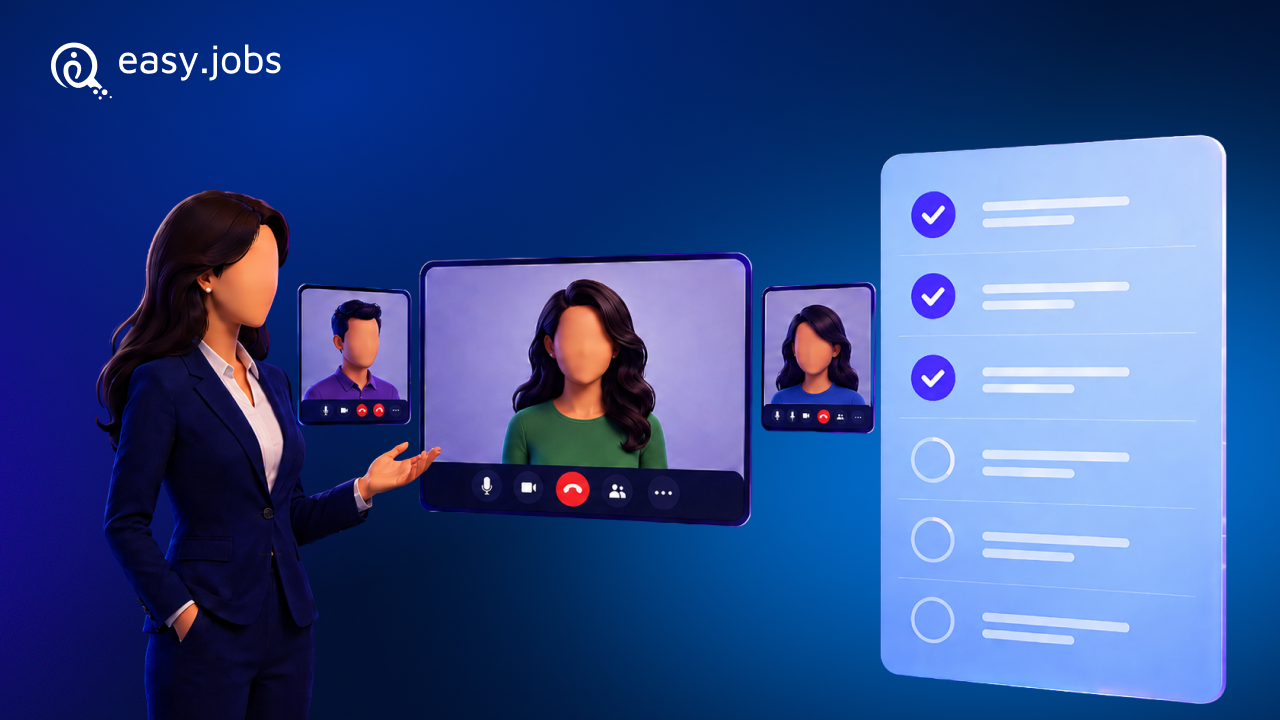
This guide explains below what a structured interview is, why it produces fairer results and how to run one step by step.
Key Takeaways
- A structured interview asks every candidate the same job-related questions in the same order, then scores answers on a consistent rubric.
- Structured interviews reach a predictive validity near 0.51, compared with about 0.38 for unstructured interviews (Schmidt & Hunter, 1998).
- Standardized scoring reduces bias, raises reliability and creates the comparable data teams need to measure quality of hire.
- The stakes are high: replacing a poor hire can cost 50% to 200% of that role’s annual salary (SHRM).
What Is a Structured Interview?
A structured interview is a standardized hiring conversation in which every candidate is asked the same predefined, job-related questions and evaluated with the same scoring rubric. That consistency is the point. Structured interviews achieve a predictive validity of about 0.51, compared with about 0.38 for unstructured interviews.
The format works because it standardizes two things at once: the questions and the scoring. Instead of improvising, interviewers prepare questions based on a job analysis, ask them in a set order, and rate each answer against the described performance levels. Candidates are then compared on the same evidence rather than on memory or first impressions.
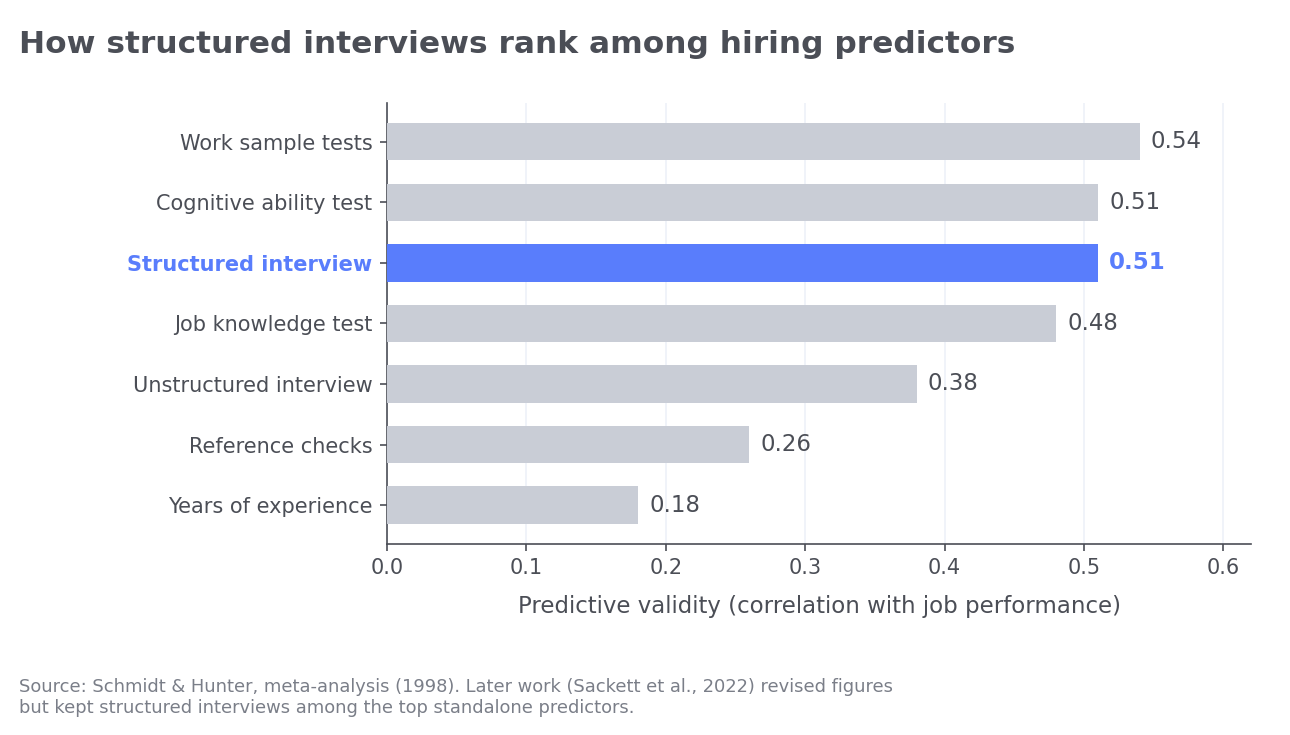
Structured interviews sit among the strongest predictors of job performance.
A structured interview standardizes both the questions and the scoring. In their landmark meta-analysis, Schmidt and Hunter found structured interviews predicted job performance at a validity of 0.51, well above the 0.38 recorded for unstructured interviews. Later research by Sackett and colleagues (2022) adjusted these estimates but still ranked structured interviews among the top standalone predictors.
For the candidate side of a well-run process, see our guide to a positive candidate interview experience.
Structured Interview vs Unstructured Interview: What Is the Difference?
The difference is consistency. An unstructured interview changes from candidate to candidate, so scores reflect the interviewer as much as the applicant. A structured interview holds the questions and scoring steady, which improves fairness, comparability and legal defensibility.
| Dimension | Structured interview | Unstructured interview |
|---|---|---|
| Questions | Same, predefined, job-related | Improvised, vary by candidate |
| Scoring | Anchored rubric (1 to 5) | Overall gut feeling |
| Consistency | High | Low |
| Bias control | Strong | Weak |
| Predictive validity | ~0.51 | ~0.38 |
| Candidate comparison | Direct and fair | Difficult |
| Legal defensibility | Strong and documented | Weak |
The Four Core Elements of a Structured Interview
Four ingredients separate a true structured interview from a friendly chat with a checklist:
- Job-related questions are built from a role analysis, not invented on the day.
- The same questions are asked in the same order for every candidate.
- Anchored rating scales that describe what each score actually looks like.
- Independent evaluation, where interviewers score before they discuss.
Miss any one of these and the interview drifts back toward opinion. Together, they turn a conversation into a measurement.
Why Do Structured Interviews Lead to Fairer, Better Hiring Decisions?
Structured interviews lead to better decisions because they remove inconsistency from both the questions and the scoring. Standardized evaluation reduces bias and raises reliability. It also produces comparable data, the same data teams need to measure quality of hire, a top priority for 89% of talent leaders, yet measured well by only 20% (SHRM, 2025).
When every candidate faces the same questions and the same rubric, there is less room for affinity bias, halo effects or first-impression judgments to steer the outcome. Evaluations rest on job-related evidence, which also makes decisions easier to document and defend.
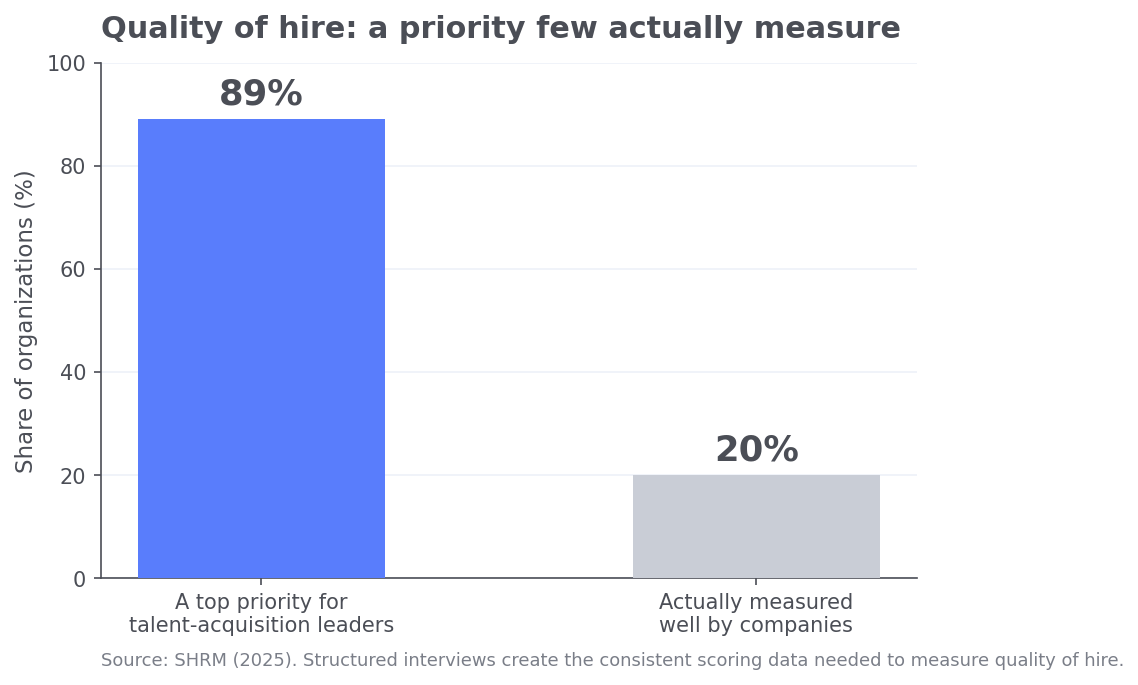
Structured scoring produces the comparable data most teams still lack.
Structured interviews are not only a fairness tool; they are a data-generation engine. Because every candidate is scored on the same scale, you finally get comparable numbers to feed quality-of-hire analysis, something unstructured chats can never produce. The scorecard is where hiring becomes measurable.
Structured interviews predict more than core task performance. A 2025 meta-analysis of 30,646 participants found they also predicted contextual performance, teamwork, citizenship and commitment at a validity of 0.28 (Wingate et al., International Journal of Selection and Assessment, 2025). Standardized questions capture how people work with others, not only what they know.
The stakes are financial as much as cultural. The U.S. Department of Labor estimates that a bad hire costs at least 30% of that person’s first-year earnings. SHRM puts full replacement at 50% to 200% of annual salary. A more predictive interview is one of the cheapest ways to lower that risk.
Consistent scoring depends on consistent feedback; see our interview feedback tips for recruiters.
How to Conduct a Structured Interview: A Step-by-Step Process
To conduct a structured interview, define the role’s success criteria, write the same job-related questions for every candidate, score answers on an anchored rubric and decide from the evidence. The discipline pays off, yet about one in three hiring teams still skip structured evaluation (Talent Board).
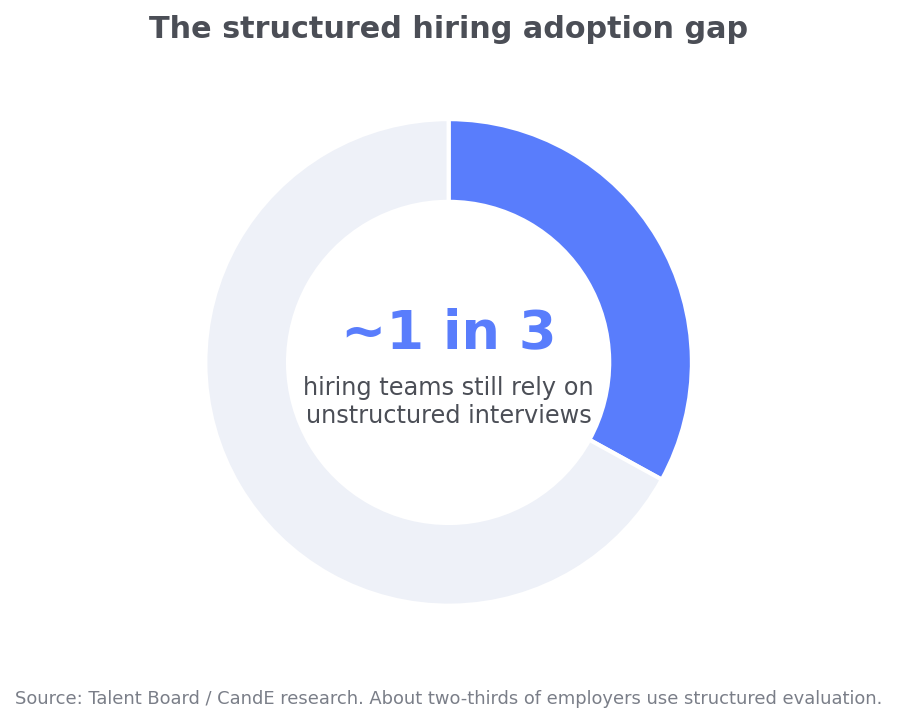
A structured process is still a competitive advantage, not a default.
Step 1: Define the Role And Success Criteria
Start with a short job analysis. Agree with the hiring manager on the core responsibilities, the must-have skills and the two or three signals that separate a strong hire from an average one. Every later question should trace back to one of these criteria. For turning criteria into scoring, our interview scorecard guide walks through the details.
Step 2: Write Standardized, Job-Related Questions
Draft a shared question set for the role. Mix behavioral questions, which ask about real past situations, with situational questions, which pose realistic scenarios. Map each question to a specific competency so the answers produce evidence you can score. Reuse the same set for every candidate in that role.
Step 3: Build the Scorecard And Rating Scale
Attach a rating scale to each competency, usually 1 to 5, with a short description of what each level looks like. These behavioral anchors are what keep two interviewers scoring the same answer the same way. Keep the scorecard to five to eight competencies so it stays usable.
Step 4: Train And Calibrate Your Interviewers
A rubric only works if interviewers read it the same way. Run a short calibration session with sample answers so the panel agrees on what a 3 and a 5 look like. Calibration reduces leniency, halo effects and the drift that creeps in over a long interview loop.
Step 5: Ask Every Candidate the Same Questions
During the interview, follow the script. You may ask brief clarifying follow-ups, but the core questions and their order stay fixed. Take notes tied to each competency so your scores rest on evidence, not on a general impression formed in the first five minutes.
Step 6: Score Independently, Then Discuss
Have each interviewer complete their scorecard before the group debriefs. Independent scoring prevents the loudest voice from anchoring the room. It also surfaces genuine disagreement worth discussing. Only after individual scores are in should the panel compare notes and reach a decision.
Hiring teams that record scores inside the pipeline, before the debrief, reach consensus noticeably faster. When every interviewer sees the same criteria and logs evidence against them, the final conversation shifts from “I liked them” to “Here is how they scored,” and decisions move quicker.
What Are the Best Structured Interview Questions to Ask?
The best structured interview questions are job-related, consistent and tied to your scorecard. Most fall into three families: behavioral, situational and role-specific. Behavioral questions are the workhorses because past behavior is a reliable guide to future performance the same logic that gives structured interviews their edge, near 0.51 validity (Schmidt & Hunter, 1998).
Behavioral Questions And the STAR Method
Behavioral questions start with “Tell me about a time when…” and ask for a real example. Strong answers follow STAR: situation, task, action and result. For a ready-made set, see our list of behavioral interview questions, then map each one to a competency on your scorecard.
Situational And Critical-Thinking Questions
Situational questions pose a realistic scenario “What would you do if…” and reveal judgment before the candidate is on the job. Pair them with prompts that test reasoning; our guide to critical thinking interview questions gives examples you can standardize across candidates.
Role-Specific And Pre-Screening Questions
Add a few questions that target the exact skills of the role, plus early filters you can ask before a full interview. Our pre-screening interview questions help you shortlist consistently. The top 50 HR interview questions offer a wider range to adapt.
| Competency | Sample structured question | A strong answer shows |
|---|---|---|
| Problem solving | Tell me about a time you solved a problem with incomplete information. | Structured reasoning and a clear outcome |
| Collaboration | Describe a time you worked with a difficult colleague. | Empathy, communication and resolution |
| Ownership | Tell me about a goal you set and how you reached it. | Initiative and follow-through |
| Adaptability | What would you do if priorities changed midway through a project? | Flexibility and sound judgment |
How Do You Score Candidates With a Structured Interview Scorecard?
You score candidates with a structured interview scorecard by rating each answer against predefined, anchored criteria, usually a 1 to 5 scale with described levels. This turns opinions into comparable evidence, which is why structured, rubric-based scoring reduces bias and raises reliability across interviewers, according to a report by Levashina et al. (2014).
A working scorecard has four parts: the competencies you are assessing, a rating scale with behavioral anchors, a notes field for evidence and an overall recommendation such as strong hire, hire, neutral, no hire or strong no hire. The notes matter as much as the number because they justify the score and guide the debrief.
Score each candidate independently, then calibrate as a panel. Independent scoring keeps one confident voice from setting the tone. It makes real disagreement visible. The result is a defensible decision backed by evidence rather than by whoever spoke first.
Structured interviews improve on unstructured ones precisely because scoring is standardized. In a comprehensive review, Levashina and colleagues (2014) found that structured formats show higher reliability and reduce the subgroup differences that drive unfair outcomes. The scorecard, not the conversation, is where fairness and predictive power are won.
For anchors, templates and common mistakes, our step-by-step interview scorecard guide covers the build in full.
How Can easy.jobs Help You Run Structured Interviews at Scale?
easy.jobs helps you run structured interviews at scale by standardizing every stage in one AI-powered recruitment platform, from job posts and screening to interviews, scoring and offers. As AI moves into most hiring workflows, a consistent, structured process keeps human judgment firmly in control of the final decision.
- A structured candidate pipeline moves every applicant through the same stages, so no candidate skips a step or a scorecard.
- Candidate Import brings applicants into your pipeline in one action, ready for the same screening and interview flow.
- Online assessments and quiz screening evaluate skills consistently before the interview, so you shortlist based on evidence.
- A dedicated remote interview stage lets you schedule the time, date, duration and platform, with Zoom or Google Meet built in.
- Structured feedback and internal notes keep every interviewer scoring against the same criteria in one place.
- AI screening ranks applicants against your requirements. Automated scheduling then removes the back-and-forth of booking interviews.
- A white-label career site lets you add your own branding for a professional, consistent candidate experience.
Setting up the interview stage takes minutes; follow our guide to set up a remote interview, explore the latest AI screening updates and see how to automate interview scheduling. A full overview lives on the easy.jobs features page.
Recruiters tell us the biggest change is not speed but confidence. When scorecards, assessments and interview notes sit beside each candidate in one pipeline, hiring managers stop debating impressions and start comparing evidence and the same structure scales cleanly from one role to fifty.
Ready to standardize your hiring? Build structured, AI-powered interviews with easy.jobs and turn guesswork into evidence.
Common Structured Interview Mistakes to Avoid
Even a good, structured interview can underdeliver if it is applied poorly. The most common mistakes share one root cause: teams keep the format but drop the discipline that makes it work. Avoid these and your scores stay fair, consistent and predictive.
- Being too rigid. A script does not ban follow-up questions; brief clarifiers are fine as long as the core questions stay fixed.
- Vague criteria. “Good attitude” cannot be scored. Define observable behaviors for each level instead.
- Skipping calibration. Without a shared understanding of the scale, two interviewers rate the same answer differently.
- Overloading the scorecard. Ten competencies dilute focus; five to eight keep interviewers sharp.
- Ignoring the candidate experience. A rigid, cold process can still lose good people, so keep the interaction human.
A structured process and a warm one are not at odds; our candidate interview experience best practices show how to hold both.
Frequently Asked Questions
What is a structured interview in simple terms?
A structured interview asks every candidate the same job-related questions in the same order, then scores each answer on a set rubric. The consistency is what makes it fair and comparable.
It also helps explain why structured interviews reach about 0.51 predictive validity versus 0.38 for unstructured ones, according to a study by Schmidt & Hunter (1998).
Are structured interviews better than unstructured interviews?
Yes. Structured interviews predict job performance far more reliably, near 0.51 versus about 0.38 for unstructured formats. They also reduce bias and produce comparable scores. Unstructured chats feel flexible but let first impressions and interviewer style drive outcomes, which lowers both fairness and accuracy.
How many questions should a structured interview include?
Most structured interviews use five to eight core questions mapped to five to eight competencies. That range gives enough evidence to score confidently without exhausting the candidate or the panel. Quality and consistency matter more than volume, so reuse the same set for every candidate in the role.
Do structured interviews remove bias completely?
No method removes bias entirely, but structure reduces it substantially. Standardized questions and anchored scoring limit affinity and first-impression effects. Research finds structured formats show higher reliability and smaller subgroup differences than unstructured ones. Interviewer calibration strengthens the effect further.
Can structured interviews work for remote hiring?
Yes. They are especially valuable remotely. A consistent question set and shared scorecard standardize evaluation across locations, time zones and video calls. Tools like easy.jobs add a dedicated remote interview stage with Zoom or Google Meet, so distributed panels score every candidate the same way.
Standardize Your Hiring for Better Results Today
Structured interviews are one of the highest-return upgrades a hiring team can make. By standardizing the questions, the scoring and the decision, you trade guesswork for evidence and you get a process that is fairer to candidates and more predictive for the business. Start with one role: define the competencies, write a shared question set, build a simple scorecard and score independently.
If you have found this guide useful, subscribe to our blog. Join our Facebook Community to connect with fellow HR leaders and share your thoughts.
➡️ Next Steps: Adapt our templates: Borrow from our [Top 50 HR Interview Questions] to build your standardized script.