The best candidates are no longer applying to everyone. They are choosing. With more open roles than skilled people to fill them, today’s top talent reads your careers page, your reviews and your social feed before they ever click “Apply,” and they decide in minutes whether you’re worth their time.
A strong employer value proposition (EVP) is what tips that decision in your favor. Companies with a compelling EVP see up to 30% more applications and 28% lower turnover, according to data from Glassdoor and LinkedIn.
In this guide, you will get a clear definition, the difference between an employer and employee value proposition, a step-by-step framework, 15 real EVP examples with their actual wording, a fill-in-the-blank template and the tools to build and publish yours.
TL;DR: The Complete Guide to Employer Value Proposition (EVP)
What Does EVP Mean?
An Employer Value Proposition (EVP) is the core promise you make to your workforce. It represents what employees get (pay, culture, growth) in exchange for what they give (skills, time, effort). It is your organization’s honest answer to the question: “Why should I work here?”
Core Concepts Clarified
| Term | Definition | Focus |
| Employee Value Proposition | The actual, lived, day-to-day experience of your current workers. | Internal Reality |
| Employer Value Proposition | The outward-facing promise built on your internal reality to attract talent. | External Promise |
| Employer Branding | The marketing activities and strategies used to communicate your EVP. | Communication |
| Employer Brand | The resulting perception or reputation that people hold about your company. | Result |
The 5 Pillars of a Strong EVP
A compelling EVP does not need to max out all five pillars, but it should be distinct in two or three while remaining truthful about the rest:
- Compensation & Benefits: Base pay, health coverage, and foundational perks.
- Career Growth: Clear advancement paths, mentorship, and learning budgets.
- Culture & Environment: Collaboration, leadership quality, and daily workplace vibe.
- Work-Life Balance: Flexibility, remote options, and wellness support.
- Purpose & DEI: A meaningful mission, lived values, and genuine inclusion.
How to Build Your EVP in 7 Steps
- Secure Buy-In: Get executive sponsorship and align with business strategy.
- Audit the Reality: Survey employees to uncover why they join, stay, or leave.
- Mine for Themes: Identify recurring words and authentic truths from your data.
- Benchmark Competitors: Find your unique market edge that rivals cannot claim.
- Define Your Statement: Draft a clear promise tailored to your target audience.
- Pressure-Test: Ensure the statement is true, credible, relevant, and aspirational.
- Roll it Out: Consistently integrate your EVP across job ads, interviews, and onboarding.
The Golden Rule: Do not overpromise. You cannot brand your way out of a weak EVP. If your external marketing does not match the internal reality of working at your company, new hires will feel misled and leave.
What Is an Employer Value Proposition (EVP)?
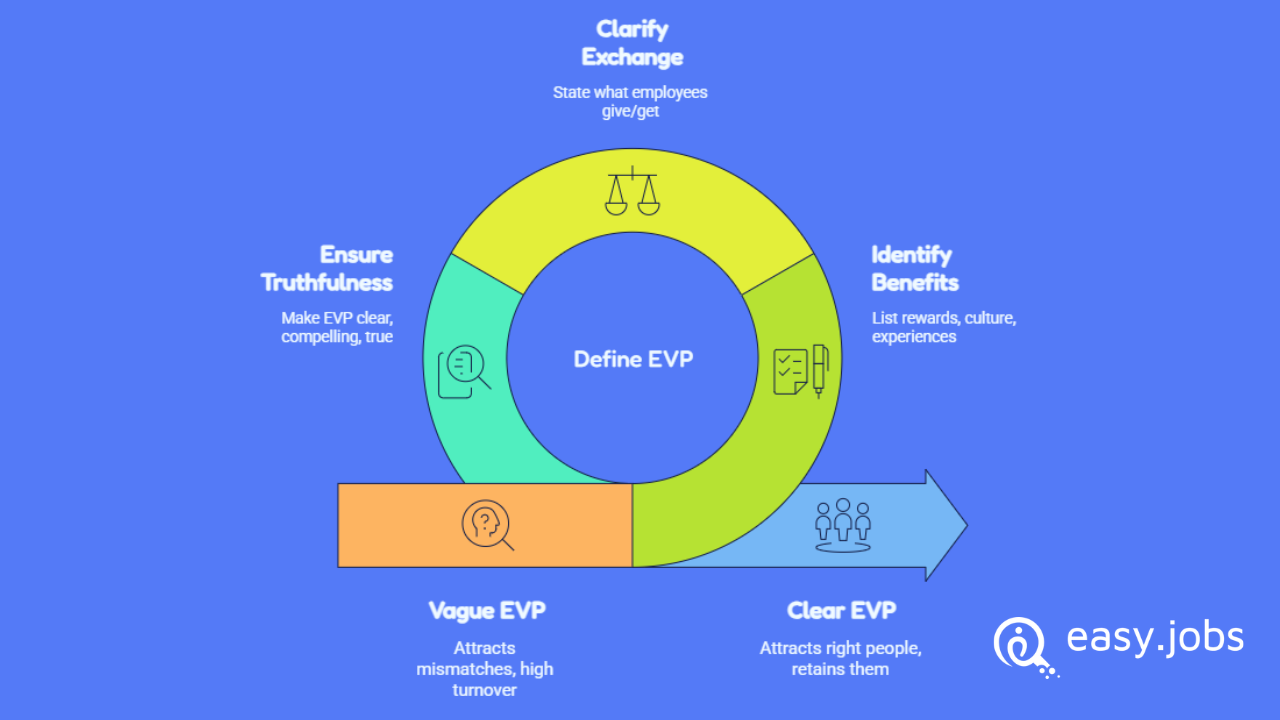
An employer value proposition (EVP) is the unique set of benefits, rewards, culture and experiences a company offers employees in exchange for their skills, effort and commitment. It is the promise you make to current and future employees, the honest answer to the question every candidate is silently asking: “Why should I work here instead of somewhere else?”
Think of your EVP as the substance behind your reputation as an employer. It goes beyond salary to capture everything that makes working at your company worthwhile: how people grow, how they are treated, what they are part of and what they get in return.
The UK’s CIPD puts it simply: an EVP “describes what an organisation stands for, requires and offers as an employer.” A useful way to hold it in one line:
EVP = what employees give (skills, energy, commitment) ⇄ what they get (pay, growth, culture, purpose, experience).
When that exchange is clear, compelling and true, you attract the right people and keep them longer. When it is vague or oversold, you attract mismatches and watch them leave.
Employer vs Employee Value Proposition: What Is the Difference?
This is the single most confusing part of the topic and the source of endless “is it employee or employer value proposition?” searches. Here is the clean answer: both terms exist, both are correct and they describe two sides of the same coin.
| Employee Value Proposition (EeVP) | Employer Value Proposition (EVP) | |
| Focus | What employees gain day-to-day | How the company presents itself as a place to work |
| Direction | Internal, current employees | External, candidates and the talent market |
| Question it answers | “What’s in it for me as an employee?” | “Why is this a great employer to join?” |
| Lives within | The lived experience | The employer brand |
The employee value proposition is the internal reality: the real benefits, culture and experience your people actually receive. The employer value proposition is the outward-facing promise built on top of that reality, which you communicate to the market to attract talent.
Which term should you use? In practice, most people use “EVP” to mean both and the two overlap heavily. The important rule is this: your external Employer Value Proposition must be built on an authentic internal Employee Value Proposition. If the promise you advertise doesn’t match the experience employees live with, new hires feel misled and leave, and your employee retention suffers. Get them aligned and they reinforce each other.
EVP vs Employer Branding: How They Connect
EVP and employer branding are often used interchangeably, but they are distinct stages of the same process:
- Employer Value Proposition (EVP) is the substance. The actual promise and offer.
- Employer Branding is the strategy and activity used to communicate that promise (careers page, job ads, social content, employee stories).
- Employer Brand, the result. The perception people hold about you as an employer is whether positive, neutral, or negative.
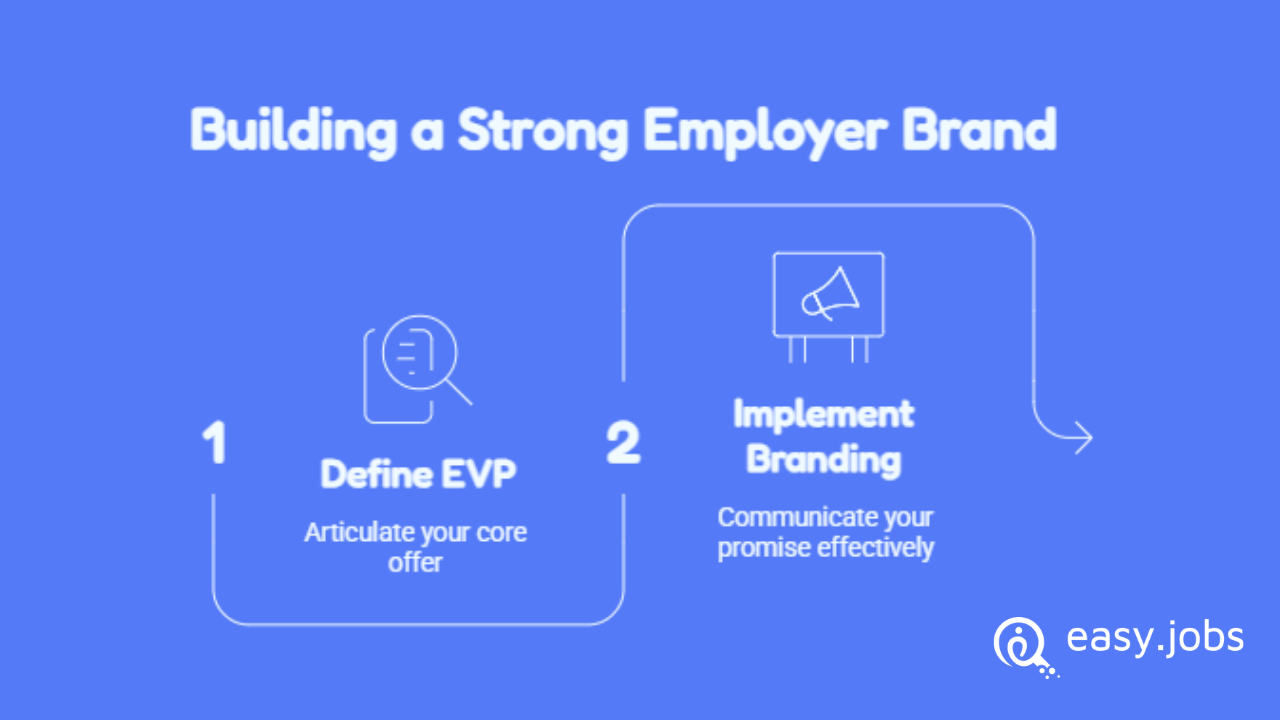
The flow is straightforward:
“EVP (what you offer) → Employer Branding (how you communicate it) → Employer Brand (what people believe).”
You can not brand your way out of a weak EVP. Marketing a promise you do not deliver only spreads disappointment faster. Build the substance first, then amplify it.
Why Your EVP Matters: The Business Case
A well-defined EVP is not an HR nicety; it is a measurable competitive advantage in a tight labor market. Here is what a strong one does:
- Attracts the right talent. A clear EVP tells the right people why to apply and the wrong people why not to, improving applicant quality, not just quantity.
- Reduces turnover. When the promise matches reality, people stay. Gartner research has linked strong EVPs to turnover reductions of roughly 69%.
- Cuts hiring costs. Stronger brand recognition means lower cost-per-hire and shorter time-to-fill.
- Boosts engagement and performance. Towers Watson found that organizations that use their EVP effectively are five times more likely to report highly engaged employees, and twice as likely to report financial performance above their peers.
- Strengthens your employer brand. A credible EVP becomes the foundation on which every recruitment-marketing message is built.
The numbers worth quoting:
| Metric | Impact of a strong EVP |
| Job applications | Up to +30% (Glassdoor) |
| Employee turnover | −28% (LinkedIn) to −69% (Gartner) |
| Engagement | 5× more likely to report high engagement (Towers Watson) |
| Productivity | Engaged employees are up to 21% more productive |
When you can connect your EVP to quality of hire and retention, it stops being a slogan and becomes a line item that leadership cares about.
The Components of A Strong EVP: The 5 Pillars
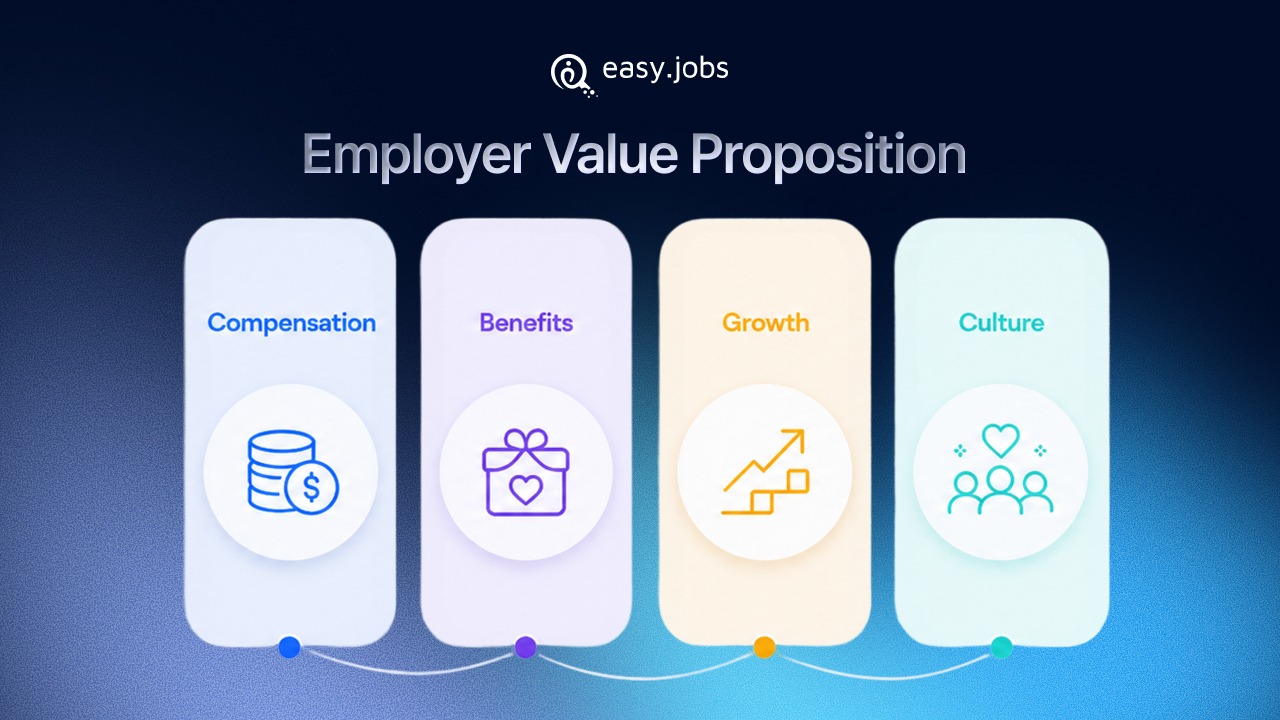
Almost every effective EVP is built on five pillars. The mix and emphasis differ by company, but the categories are consistent:
- Compensation & benefits, competitive pay, health coverage, retirement plans, paid time off and performance incentives. This is the foundation; it rarely wins talent alone, but a weak offer here undermines everything above it.
- Career growth & development, clear advancement paths, learning budgets, mentorship and internal mobility. Ambitious people want to know they have a future with you.
- Work environment & culture, collaboration, inclusion, leadership quality and the day-to-day feel of working there. This is where you can genuinely differentiate.
- Work-life balance & wellbeing, flexible or remote work, mental-health support, wellness programs and sustainable workloads. Increasingly a deciding factor, especially for younger candidates.
- Purpose, values & DEI, a mission people believe in, a real commitment to diversity and inclusion and values lived rather than laminated.
A strong EVP doesn’t max out all five. It picks the two or three where you’re genuinely distinctive and tells the truth about the rest.
EVP Frameworks & Models Compared
Most articles borrow one framework. Here are the three most useful, so you can pick what fits your organization.
1. The EVP Pyramid (Contractual → Experiential → Emotional)
This model stacks your offer in three layers:
- Contractual (base): compensation and benefits, the tangible “what you get.”
- Experiential (middle): career growth, work environment, day-to-day experience.
- Emotional (top): purpose, belonging and pride, the deepest and most durable driver of loyalty.
Use it when you want to diagnose where your offer is strong or weak. Many companies over-invest in the base and neglect the emotional peak, which is exactly what keeps people long-term.
2. The 5-Pillar / CEB-Gartner Model
The five categories above (compensation, benefits, career, work, culture) are treated as parallel buckets. Use it when you’re auditing your offer category by category and benchmarking against competitors.
3. The 5-attribute Test (Universum)
Less a structure than a quality check. A strong EVP should be:
- True, accurate to the real experience.
- Credible, believable to candidates and employees.
- Relevant, meaningful to the talent you want.
- Distinctive, different from competitors.
- Aspirational, something to live up to.
Use it when you have drafted your EVP and need to pressure-test it before launch.
The verdict: use the Pyramid to find gaps, the 5 Pillars to organize your offer and the 5-attribute test to validate the final statement. They are complementary, not competing.
How to Build Your Employer Value Proposition: Step By Step
Here is the practical sequence to go from a blank page to a published EVP.
Step 1: Secure Leadership Buy-In And Budget
Your EVP must align with the company’s strategy, so get executive sponsorship early. This is a cross-functional effort led by HR but owned by the business.
Step 2: Audit Your Current Offer
Gather honest data on what it is actually like to work for you. Run employee surveys, focus groups and one-on-one interviews. The three most revealing questions: Why did you join? Why do you stay? Why would you (or did you) leave? Include exit interviews and recent-hire feedback for the full picture.
Step 3: Mine the Data for Themes
Look for the words and reasons that come up repeatedly. These recurring themes, not your aspirations, are the raw material of an authentic EVP.
Step 4: Benchmark Competitors
Review how the companies you compete with for talent position their EVPs. Don’t copy; find the gaps you can own. If a rival can not offer flexibility and you can, lean into it.
Step 5: Define Your Pillars And a Core Statement
Choose the two or three pillars where you’re genuinely distinctive, then draft a single, clear EVP statement that captures your promise (template below).
Step 6: Pressure-Test It
Run the draft through the 5-attribute test: is it true, credible, relevant, distinctive and aspirational? Validate it with a sample of employees and candidates before going public.
Step 7: Roll It Out Across Every Touchpoint
Your EVP should show up consistently on your careers page, in job descriptions, across social media, during interviews and through onboarding. Consistency is what turns a statement into a brand.
Discovery shortcut: Before Step 5, run your team through the classic “34 questions to define your EVP” exercise, a structured worksheet covering pay, growth, culture, leadership, flexibility and purpose. It surfaces the raw themes fast. (Grab the worksheet in our free template, below.)
A great EVP also has to survive contact with your actual hiring process. If your promise says “we respect your time,” but candidates wait three weeks for a reply, the EVP breaks. Tightening your recruitment pipeline and candidate interview experience is part of delivering the EVP, not separate from it.
Free EVP Template + Statement Formula
Most EVPs collapse into one core statement, then flex for different audiences. Use this fill-in-the-blank formula:
“We offer [target audience] a place to [core promise], where you’ll [key differentiator], so you can [bigger-picture outcome].”
Start with a single anchor statement, then tailor the second half for each group without changing the core:
| Audience | Tailored EVP statement |
| Core (anchor) | “We offer a place to do meaningful work with exceptional people.” |
| Early-career / interns | “…with exceptional people, and the mentorship to grow faster than you thought possible.” |
| Managers | “…with exceptional people, and the autonomy to make decisions that matter.” |
| Executives/senior | “…with exceptional people, and the platform to shape an entire industry.” |
The core stays consistent (that is, your brand); the tail speaks to what each group values most. This is segmentation done right, tailored, but not so fragmented that the message dissolves.
Your Free EVP Toolkit Includes:
- The fill-in-the-blank statement template above
- The 34-question EVP discovery worksheet
- A 5-pillar audit checklist
- The 5-attribute validation test
15 Real Employer Value Proposition – EVP Examples (with Actual Statements)
The fastest way to understand a great EVP is to read real ones. Here are 15 EVP examples of companies across tech, retail, manufacturing and mission-driven brands, and what makes each work as a real employer value proposition example.
- Google, “Do cool things that matter.” Built on scale of impact, brilliant peers and best-in-class perks. Works because it speaks to ambition and meaning at once.
- Salesforce, “Ohana culture.” A family-style culture plus a loud commitment to equality and philanthropy (the 1-1-1 model). Works because the value is lived, not just stated.
- HubSpot, “Grow better.” Famous “Culture Code,” transparency and autonomy. Works because the EVP mirrors the brand promise it makes to customers.
- Netflix, “Freedom and responsibility.” High pay, high performance, radical candor and adult-to-adult trust. Works because it is brutally honest about who thrives there.
- Patagonia, “Build the best product, cause no unnecessary harm.” Purpose and environmental activism at the core. Works because it self-selects deeply mission-aligned talent.
- Unilever, “Make sustainable living commonplace.” Purpose plus global career mobility. Works because scale and meaning rarely come together.
- Spotify, “Work from anywhere.” Flexibility-first culture and creative autonomy. Works because it productized a benefit candidates actually want.
- Microsoft, “Empower every person and organization to achieve more.” Growth mindset, learning culture and inclusion. Works because the EVP and the corporate mission are the same sentence.
- Starbucks, “More than a cup of coffee.” Benefits are famously extended to part-time “partners,” including tuition coverage. Works because it over-delivers where competitors do not.
- Nike, “If you have a body, you’re an athlete.” Performance, ambition and a powerful sense of belonging to the brand. Works because identity and aspiration drive it.
- L’Oréal, “Lead the future of beauty.” Innovation, entrepreneurship and rapid development. Works because it promises momentum.
- Goldman Sachs, “Make an impact.” Prestige, top compensation and elite development. Works because it is honest about the trade and the reward.
- BMW, “A place to thrive, innovate and build the future of mobility.” Engineering excellence and stability. Works because it leans into the pride of craft.
- Schneider Electric, “Bring your meaningful purpose to life.” Sustainability and flexibility (“work your way”). Works because purpose and autonomy reinforce each other.
- Airbnb, “Belong anywhere.” The same belonging promise is made to guests and employees. Works because internal and external brands are perfectly aligned.
Notice the pattern: the strongest EVPs are specific, true and consistent with the company’s wider brand, never generic “great culture, competitive pay” filler.
EVP Best Practices & Common Mistakes to Avoid
Best practices:
- Be specific. “Competitive salary and great culture” says nothing. Name what’s actually different about you.
- Differentiate honestly. Lead with the two or three things you genuinely do better, and be truthful about the rest.
- Cover the full lifecycle. Your EVP should hold up across recruiting, onboarding, development and retention, not just at the point of hire.
- Segment without fragmenting. Tailor the message to audiences while keeping one consistent core.
- Involve employees. The most authentic EVP is built from your people’s actual words.
Common mistakes:
- Being too generic, the number-one EVP failure. If a competitor could paste their logo over yours, start again.
- Overpromising, advertising a culture you do not deliver, leads to fast, expensive turnover.
- Ignoring employee input, an EVP written only in the boardroom rings false.
- Focusing only on compensation, pay matters, but it is the easiest thing for a competitor to beat.
- Misaligning with company values, if your EVP and your mission point in different directions, neither feels credible.
How to Measure If Your EVP Is Working
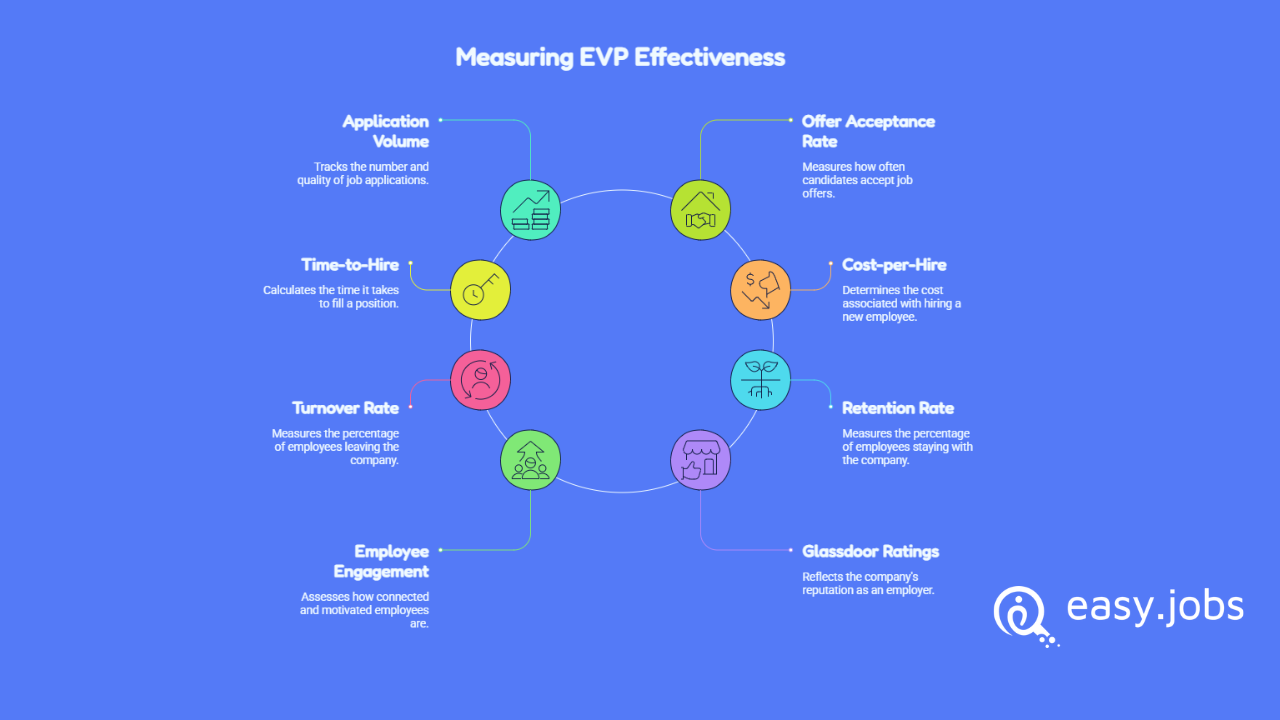
An EVP is not “done” at launch, it is a living asset you track and refine. The metrics that tell you whether it is landing:
- Application volume and quality, are more of the right candidates applying?
- Offer acceptance rate, are your chosen candidates saying yes?
- Time-to-hire and cost-per-hire, a strong EVP usually lowers both.
- Turnover and retention rate, the clearest long-term signals.
- Employee engagement / eNPS: Do current employees feel the promise is real?
- Glassdoor and review-site ratings, how the market perceives you as an employer.
Review these quarterly. When a number drifts, revisit the pillar behind it. Your modern ATS and recruitment analytics make most of these trackable in one place rather than scattered across spreadsheets.
Tools to Research, Build & Measure Your EVP
You do not need a dozen platforms, but the right tools make each stage faster. Here is a practical stack mapped to the EVP lifecycle:
- Discovery & listening: employee survey and eNPS tools, exit-interview software and focus-group notes to capture the real internal experience.
- Competitor & market research: Glassdoor, employer-brand indices and salary-benchmark data to find your distinctive ground.
- Build & collaborate: shared docs for your statement and pillars, plus a brand-messaging framework to keep wording consistent.
- Communicate & publish: a branded careers page, job-description templates and a social scheduler to push the EVP everywhere candidates look.
- Deliver & measure: an applicant tracking system to keep the candidate experience on-brand, plus analytics to track application quality, time-to-hire and acceptance rates.
This is where easy.jobs does a lot of the heavy lifting. As an AI-powered recruitment platform, it gives you a fully branded career page to showcase your EVP, your culture, benefits, values and employee stories, exactly the way you have defined it.
From there, AI-assisted screening, structured pipelines and built-in analytics make sure the experience candidates have matches the promise you have made. Because the fastest way to break an EVP is to advertise “we value your time,” then leave applicants waiting.
easy.jobs keeps the promise and the process in sync and surfaces the hiring metrics that prove your EVP is working. If your EVP is the message, your careers page and ATS are the megaphone, and the proof.
FAQ: Employer Value Proposition
Building an Employer Value Proposition introduces a lot of overlapping terminology. Here are quick, definitive answers to the most common questions about defining, differentiating and measuring your EVP.
What is an EVP in simple terms?
An employer value proposition is the promise you make to employees: the unique mix of pay, benefits, growth, culture and purpose they get in return for working with you. It is your honest answer to “why work here?”
What’s the difference between EVP and employer branding?
The EVP is the substance, what you actually offer. Employer branding is the activity of communicating what offers to attract and retain talent. EVP comes first; branding amplifies it.
What are the 5 components of an EVP?
Compensation and benefits, career growth and development, work environment and culture, work-life balance and wellbeing and purpose, values and DEI.
Is it an “employee” or “employer” value proposition?
Both are correct and closely related. The employee value proposition is the internal, day-to-day experience employees receive; the employer value proposition is the external, market-facing promise built on top of it. People often use “EVP” for both.
What makes a good EVP statement?
It should be true, credible, relevant to your target talent, distinctive from competitors and aspirational, and specific enough that a rival couldn’t simply swap in their own logo.
How do you measure an EVP?
Track application quality, offer acceptance rate, time-to-hire, turnover and retention, employee engagement (eNPS) and Glassdoor ratings, then refine the pillar behind any metric that slips.
Build an EVP that Candidates Actually Believe
A great employer value proposition is not a tagline you write once and frame on a wall. It is a promise you define honestly, communicate consistently and prove at every step of the hiring journey. Define your pillars, draft a statement that’s true and distinctive, validate it with your people and publish it everywhere candidates look.
Then make sure your hiring experience lives up to it. Build a branded career page that showcases your EVP. Book a demo to see how AI-powered hiring turns your promise into proof.
If you have found this guide useful, subscribe to our blog. Join our Facebook Community to connect with fellow HR leaders, share your EVP success stories and get real-time advice on building a brand that attracts top talent!