A single job opening can now attract more than 300 applicants, yet most teams still screen them, one resume at a time. When you multiply that load across dozens or hundreds of open roles, the cracks show fast: ballooning time-to-hire, rising cost-per-hire and qualified candidates who drop off before anyone replies to them.
High-volume recruiting does not have to work this way. With the right system, you can move quickly, protect the candidate experience and still hire for quality. Below are nine strategies that turn chaotic bulk hiring into a process you can repeat every season.
What Is High-Volume Recruiting?
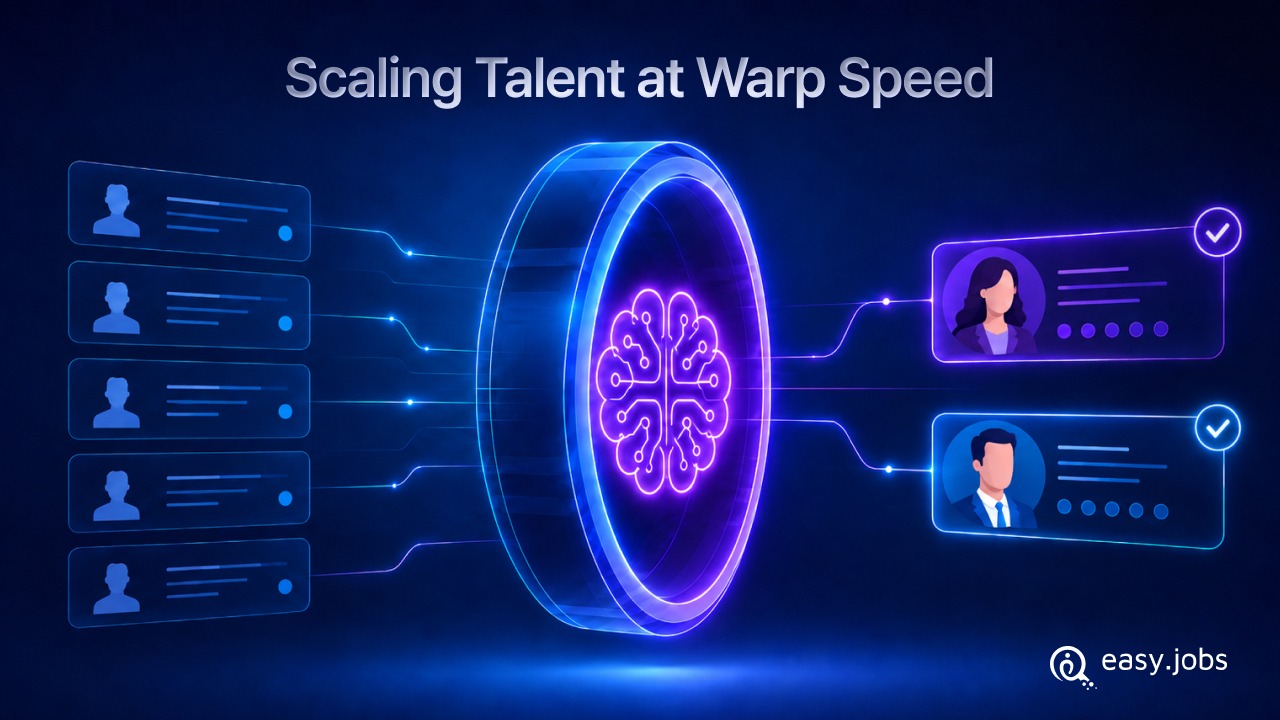
High-volume recruiting is the process of filling a large number of positions, typically dozens to hundreds, within a tight timeframe. It is most common in retail, hospitality, business process outsourcing, healthcare, logistics and seasonal hiring, where applications per hire have stayed above several hundred.
What separates it from traditional hiring is not just the number of seats to fill. It is the operational tension underneath. Specialized hiring rewards slow, careful evaluation of a small pool. High-volume hiring rewards speed and consistency across a flood of applicants, without letting quality or candidate experience slip. Getting all three right at once is the real challenge. It is also why manual processes that work for a handful of roles fall apart at scale.
Why Is High-Volume Hiring So Hard to Get Right?
High-volume hiring is hard because manual processes collapse under load. Scheduling alone consumes close to half of a recruiter’s workday before a single candidate is properly assessed.
The bottlenecks compound on each other. Resume volume overwhelms screeners, screening delays push back interviews, communication gaps leave candidates guessing and drop-off climbs with every silent day. The cost is concrete, too. The average cost-per-hire reached $4,000+ for non-executive roles in SHRM’s 2025 report. That figure multiplies across every open seat.
There is a reputational risk as well. 66% of U.S. adults say they would avoid applying for jobs that use AI in hiring decisions, so how you automate matters as much as whether you automate.
What Are the 9 Best High-Volume Recruiting Strategies?
The most effective high-volume recruiting strategies all share one trait. They remove manual repetition from the funnel. Teams that automate screening and scheduling report 30% to 50% faster time-to-hire. The strongest high-volume teams reach efficiency gains of up to 70%. Here is how to build that system, one strategy at a time.
1. Build a Talent Pool You Can Reuse
Stop starting from zero with every requisition. Pipeline and talent-pool segmentation can deliver 60% to 70% of placements from existing pools, which is a major advantage when you hire for the same roles again and again.

In practice, that means tagging and re-engaging past applicants, segmenting your database by role, skills and availability and reaching out to warm candidates first. A strong runner-up from last quarter is often a perfect hire this quarter.
2. Automate Resume Screening with AI
Resume screening is where most high-volume funnels grind to a halt. Automating it changes the math entirely, since AI resume screening has been shown to reduce time-to-hire by less than half.
Set knockout questions for non-negotiable requirements, define skill and certification filters and let the system surface a ranked shortlist. Keep a person in the loop on final decisions, because 93% of hiring managers still say human involvement is essential even as AI usage grows.
3. Use Candidate Import to Scale Sourcing
When you already have lists of qualified people in spreadsheets, past events or partner referrals, Candidate Import lets you bring them into one system instead of rekeying them one by one. Centralizing the pipeline this way is how high-volume teams expand reach without losing track of anyone. AI-assisted sourcing expands candidate pools by an average of 340% while cutting sourcing time by 67%, according to Demandsage.
4. Add Conversational AI And Chatbots for Pre-Screening
A chatbot never sleeps. That matters when applicants apply at midnight. Chatbot pre-screening enables round-the-clock engagement and can reduce time-to-interview by more than half.
Use conversational AI to answer common questions, pre-qualify applicants against your criteria and book the next step instantly, so candidates never wait on a queue.
5. Switch to Asynchronous And Video Screening
One-way video interviews let candidates record answers on their own time and let your team review them in batches. The capacity gain is large because video and asynchronous screening can assess 5 to 10 times more candidates and cut time-to-hire.
Standardize the questions and score every response against the same rubric. Structured evaluation keeps the process fair and makes it far easier to compare a high volume of applicants.
6. Automate Interview Scheduling
Since scheduling eats a lot of recruiter time, automating it returns the single biggest block of hours to your team. Self-serve booking removes the back-and-forth entirely.
Sync recruiter calendars, let candidates pick from open slots and send automated reminders to cut no-shows. The result is a faster path from shortlist to conversation without any email tag in between.
7. Run Drip Campaigns to Keep Candidates Warm
Silence is the fastest way to lose a good applicant. Automated nurture sequences keep people engaged while you work through the pipeline. The payoff is measurable: automated candidate engagement improves response rates and reduces manual follow-up.
Build templated sequences for status updates, next-step instructions and re-engagement of candidates who went quiet. Consistent communication signals respect, even to applicants you do not hire.
8. Add Your Branding With White-Label Career Pages
Candidates judge your company by the experience they have before they ever meet you. With white-label career pages, you add your logo, colors and domain to create a consistent and professional candidate-facing experience that looks like your brand from the first click.
This is not a cosmetic detail. More than half of rejected applicants who had a good experience are likely to apply again, which keeps your future talent pool full.
9. Track Pipeline Metrics And Optimize Continuously
You cannot improve what you do not measure. Organizations that bring data into hiring see real returns. AI-assisted recruiting is linked to an increase in the quality of hire.
Monitor time-to-hire, source quality and drop-off rate at every stage. Then test your job posts and screening questions to fix the weakest link. Treat the funnel as something you tune every cycle, not a process you set once and forget.
How Does AI Improve High-Volume Recruiting?
AI improves high-volume recruiting by removing the repetitive screening and coordination work that slows recruiters down. Adoption reflects how well it works, since most of companies now use AI somewhere in recruiting, up from 26% in 2024.
AI delivers the most value in a few specific places. Among teams using generative AI for talent acquisition, the most common uses are automating job descriptions at 61%, candidate communication at 55%, resume filtering at 45%, interview scheduling at 36% and candidate discovery at 35%, according to a LinkedIn report in 2025.
The guardrails matter as much as the gains. Watch for bias in your filters, be transparent with candidates about where AI is used and keep a human in the loop on final hiring decisions.
How Do You Choose the Right High-Volume Recruiting Software?
Choose software that automates the full funnel of sourcing, screening, scheduling and communication in one place, because point tools recreate the manual gaps you are trying to close. Every handoff between disconnected systems is a place where candidates slip through.
Use this checklist when you evaluate platforms: AI-powered screening, Candidate Import, scheduling and engagement automation, white-label branding, pipeline analytics, integrations with your existing stack and pricing that holds up at scale. easy.jobs brings these capabilities together as an AI-powered recruitment platform built for hiring at volume, so your team runs one process instead of stitching five tools together.
Frequently Asked Questions About High Volume Recruiting
Navigating high-volume recruitment can bring up a lot of operational hurdles and questions. Below are quick answers to some of the most common queries to help you refine your hiring process at scale.
What is the average cost-per-hire in 2026?
The average cost-per-hire was $5,475 for non-executive roles in SHRM’s 2025 report. It climbs sharply for senior and executive positions.
What is considered high-volume recruiting?
High-volume recruiting is filling a large number of roles, usually dozens to hundreds, within a short timeframe. It is common in retail, hospitality, logistics, healthcare and seasonal hiring.
How long does high-volume hiring take?
In 2025, it took an average of 46.2 days from a candidate’s first interaction to an accepted offer, though automation can compress that timeline significantly.
Can AI handle high-volume hiring on its own?
No. AI handles the repetitive work, but 93% of hiring managers say human involvement is essential. The best results come from a human-in-the-loop approach.
How do I improve candidate experience at scale?
Communicate consistently, automate fast responses and scheduling, and present a branded, professional application process. A great experience turns today’s rejected applicants into tomorrow’s warm talent pool.
Volume Meets Velocity: Perfecting Hiring at Scale
High-volume recruiting becomes manageable the moment you stop treating it as a series of one-off tasks and start treating it as a system. Build a reusable talent pool and automate screening. Import candidates and engage them through conversational AI and drip campaigns. Schedule interviews automatically and add your branding. Measure everything.
If you found this article helpful, subscribe to our blog for more actionable recruitment strategies, industry insights, and hiring tips delivered straight to your inbox. Want to connect with other talent acquisition professionals? Join our Facebook Community to share insights, discuss industry trends, and network with a growing community of recruiters mastering high-volume hiring.