Most hiring teams shopping for software hit the same wall: the recruitment CRM vs. ATS question. One vendor calls its product a recruitment CRM. Another calls a near-identical screen an ATS. A third sells “both,” and you are left guessing whether you are about to pay twice for the same thing or miss a tool you actually need.
The confusion is expensive. Buy the wrong category and you either overspend on features you will never use or leave a gap in your hiring process that quietly costs you good candidates. This guide settles the recruitment CRM vs. ATS debate: what each tool does, how they work together and a simple framework for deciding which one your team actually needs in 2026.
TL;DR: Recruitment CRM vs. ATS
Struggling to choose the right hiring software? Here is the short version of how an applicant tracking system and a recruitment CRM differ and how to know which one your team actually needs:
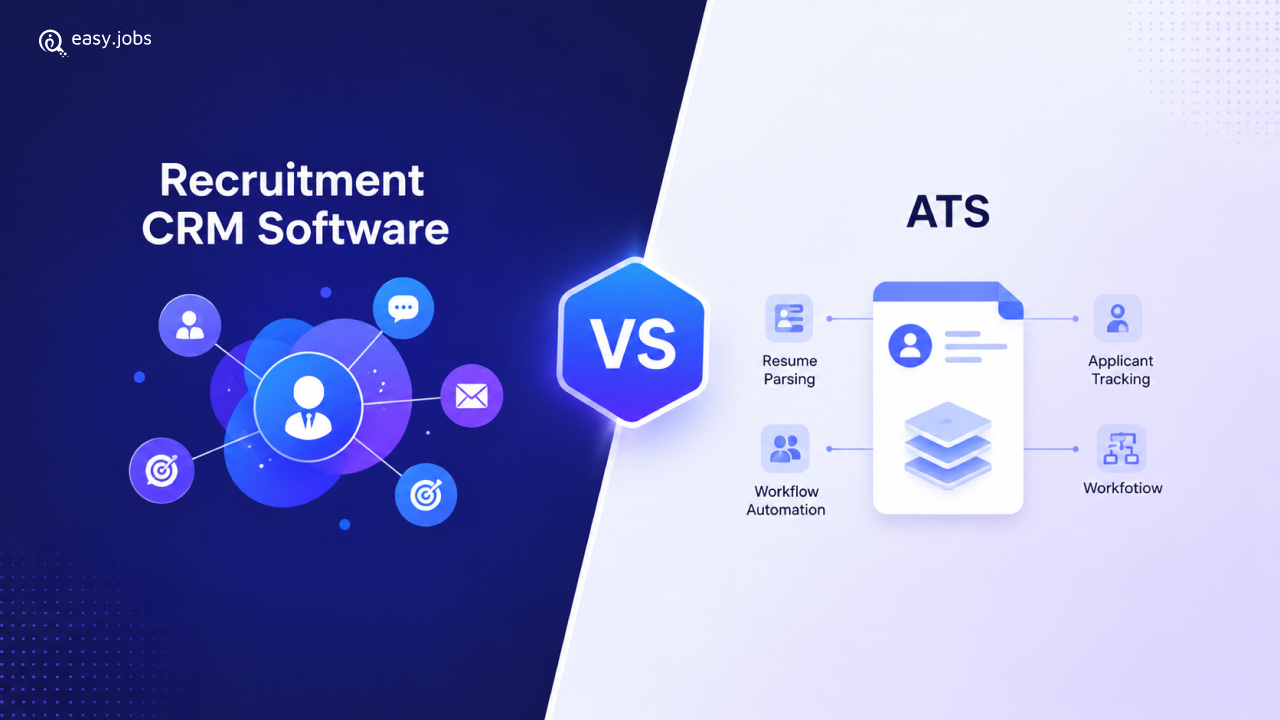
- The Core Difference: An ATS manages active candidates after they apply (reactive), while a CRM builds relationships with passive talent before they apply (proactive).
- What an ATS Does: Acts as your system of record for active hiring. It handles job postings, resume parsing, interview scheduling, and moving applicants through the hiring funnel stages.
- What a Recruitment CRM Does: Acts as your sourcing engine. It helps you build talent pools, run automated drip campaigns, and nurture passive candidates so you have a warm pipeline ready before a role even opens.
- Which Do You Need? If you have a small team, lower hiring volume, and get enough inbound applications, start with a standalone ATS. If you are struggling to fill specialized roles and rely heavily on outbound sourcing, you need a recruitment CRM.
- The Best Approach: They are a relay, not a rivalry. Integrated platforms (like easy.jobs) combine both tools into a single, AI-powered system to eliminate data silos and keep the candidate journey seamless from first touch to final offer.
What is the Difference Between a Recruitment CRM & an ATS?
The difference is straightforward: an applicant tracking system manages candidates after they apply, while a recruitment CRM builds relationships with talent before they apply. LinkedIn’s Future of Recruiting 2025 report found that 52% of recruiters say hiring is becoming more competitive. That competition is exactly why these two jobs have split into two distinct tools.
Imagine you are hiring a Senior Backend Engineer. Sarah was not selected six months ago, but she impressed your team. Your Recruitment CRM automatically keeps her engaged with occasional updates. When a similar position opens, she is already familiar with your company and just one message away from applying.
What Does an Applicant Tracking System (ATS) Do?
An ATS is the system of record for active hiring. It is where a job requisition becomes a posting, where applications land and where every candidate is moved from screening to offer. As AIHR notes in its talent acquisition guidance, core recruiting metrics such as time-to-fill are typically tracked inside the ATS, because the ATS owns the structured, stage-by-stage workflow.
Typical ATS capabilities include job posting management across multiple boards, resume parsing, interview scheduling, candidate status tracking and compliance record-keeping. If your problem is “we receive applications and lose track of them,” an ATS is the fix.
What Does a Recruitment CRM Do?
A recruitment CRM is built for the part of recruiting that happens before anyone clicks apply. As AIHR describes it, a CRM emphasizes the long-term cultivation of your talent pool rather than the management of a single open role. It is where you store passive candidates, re-engage strong past applicants and run outreach so that a warm pipeline already exists when a role opens.
Typical CRM capabilities include candidate sourcing, talent pool segmentation, automated outreach and drip campaigns, employer branding touchpoints and engagement tracking over months or years. If your problem is “we start every search from zero,” a CRM is the fix.
At easy.jobs, we have observed that teams hiring continuously often struggle less with applicant volume than with maintaining relationships with promising candidates over time.
Recruitment CRM vs. ATS at a glance
| Recruitment CRM | Applicant tracking system (ATS) | |
| Core purpose | Build and nurture relationships with talent | Track and manage active applicants |
| Stage in the funnel | Before the application (top of funnel) | After the application (mid to bottom of funnel) |
| Primary users | Sourcers, recruitment marketers, agency recruiters | Recruiters, hiring managers, coordinators |
| Signature features | Sourcing, talent pools, drip campaigns, outreach | Job posting, resume parsing, interview scheduling, pipeline stages |
| Best for | Proactive, high-volume or hard-to-fill hiring | Organized, repeatable hiring once candidates apply |
Decision Matrix: Which should you choose?
| If your situation is… | Choose… |
| Small team hiring occasionally | ATS |
| Startup | ATS first |
| Heavy outbound recruiting | CRM |
| Fast-growing company | Both |
| Agency recruiter | Both |
| Seasonal hiring | Both |
How Do a Recruitment CRM & an ATS Work Together in the Hiring Funnel?
They work as a relay, not a rivalry. A CRM warms talent at the top of the funnel and hands ready candidates to the ATS, which moves them through to hire. Because 87% of companies now use AI in recruitment, according to DemandSage, the handoff between these two systems is increasingly where automation lives: the CRM scores and surfaces a candidate, then the ATS routes them into the right stage.
Where the CRM Fits: Sourcing & Nurturing Passive Candidates
The CRM owns everything before the application. It is where outbound recruiting happens, finding passive candidates, re-engaging the strong runners-up from past searches and keeping a talent pool warm with relevant, timely outreach. The payoff is a pipeline that is already full on the day a requisition opens, rather than a cold start that adds weeks to time-to-fill.
This is also where teams quietly lose value. A candidate who came second for a role last quarter is one of the most qualified leads you will ever have, yet without a CRM, that person disappears the moment the role is filled. Teams that treat past applicants as a living pipeline, not a closed file, consistently fill repeat roles faster.
Where the ATS Fits: Tracking & Moving Active Applicants
The ATS owns everything after the application. It receives inbound applications, parses resumes, organizes candidates into hiring funnel stages and keeps the process consistent across every recruiter and hiring manager involved. Its job is speed and structure once intent exists — making sure no application stalls and no candidate falls through a crack.
Do You Need Both An ATS & A CRM?
In most cases, yes, eventually. LinkedIn’s Future of Recruiting 2025 report found that 89% of talent acquisition professionals expect measuring quality of hire to become more important.
You cannot improve the quality of hire if you only manage the people who happen to apply. That said, the honest answer depends on your hiring volume and how much you rely on sourcing.
When an ATS Alone is Enough
A standalone ATS is often the right starting point for smaller teams, lower hiring volume and roles that attract enough qualified inbound applications on their own. If your open positions fill from applicants without heavy outbound sourcing, an ATS gives you the structure you need without paying for pipeline tools you will not use.
Start here, get your process in order, then add a CRM when sourcing becomes the bottleneck.
When You Need a CRM as Well
You need a CRM once inbound applications stop being enough. The classic triggers are hard-to-fill or specialized roles, high-volume or continuous hiring, recurring seasonal roles and any serious investment in employer branding.
The moment your recruiters are doing meaningful outbound sourcing, a CRM stops being a luxury and becomes the system that protects all that sourcing work from being lost.
Why an Integrated ATS Plus CRM Beats Two Disconnected Tools
Buying a separate CRM and a separate ATS solves both jobs but creates a new one: keeping them in sync. AIHR points out that modern talent acquisition automation is built around an integrated ecosystem, where sourcing, screening, scheduling, and offers all live in one place, so every candidate journey is visible.
Two disconnected tools lead to duplicate data entry, conflicting candidate records, and a disjointed experience for the candidate, who may be nurtured in one system and then treated as a stranger in another.
An integrated platform removes that seam. When the CRM and the ATS share one candidate database, a sourced lead becomes an applicant without anyone re-keying data, and the full history travels with the candidate.
Modern recruitment platforms such as easy.jobs combine both capabilities into a single workflow, eliminating the need to sync multiple tools. This allows sourcing, AI screening, and tracking to all happen seamlessly within a single platform.
How Do You Choose the Right Recruitment Software for Your Team?
Match the tool to your funnel, not to the feature list. LinkedIn’s Future of Recruiting 2025 report found that 75% of recruiters say skills-based hiring is a top priority, so the right system is the one that helps you find and assess the right skills at the volume you actually hire, nothing more, nothing less. Work through the questions below before you compare vendors.
Five questions to ask before you buy
- What is our hiring volume?
A handful of roles a quarter points to an ATS. Continuous or seasonal hiring points to both. - How much do we source?
If recruiters spend real time on outbound sourcing, you need a CRM to hold that pipeline. - How hard are our roles to fill?
Specialized or senior roles reward proactive pipelines over reactive posting. - What is our budget and team size?
Tight budgets favor starting with an ATS, then layering in CRM capability. - Do the systems integrate?
If you buy two tools, they must share one candidate record or you will inherit data silos.
How easy.jobs Combines an ATS & a Recruitment CRM in One Platform
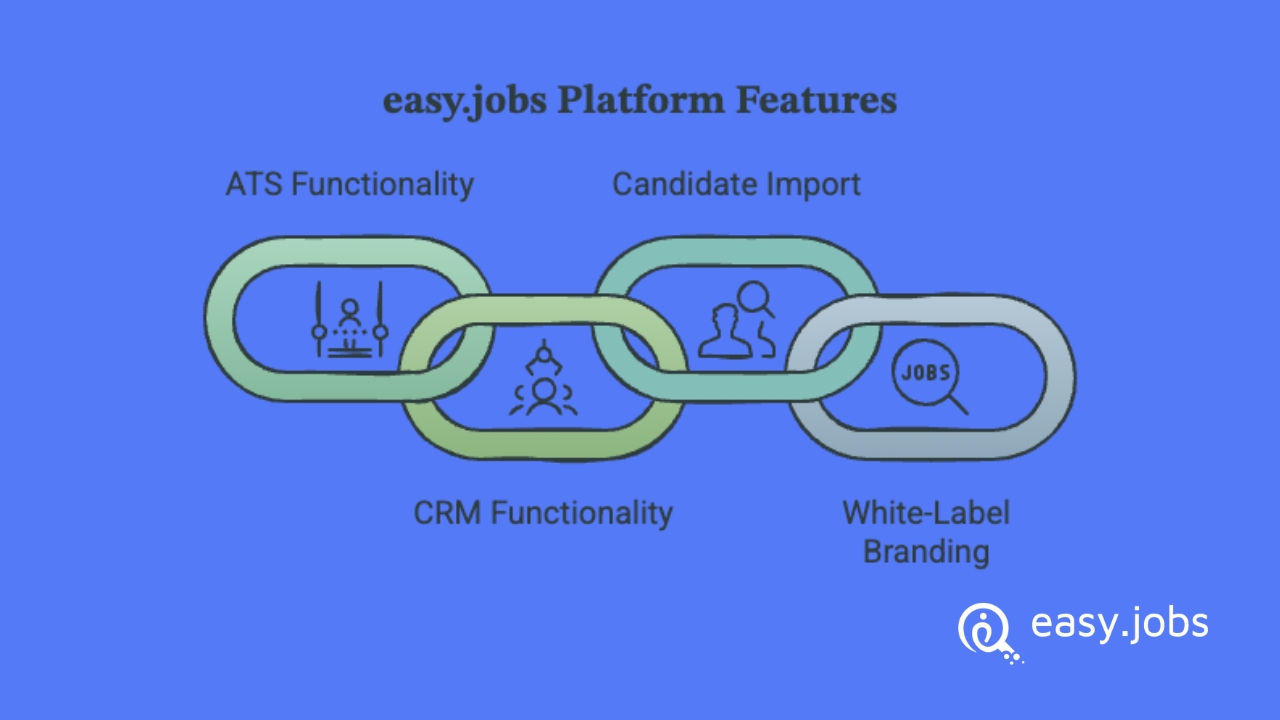
For teams that would rather not stitch two systems together, easy.jobs brings applicant tracking and candidate relationship management into a single AI-powered platform. It covers the full funnel:
AI-assisted screening and pipeline stages on the ATS side, plus talent pools and a branded career site on the CRM side. Recruiters can grow a pipeline using Candidate Import to bring existing contacts into one searchable database, then move qualified people straight into an active hiring stage without exporting a thing.
White-label branding can be added across the career site and candidate communications so the whole experience carries your company’s identity, not a vendor’s. A detail that matters when employer branding is doing real recruiting work. For a deeper look at automating the funnel, see our guide on recruitment automation.
Frequently Asked Questions About Recruitment CRM vs. ATS
Is a CRM the same as an ATS?
No. A recruitment CRM and an ATS are different tools for different stages. A CRM builds relationships with candidates before they apply, focusing on sourcing and nurturing a talent pool. An ATS manages and tracks candidates after they apply, focusing on organizing the active hiring process.
Can a CRM replace an ATS?
Generally no. A CRM is built to source and nurture talent, not to run structured hiring workflows, compliance records and stage-by-stage tracking. Teams that try to run hiring from a CRM alone usually lose the process discipline an ATS provides. The two are complementary, not interchangeable.
Does an ATS include a CRM?
Some do and many do not. Traditional applicant tracking systems focus only on active applicants. Modern all-in-one platforms combine both functions, giving you sourcing and pipeline nurturing alongside application tracking in one shared candidate database.
What comes first in recruiting, the CRM or the ATS?
The CRM comes first in the funnel. It finds and engages talent before a role is even open. The ATS takes over once candidates apply and need to be moved through the hiring stages. In practice, many small teams adopt an ATS first, then add CRM capability as sourcing grows.
Is easy.jobs an ATS or a CRM?
It is both: an AI-powered recruitment platform that combines applicant tracking with candidate relationship management, so teams can source, screen and hire from one place rather than paying for and syncing two separate systems.
What is the main benefit of integrating an ATS with a CRM?
A single, continuous candidate journey. When both functions share one database, a sourced lead becomes an applicant without re-entering data, recruiters see the full history of every candidate and the experience stays consistent, which supports faster, better-informed hires.
Choose the Right Software for Your Hiring Funnel
The debate between a recruitment CRM and an ATS is not about choosing a winner. It is about understanding your hiring funnel. While an applicant tracking system brings much-needed order and speed to your active hiring stages, a recruitment CRM fuels that process by proactively nurturing a pipeline of passive talent.
Together, they form a complete ecosystem that transforms talent acquisition from a reactive scramble into a predictable, relationship-driven strategy. As hiring grows more competitive in 2026, relying solely on inbound applications is no longer enough to secure the best candidates.
By investing in integrated hiring software like easy.jobs, your team can seamlessly bridge the gap between sourcing and tracking. Ultimately, equipping your recruiters with a single platform eliminates data silos and helps you hire smarter and scale faster.
Still unsure whether your hiring team needs an ATS, a Recruitment CRM, or both? Try easy.jobs free and see how an integrated platform manages sourcing, applicant tracking, AI screening, and hiring workflows in one place.
If you have found this blog useful, subscribe to our blog for the latest insights on optimizing your recruitment process. Also, join our Facebook Community to connect with fellow talent acquisition professionals, share winning hiring strategies, and stay ahead of industry trends!