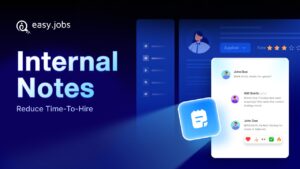
Un candidat exceptionnel n'attend pas. Pendant que votre équipe de recrutement court après les retours par e-mail et tente de se souvenir des interventions de la semaine dernière, ce candidat a déjà accepté une autre offre. Le coût caché d'un processus de recrutement trop lent réside rarement dans l'entretien lui-même, mais plutôt dans le silence et la confusion qui s'ensuivent.
Ce guide explique en détail où le temps de recrutement est réellement gaspillé, pourquoi le manque de retours d'information constitue un véritable goulot d'étranglement et comment un système de notes internes partagées permet à tous les intervieweurs, recruteurs et responsables du recrutement de travailler de concert. Nous verrons également précisément comment l'utiliser. Notes internes dans easy.jobs, étape par étape.
Points clés à retenir
- The global median time-to-hire now sits at 38 jours more than five weeks to fill a single role. (SmartRecruiters, 2025 Recruitment Benchmarks)
- Most of that delay is not interviewing. It is the waiting between interviews while feedback sits in inboxes, chat threads and people’s memories.
- Companies that adopt AI-assisted hiring cut their time-to-hire by 26%, an eleven-day advantage on average.
- Shared, centralized internal notes turn scattered opinions into a single decision record so your team moves from “I think we discussed this” to “here is exactly what we agreed.”
- Inside easy.jobs, the Internal Notes feature adds tagging, threaded replies, reactions and auto-saved drafts to every candidate profile, keeping feedback in one searchable place.
What Is Time-to-Hire And Why Does It Keep Slipping?
Time-to-hire measures the number of days between a candidate entering your pipeline and accepting your offer. The global median is 38 jours and in technology roles it stretches to roughly 48 days, about 26% slower than the cross-industry median.
It helps to separate two metrics that are often confused. Time-to-fill counts from the moment a role is approved to the day it is filled, so it measures the health of your whole requisition process. Time-to-hire is narrower: it starts when a specific candidate engages and ends when they say yes. Time-to-fill tells you whether your pipeline is full. Time-to-hire tells you how fast your team can make a confident decision once the right person appears.
That distinction matters because time-to-hire is the metric most directly controlled by your team’s internal coordination. You cannot always speed up a candidate’s notice period, but you absolutely can speed up how quickly your interviewers align, compare notes and reach a verdict.
Why Do Disconnected Hiring Teams Slow Down Every Decision?
The single biggest source of avoidable delay is fragmented feedback. When interview observations live in five different places: one recruiter’s inbox, a manager’s notebook, a Slack thread, a spreadsheet and somebody’s memory, the team cannot decide until someone manually gathers it all.
Picture the typical breakdown. Three people interview a candidate on Tuesday. One sends feedback the same evening. One waits to be reminded on Thursday. The third gives a verbal “they were good” in the hallway that never gets written down. By Friday, the recruiter is chasing replies instead of moving the candidate forward and the momentum that made the candidate excited has cooled.
From conversations with hiring teams using ATS like easy.jobs, the delay rarely comes from a lack of opinions. It comes from those opinions being trapped in separate tools. When teams moved their interview feedback into one shared space attached to the candidate, the most common change they reported was not better decisions, it was faster ones, because nobody had to reassemble the conversation from scratch.
Disconnected feedback also quietly damages quality. When notes are scattered, recency bias takes over and the loudest or latest voice wins. Centralized notes give every interviewer’s input equal weight on the record, which leads to fairer, more defensible hiring decisions.
How to Reduce Time to Hire in Your Hiring Process
When hiring teams try to speed up their recruitment cycles, they often look at rewriting job descriptions or changing job boards. But the real bottleneck is usually much closer to home: the slow, fragmented feedback loops between interview rounds.
While internal notes do not solve all hiring delays, they eliminate this exact bottleneck by centralizing collaboration right on the candidate’s profile. Instead of a recruiter spending days chasing follow-ups via email or chat apps, every observation is logged the moment it happens. This is what true collaborative hiring looks like in practice, driven by three critical shifts:
- Immediate Feedback: Interviewers add notes while conversations are fresh, capturing genuine, detailed impressions instead of a watered-down summary written days later.
- Centralized Context: Every note, reply, and reaction lives in one place. A hiring manager joining the process late can read the full history in two minutes rather than scheduling a recap meeting.
- Accountable Decisions: A transparent, shared record removes any confusion about alignment. The team can see precisely who raised which concern and how it was resolved, replacing guesses with defensible, data-backed choices for close-call candidates.
Implementing this does not require a massive workflow overhaul. It just requires the right platform. Modern hiring tools like easy.jobs include built-in internal note features designed specifically to keep your team aligned in real time. We will share a detailed guide soon on how to fully configure this within your workspace to maximize efficiency.
What Makes Good Interview Notes and Feedback?
Good interview feedback is specific, evidence-based and tied to the requirements of the role, not a vague impression. The strongest interview notes answer one question: what did this candidate actually say or do that maps to what the job needs? Teams that use a consistent format here make faster comparisons because every candidate is measured against the same bar.
A simple, repeatable structure keeps notes useful. Use this as an interview notes template:
- Role criterion: the specific skill or competency being assessed (for example, “stakeholder communication”).
- Evidence: what the candidate said or demonstrated, quoted or paraphrased.
- Rating: a consistent scale your whole team uses (for example, 1 to 4).
- Open question or concern: anything the next interviewer should probe.
A few principles separate feedback that speeds decisions from feedback that stalls them:
Write it down immediately. A note captured within an hour of the interview is far more accurate than one reconstructed days later.
Describe behavior, not personality. “Walked through a past migration and named the trade-offs” is useful. “Seemed smart” is not.
Make concerns actionable. Instead of “not sure about them,” write “needs deeper testing on system design, recommend a follow-up.” This hands the next interviewer something to verify rather than a dead end.
Keep it comparable. When every interviewer scores the same criteria, your interview scorecard becomes a side-by-side view instead of a pile of opinions.
Strong interview feedback is specific, written immediately, focused on observable behavior and scored against consistent role criteria. Centralizing it on the candidate profile lets a hiring team compare candidates side by side and decide faster.
How Do You Use Internal Notes in easy.jobs? (Step-by-Step)
Inside easy.jobs, internal notes live directly on each candidate profile, so feedback is attached to the person it describes with no separate documents and no switching tools.
If your hiring team still relies on email and Slack for feedback, internal notes in easy.jobs can help you cut decision time significantly. Here is how to add and manage them.
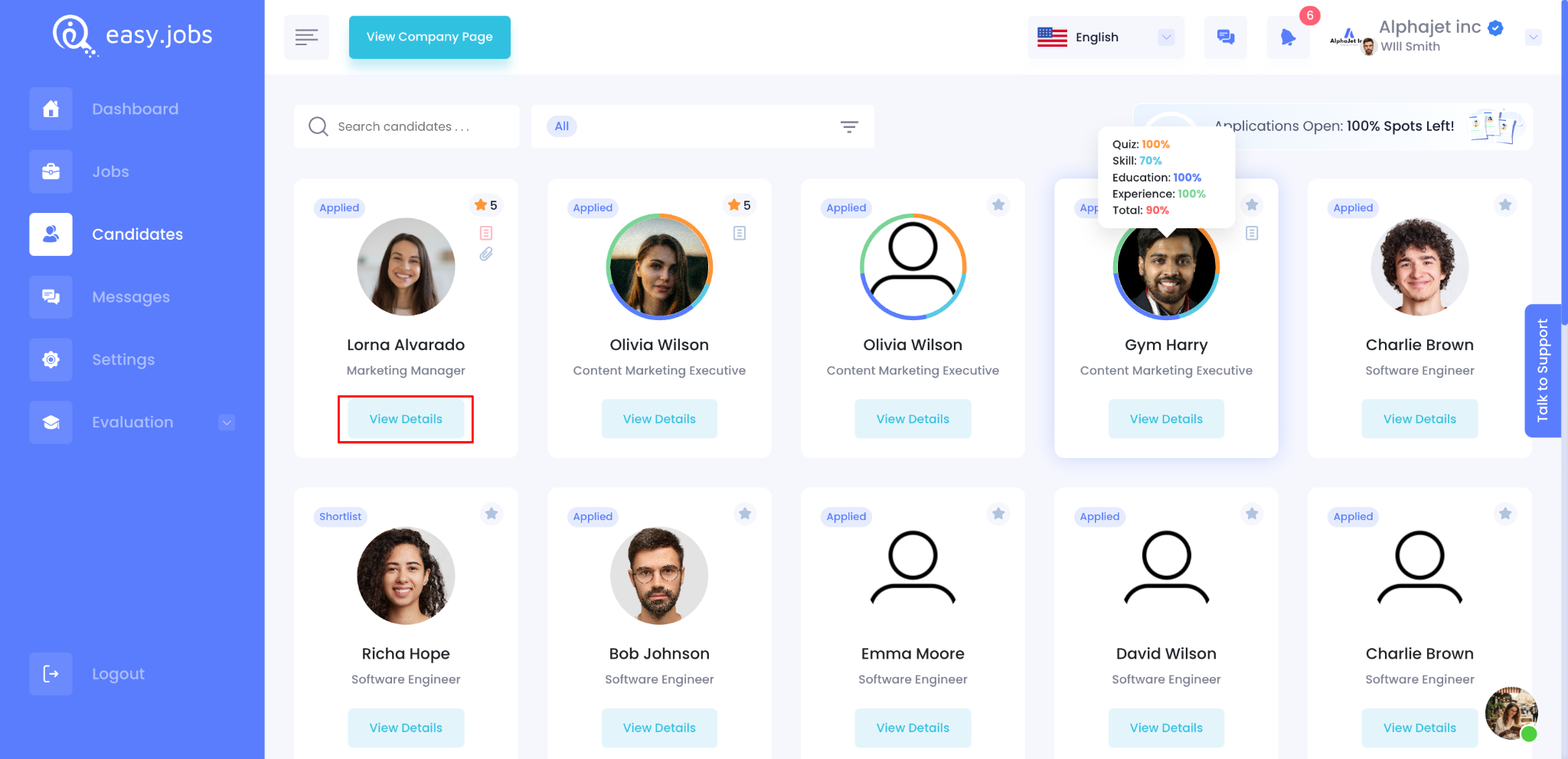
Step 1: Open the candidate profile
Log in to your easy.jobs dashboard and click Candidats in the sidebar. Select the candidate whose profile you want to open.
Step 2: Find the Internal Notes section
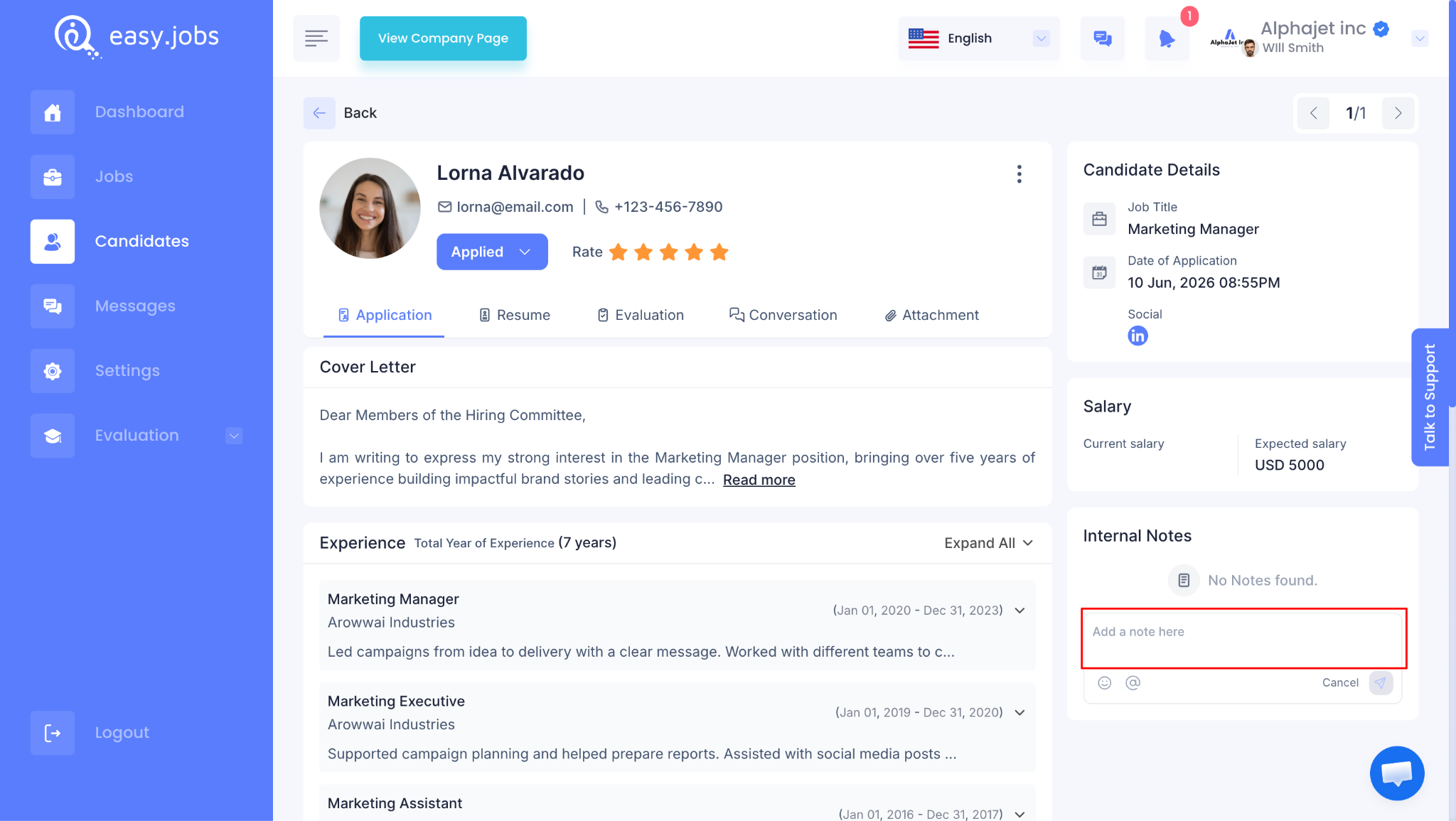
On the right side of the candidate’s profile, locate the Notes internes panel.
Step 3: Add your note
Click into the “Add a note here” space, type your observations and click Sauvegarder. The note is instantly visible to your team on that profile.
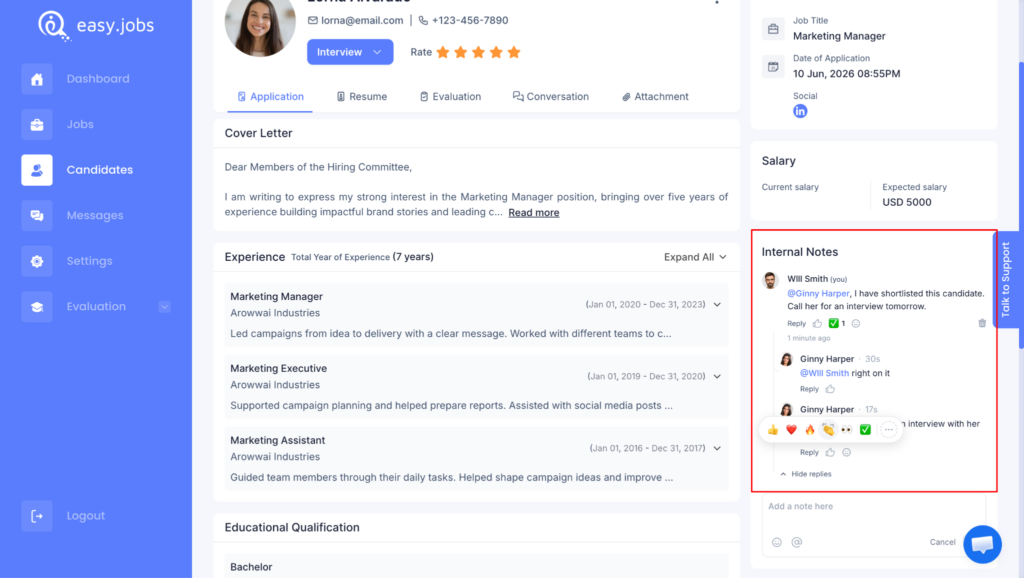
That covers the basics. The features that genuinely move your time-to-hire are the collaboration tools built into the same panel:
- Tagging: type @[Team Member Name] to notify a colleague directly by email. Instead of writing a note and then chasing someone to read it, the request and the context arrive together.
- Threads: reply to an existing note to keep a discussion in one place. A panelist’s concern and the follow-up answer stay linked, so the decision trail reads cleanly.
- Reactions: add an emoji to a note for a fast acknowledgment or approval, a lightweight way to signal agreement without adding noise.
- Drafts: if you start a note and navigate away, easy.jobs saves it automatically as a draft, so a half-written thought is never lost between interviews.
Together these turn a static comment box into a live coordination layer for your hiring team. The tag replaces the “did you see my email?” follow-up. The thread replaces the scattered reply-all. The draft makes sure feedback survives a busy day.
For a complete walkthrough with screenshots, see the easy.jobs Internal Notes documentation.
What Results Can a Hiring Team Expect?
The payoff of centralized notes shows up as a shorter, calmer decision phase. When feedback is captured in real time and visible to everyone, the recruiter stops acting as a messenger, and the team reaches a verdict in days rather than weeks.
In fact, modern teams frequently find that structured, in-app collaboration entirely transforms their administrative overhead. For example, when aviation recruitment firm AviatorXperts scaled their team using easy.jobs, moving away from scattered external threads to a unified system, dramatically cut down their manual overhead. As Nicolas Lejeune, Founder of AviatorXperts, noted:
“The flexible platform can be set up to meet a company’s specific workflow, branding, and integration needs. As soon as I started to use it, I realized how much time I saved.”
One pattern teams describe after switching to shared internal notes: the weekly hiring sync gets shorter. Because everyone has already read the notes on each candidate, the meeting becomes a quick confirmation rather than a thirty-minute reconstruction of who thought what. That recovered time goes straight back into the pipeline—helping companies like AviatorXperts save an average of two hours per hire.
There is a candidate-experience dividend, too. A team that decides quickly extends offers while the candidate is still excited, which protects your offer-acceptance rate and your employer brand. Speed and alignment are not competing goals; the same shared record delivers both.
Questions fréquemment posées
What is the difference between time-to-hire and time-to-fill?
Time-to-hire counts the days from a candidate entering your pipeline to accepting your offer, so it measures decision speed. Time-to-fill counts from when a role is approved to when it is filled, so it measures the whole requisition process. Internal alignment is the fastest lever for improving time-to-hire.
How does centralized feedback impact our standard time to hire benchmark?
The average professional time to hire benchmark hovers between 24 and 30 days, largely dragged down by delayed internal feedback. Centralizing notes on platforms like easy.jobs eliminates the manual feedback chase, shaving days off your evaluation cycle and positioning you to secure top talent ahead of your competitors.
How do internal notes actually speed up hiring?
They remove the feedback-collection step. Instead of a recruiter gathering opinions from inboxes and chat threads, every interviewer writes directly onto the candidate profile, so the team can compare input and decide without delay.
How do you give interview feedback to a hiring manager efficiently?
Write it where the manager already works on the candidate record and tag them directly. In easy.jobs you type @[Manager Name] in a note, which notifies them by email with the full context attached, removing a separate handoff message.
Can interviewers reply to each other’s notes?
Yes. easy.jobs supports threaded replies, so a concern raised by one panelist and the response from another stay linked on the same candidate profile, keeping the decision trail organized.
What should good interview notes include?
The role criterion being assessed, the specific evidence the candidate gave, a consistent rating and any open question for the next interviewer. Writing notes immediately and scoring the same criteria makes candidates directly comparable.
The Real Competitive Edge: Speed Built on Alignment
A 38-day time-to-hire is not inevitable. It is the cost of fragmented feedback. When interview observations scatter across email, Slack, and memory, teams lose days to follow-ups and coordination. Centralized internal notes eliminate that bottleneck by putting every opinion on the candidate profile, where the full decision trail is visible in minutes instead of being reconstructed over days.
Teams winning on time-to-hire are not bigger; they are coordinated. They write immediately, tag collaborators, and let transparency drive faster, fairer decisions. If your team is still chasing feedback, the 11-day advantage that structured hiring delivers is within reach. Start by moving the conversation to where the candidate is: their profile.
Si vous avez trouvé ce guide utile, abonnez-vous à notre blog for practical hiring insights. You can also rejoignez notre communauté Facebook to connect with recruitment professionals.