Recruitment advertising got more expensive even as the labor market cooled. A recent recruitment marketing benchmark report, built on 302 million clicks and 27 million applications across nearly 1,200 employers, found that cost per application and cost per hire both rose sharply despite softer hiring demand. Spending more no longer guarantees hiring more.
Most hiring teams still buy job ads the same way they did a decade ago: post, wait and hope. According to the research Evolution of Programmatic Job Advertising by Madeline Laurano, only 34 percent of enterprise companies currently use programmatic job advertising.
Meaning two-thirds of recruiting teams still distribute postings manually, according to recent industry research. This guide explains what programmatic job advertising is, how it works, why costs climbed last year, and a step-by-step framework for cutting wasted ad spend.
TL;DR: The Recruiter’s Guide to Programmatic Job Advertising
- The Problem: Recruitment ad costs are rising, yet roughly two-thirds of enterprise recruiting teams still waste their budget on manual, flat-fee job listings (the “post and pray” method).
- The Solution: Programmatic job advertising automates ad buying and placement. It acts like a real-time media-buying desk, using AI and custom rules to automatically shift your budget toward channels that produce candidates and away from those that don’t.
- The ROI: Adopting programmatic advertising cuts average cost-per-applicant by over 30% and makes companies twice as likely to reduce their time-to-fill.
- The Strategy: Stop paying for vanity metrics like Cost Per Click (CPC) and optimize for Cost Per Hire (CPH). Use a 70/20/10 budget split (70% proven channels, 20% programmatic testing, 10% experimental).
- The Missing Link: To make programmatic work, you must connect your ad campaigns to an Applicant Tracking System (ATS) like easy.jobs. This ensures you are tracking which ads actually result in hires, not just clicks.
What Is Programmatic Job Advertising?
Programmatic job advertising is the automated buying, placement and optimization of job postings across job boards, aggregators, search engines and social platforms, using rules-based or AI-driven bidding rather than manual, flat-fee listings. Global programmatic advertising spend across all industries is projected to clear 821 billion dollars in 2026, or roughly 90 percent of total digital display investment, and recruitment is following the same shift.
Traditional job posting works like a newspaper classified: an employer chooses a board, pays a flat fee for a fixed run, and waits to see who applies. Programmatic works more like a media-buying desk. Software continuously evaluates which channels are producing qualified applicants and shifts budget toward them in real time, pausing or capping spend on channels that are not converting.
The difference matters because only around a third of enterprise employers have made the switch. That leaves most recruiting teams paying for placements without any mechanism to redirect spend when a channel underperforms.
How Does Programmatic Job Advertising Work?
Programmatic platforms run on four connected mechanics: data ingestion, rules and bidding, real-time placement and a feedback loop that reallocates budget continuously. Companies planning to increase programmatic investment reached 56 percent in the coming year, a sign that the mechanics below are proving out in practice.
Data ingestion. Job openings flow into the programmatic platform from an applicant tracking system, typically through an XML feed or a direct integration, carrying titles, descriptions, locations and custom fields.
Rules and bids. A recruiter sets parameters up front: budget per role or role group, target geography, job category and a maximum cost per click or per application. Some platforms also allow quality filters, such as a minimum time on page before a click counts.
Real-time placement. The system bids on placements across dozens of channels simultaneously, similar to a search engine auction and adjusts bids as performance data comes in.
The feedback loop. Budget shifts continuously toward channels producing quality applicants and away from channels producing clicks that never convert. No manual intervention is required once rules are set.
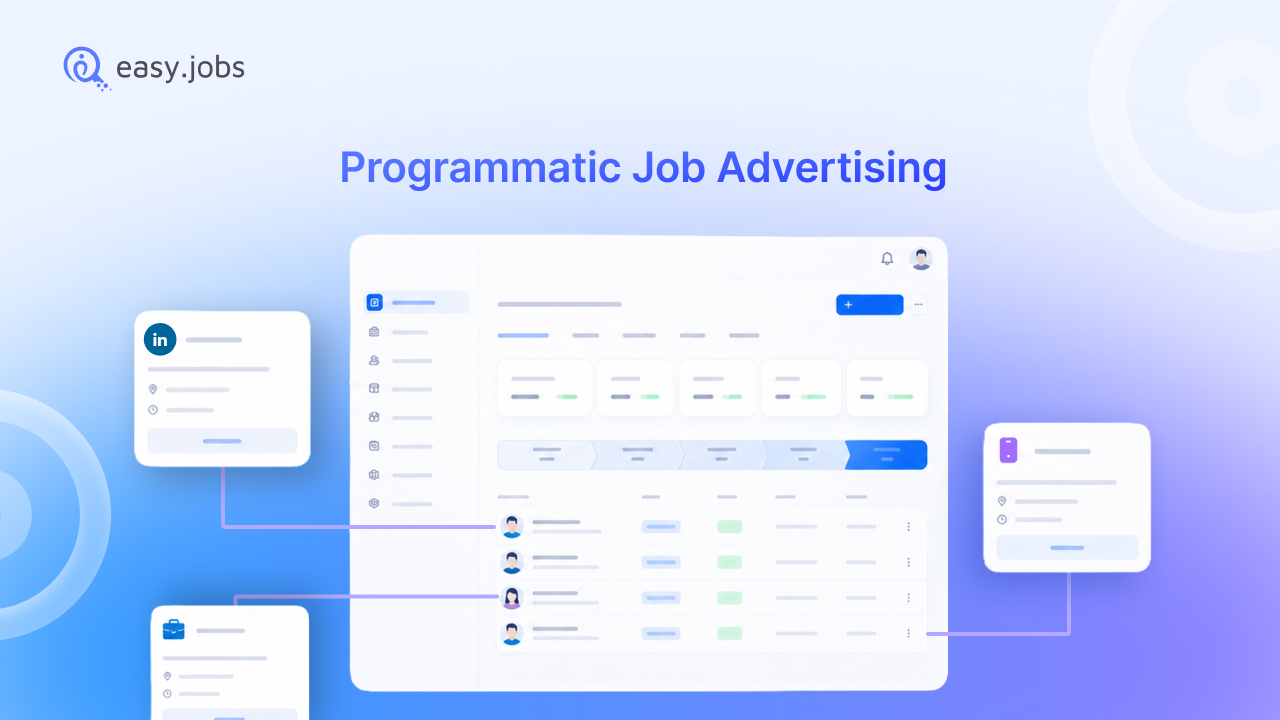
Consider a retail chain hiring for 50 cashier roles across a region. Instead of posting each opening to five boards by hand, the recruiter sets a maximum cost per application and a total campaign budget. In an ATS like easy.jobs: you can integrate multiple job boards so your existing jobs are published, reducing repetitive tasks.
The system distributes postings across job boards and social channels, pauses ads on boards already producing enough qualified applicants and increases spend on boards still under quota. Within days, the budget concentrates on whichever three or four channels are actually converting, without anyone touching the campaign.
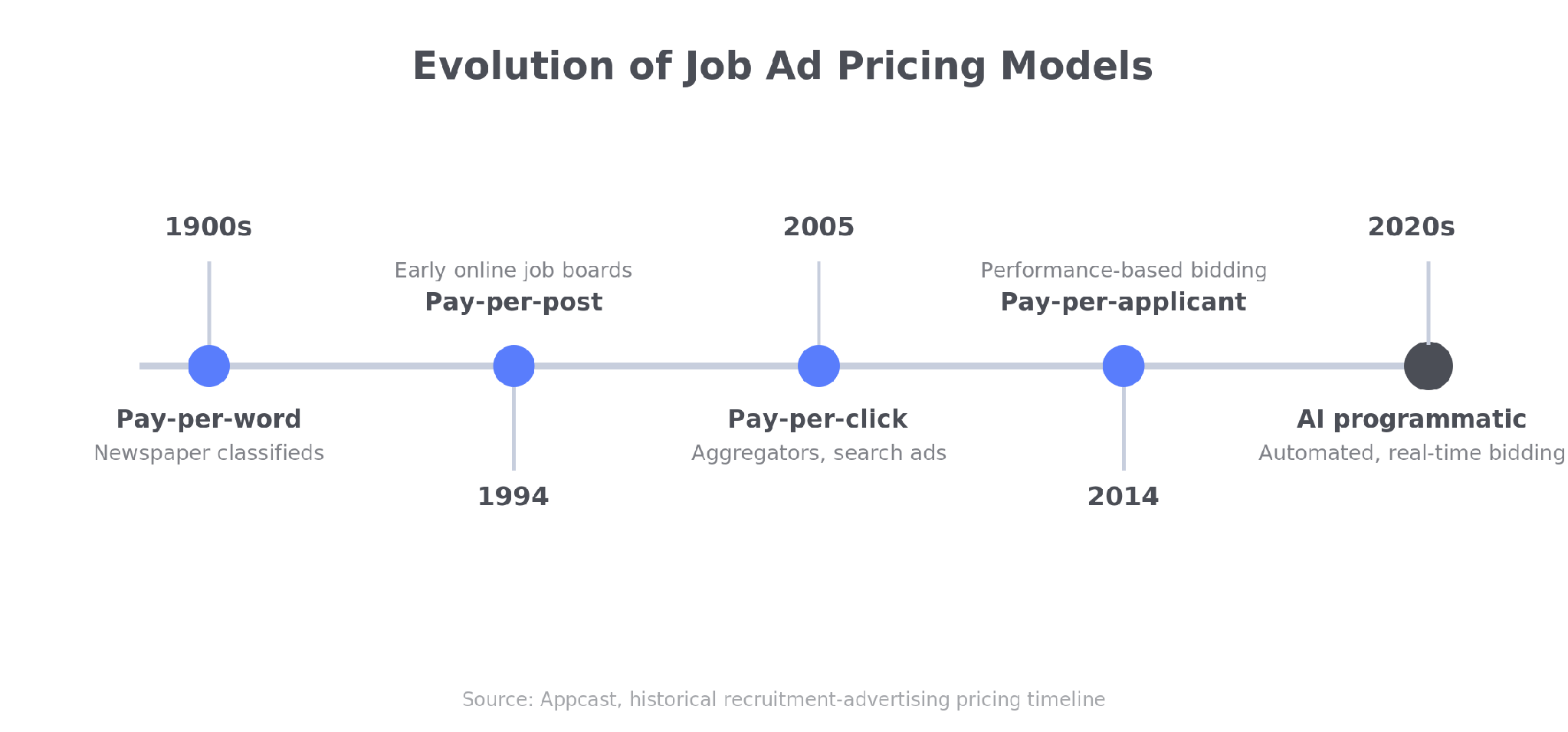
Why Did Recruitment Advertising Costs Rise in 2025?
Cost per application and cost per hire rose sharply in 2025 despite a softer labor market, according to cost per hire and cost per application data tracked across 302 million clicks and 27 million applications and nearly 1,200 employers. Apply rates actually held steady, so candidate scarcity was not the driver.
The real driver was pricing itself. Job boards and media platforms shifted their cost models as organic reach continued to shrink, pushing more employers into pay-to-play placements. Programmatic media models compounded the effect: as more buyers competed for the same inventory, auction prices climbed even while overall hiring demand softened.
Cost per click has become a vanity metric in recruitment advertising. Teams that optimize campaigns for clicks, rather than for completed hires, end up paying premium auction prices for traffic that never converts, which is precisely why costs can rise in a market where hiring itself is slowing down.
Recruiters who tie every dollar to a hire, rather than a click, are better positioned to weather this kind of pricing shift because they can identify and cut spend on channels that only ever produced traffic.
Cost per application and cost per hire rose sharply through 2025 even as the broader labor market softened, driven by shifting job board pricing models rather than candidate scarcity, since apply rates held steady throughout the year.
What Are the Benefits of Programmatic Job Advertising?
Roughly nine in ten employers who adopt programmatic recruitment do not return to manual job posting, according to research cited in Appcast’s analysis of programmatic adoption. Once teams see structured, data-driven ad spend in action, going back to flat-fee guesswork rarely looks appealing.
The benefits map directly to money and time. Cost-per-applicant reductions from programmatic advertising average more than 30 percent, with some high-volume roles seeing reductions as steep as 70 percent once the algorithm has enough data to optimize aggressively. Seventy-four percent of companies using programmatic report measurable improvements in hiring quality, not just volume.
Time-to-fill tells a similar story. Companies using programmatic job advertising are twice as likely to reduce time-to-fill compared with traditional posting. 60 percent versus 29 percent. Faster fills reduce the cost of an open seat and shrink the window in which a strong candidate might accept a competing offer.
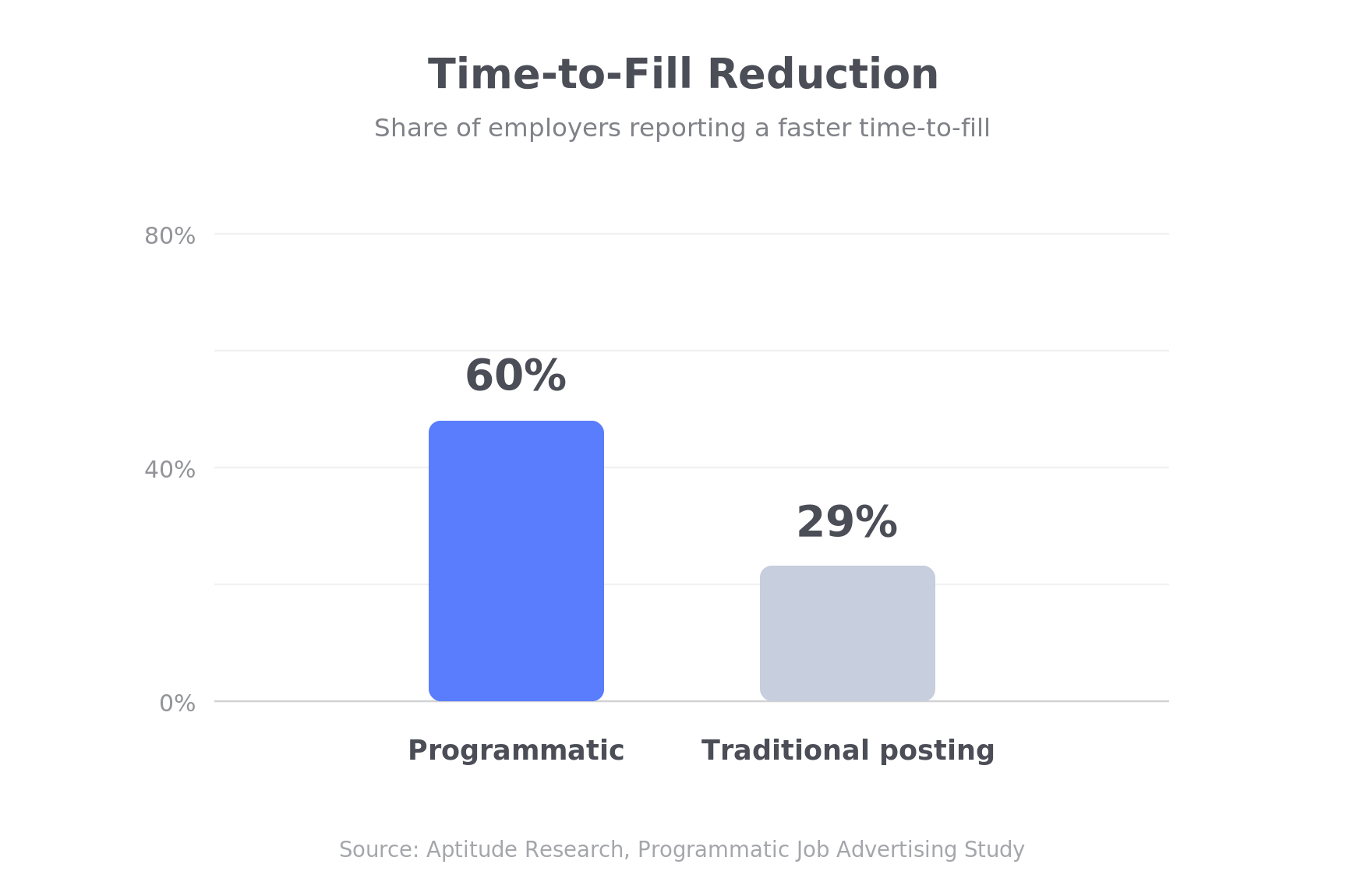
Beyond the headline numbers, programmatic advertising also extends reach to passive candidates who are not actively browsing job boards, gives recruiters back the hours once spent manually posting and re-posting and keeps budget under a hard cap rather than an open-ended monthly invoice.
Which Metrics Should Recruiters Track to Control Ad Spend?
Recruiters who judge channels by cost per hire rather than cost per click cut cost-per-applicant by more than 30 percent on average. The metric a team optimizes for determines where the budget goes, so choosing the right one is not a technicality.
Six metrics matter most:
- Cost per click (CPC): what is paid each time a candidate clicks through to a listing. Useful for spotting overpriced placements, but a poor proxy for hiring success on its own.
- Conversion rate: the share of clicks that turn into completed applications. A cheap click that never converts is not actually cheap.
- Cost per application (CPA): total spend divided by completed applications. More meaningful than CPC because it filters out clicks that go nowhere.
- Applicant-to-hire ratio: how many applicants a channel needs to produce before one becomes a hire.
- Cost per hire (CPH): total spend divided by hires from that source. This is the metric that should decide where the budget goes.
- Source quality: whether a channel produces candidates who advance through screening and accept offers, not just candidates who apply.
When easy.jobs customers turn on source-to-hire tracking inside their applicant tracking system, a pattern shows up again and again: the channel with the cheapest clicks is rarely the channel that produces the cheapest hires. Teams that only watch CPC keep funding the wrong sources.
How to Build a Smarter Job Ad Budget: A 6-Step Framework
A structured budget framework, reviewed on a fixed schedule, prevents the slow spend creep that catches most recruiting teams off guard. Below is a six-step process that works whether a team is testing programmatic for the first time or trying to fix an existing campaign.
- Baseline current cost per application and cost per hire by source. Pull the last 90 days of job board invoices and map every dollar to a result before changing anything.
- Set goals per role group. High-volume roles and specialist roles behave differently, so they need separate CPA and CPH targets rather than one blended number.
- Allocate with a 70/20/10 split. [Unique Insight] Put 70 percent of the budget behind channels with a proven hire history, 20 percent into programmatic testing across new channels and 10 percent into experimental or niche sources. No ranking guide currently offers this kind of allocation heuristic for recruitment ad spend, though the logic mirrors budget-testing practices used in broader digital marketing.
- Set automated rules and caps. Pause a job ad after a set number of applications, increase bids for roles open longer than two weeks and cap total monthly spend per campaign.
- Review weekly, not quarterly. Only 27 percent of organizations currently use AI specifically within recruiting, even though 39 percent have adopted AI somewhere in HR, which suggests most teams still lack the routine, structured review habits that catch waste early.
- Reallocate monthly based on source-of-hire data, not source-of-click data, shifting dollars away from channels that only ever produced applications and never produced hires.
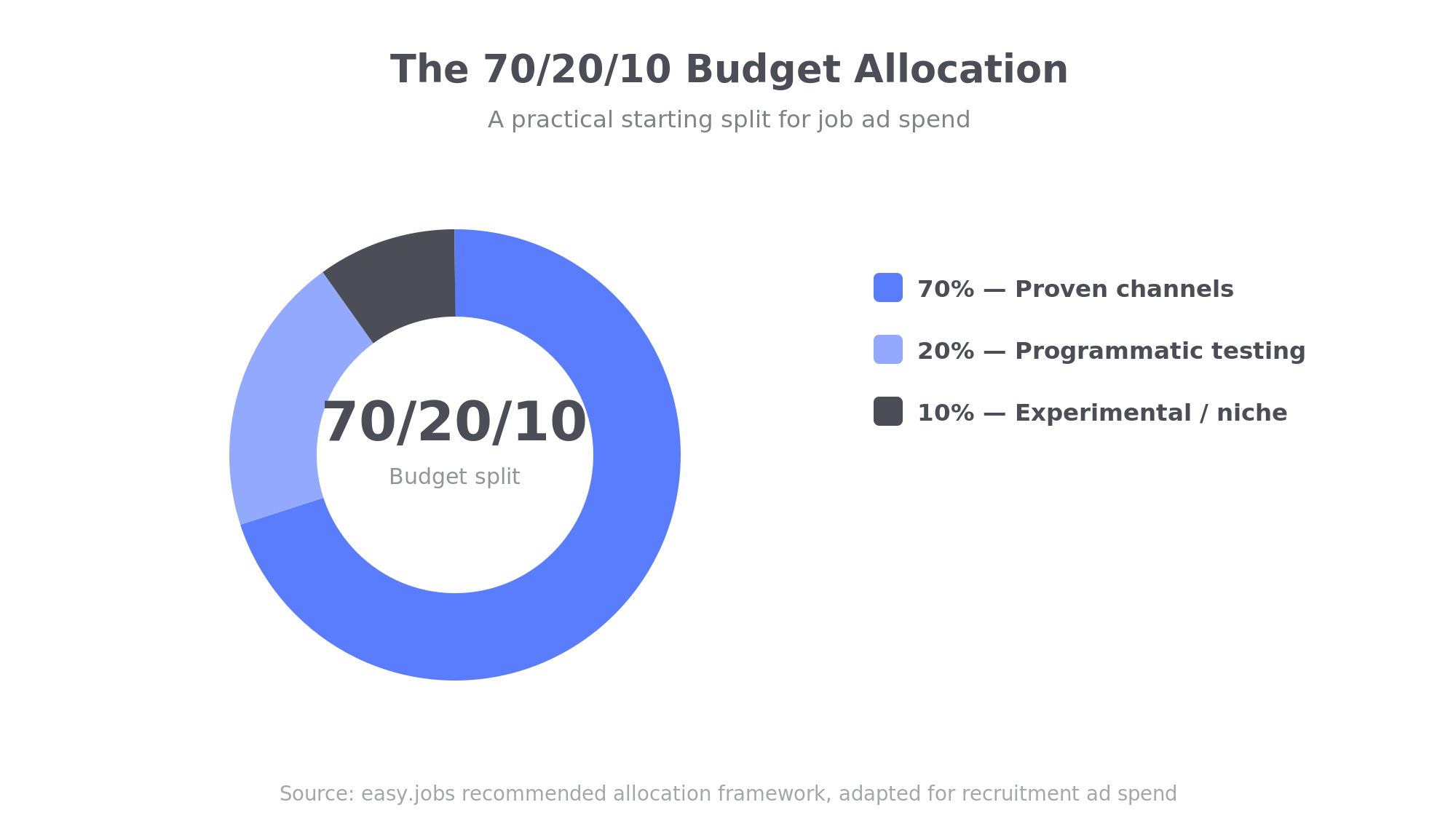
A practical starting framework for job ad budgets allocates 70 percent of spend to channels with a proven hire history, 20 percent to programmatic testing across new channels and 10 percent to experimental or niche sources, then reallocates monthly based on which channels actually produced hires rather than clicks.
Which Mistakes Waste the Most Job Advertising Budget?
Nearly two-thirds of enterprise recruiting teams still distribute job ads manually, leaving little room to catch the mistakes that quietly drain budget. A handful of recurring errors account for most of the waste.
Set-and-forget campaigns. Automation handles distribution, not strategy. A campaign left unreviewed for a month can keep spending on a channel that stopped converting weeks earlier.
Single-source dependence. Relying on one or two job boards means a recruiting team cannot see whether a cheaper, better-converting channel exists elsewhere.
Ignoring down-funnel data. Tracking clicks and applications while ignoring which sources actually produced hires means the budget keeps flowing to channels that look cheap and perform poorly.
Vague job titles and descriptions. No amount of ad optimization fixes a listing that fails to describe the role clearly. Apply rates suffer regardless of where the ad appears.
Sending clicks to a slow, unbranded career page. A candidate who clicks a well-targeted ad and lands on a generic, slow-loading application form often abandons before applying. A modern career site, with branding elements added for a polished, professional look, keeps that momentum intact rather than losing it at the last step.
How Does an ATS Complete the Programmatic Loop?
Programmatic advertising optimizes the top of the hiring funnel, but without an applicant tracking system connected to it, the feedback loop breaks. Adoption across HR overall has reached 39 percent, even though only 27 percent of organizations currently use AI specifically within recruiting, which means most teams still lack the connected system needed to know which ad dollar actually produced a hire.
Job ads can drive a flood of clicks and applications, but if a recruiting team cannot trace an applicant back through screening, interviewing and an offer, cost-per-hire numbers by source remain a guess rather than a fact. An applicant tracking system closes that gap by recording where every candidate came from and following them through to a hiring decision.
Inside easy.jobs, that connection shows up in a few concrete ways. Insights and traffic metrics on job posts are shown in the analytics dashboard, so a spike in application volume from a new programmatic channel does not overwhelm a hiring team.
Candidate Import consolidates applicants pulled in from multiple advertising channels into a single pipeline, rather than leaving recruiters to reconcile spreadsheets from five different job boards. A custom career site, with branding elements added for a consistent, professional look, gives every ad click a landing experience worth converting on.
What Is the Future of Programmatic Job Advertising?
The programmatic job advertising market is projected to grow from 2.38 billion dollars in 2026 to 8.32 billion dollars by 2035, a 14.9 percent compound annual growth rate that outpaces the broader job advertising market roughly two to one. That growth is arriving alongside a broader shift toward AI across recruiting functions.
Ninety-three percent of recruiters plan to increase their use of AI in 2026, and much of that investment will land directly on advertising and sourcing workflows. A few trends are worth watching closely.
AI agents are starting to manage bidding end to end, adjusting budgets across channels without a recruiter setting manual rules first. Skills-based targeting is replacing job-title matching, so postings reach candidates based on demonstrated ability rather than keyword overlap.
AI-powered search tools are changing how candidates discover openings in the first place, which means job ad copy increasingly needs to answer a candidate’s question directly rather than simply list requirements. Privacy-first targeting is also reshaping how platforms build audience segments, as third-party tracking continues to shrink across the wider advertising industry.
Frequently Asked Questions on Programmatic Job Advertising
What is programmatic job advertising?
Programmatic job advertising is the automated buying, placement and optimization of job postings across job boards and other channels, using rules-based or AI-driven bidding instead of flat-fee listings. Enterprise adoption of programmatic advertising sits at just 34 percent, leaving most teams to distribute ads manually.
What is an example of programmatic job advertising?
A retail chain hiring 50 cashiers can set a maximum cost per application and let a programmatic platform distribute postings across job boards, pausing channels once they hit quota and shifting budget to ones still converting. Programmatic users cut time-to-fill at twice the rate of traditional posting: 60 percent versus 29 percent.
Is programmatic job advertising worth it for small businesses?
It depends on hiring volume. Teams posting ten or more roles per month see the clearest return because the algorithm needs data to optimize meaningfully. Even smaller teams can benefit, since companies using programmatic cut cost per applicant by more than 30 percent on average.
Turn Your Ad Spend Into Actual Top Hires
Programmatic job advertising will not fix a bad job description or a broken career page, but it does remove the biggest source of wasted spend in recruitment advertising: paying for placements with no mechanism to redirect the budget when they stop working.
The path forward comes down to three habits: automate the buying, measure every channel against cost per hire rather than cost per click and review performance on a fixed weekly schedule rather than letting campaigns run unattended for a quarter.
Automate distribution and bidding instead of manually posting to each board. Track cost per hire and cost per application, not clicks, as the metrics that decide where budget goes. Connect ad performance to an applicant tracking system so source-of-hire data, not source-of-click data, drives next month’s budget.
Recruiting teams ready to see which advertising dollar actually produces a hire can start with easy.jobs and connect source tracking, screening and career site performance in a single view.
If you have found this blog useful, subscribe to our blog. Join our Facebook Community to connect with other recruiters and HR professionals, swap real-world programmatic advertising strategies and stay ahead of what’s next in hiring.