Recruitment Process Outsourcing (RPO) is a strategic workforce model in which an employer transfers all or part of its recruitment function to an external service provider. Acting as a seamless extension of your internal HR team, an RPO provider takes ownership of the end-to-end hiring lifecycle. From sourcing and screening to interviewing, offer management and onboarding, using your employer brand and recruitment technology.
Unlike a staffing agency that fills one vacancy at a time for a per-placement fee, an RPO partner is accountable for the strategy, process and measurable outcomes of your hiring engine. The result is higher-quality hires, a shorter time-to-fill and the scalability modern businesses need to grow. This guide explains what RPO means, how it works, the main models and pricing structures, the leading providers and how to decide whether RPO is right for your organization in 2026.
TL;DR — Recruitment Process Outsourcing At A Glance
- What it is: A form of business process outsourcing (BPO) where a provider runs your recruitment as an extension of your HR department.
- Who it is for: Companies scaling fast, enterprises with high-volume needs and SMBs that lack internal recruitment infrastructure.
- Main models: Enterprise, project-based, on-demand (modular) and hybrid RPO.
- Pricing: Monthly management fee, cost-per-hire, management-fee-plus-performance or hybrid models. Typically $3,000–$10,000 per hire or $8,000–$15,000 per embedded recruiter, per month.
- Why it matters: Organizations using RPO commonly see a 25–40% lower cost-per-hire and up to 40% faster hiring.
What Is Recruitment Process Outsourcing?
Recruitment Process Outsourcing is a workforce solution in which an organization hands ownership of all or part of its recruitment process to a specialist third-party vendor. The RPO provider does not simply send résumés; it assumes responsibility for the recruitment strategy, the technology stack and the results of the entire hiring function. In practice, the provider recruits under your brand, builds dedicated talent pipelines and reports on the metrics that matter to your business.
RPO Meaning In Simple Terms
In simple terms, RPO means hiring an external firm to run your recruitment for you. The provider behaves like your internal talent team. Finding, screening and onboarding candidates, but brings specialist recruiters, sourcing technology and process expertise that most companies cannot build in-house. So when people ask what RPO stands for, the answer is literally Recruitment Process Outsourcing: the outsourcing of the recruitment process itself, not just the filling of a single role.
How Recruitment Process Outsourcing Works
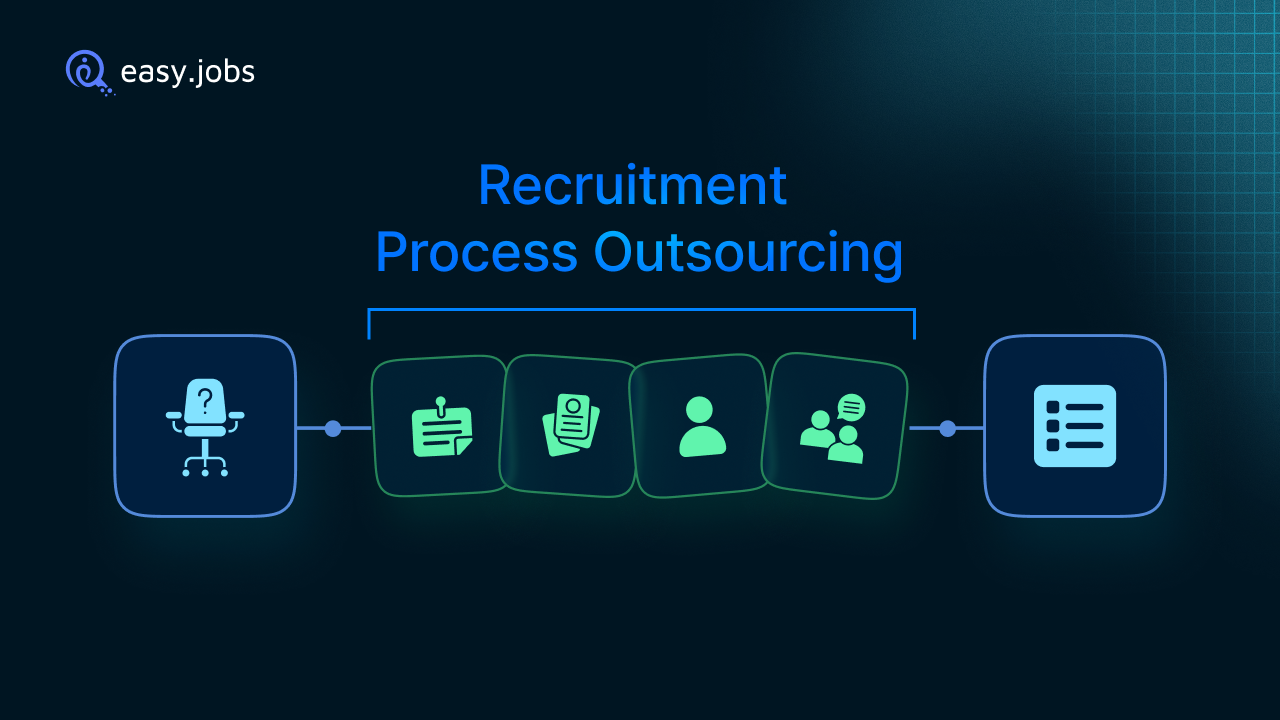
A strong RPO engagement is built on deep integration into your culture and business goals. The provider typically works through four phases:
- Discovery and alignment: the provider audits your existing hiring workflows, employer brand and pain points, then defines clear goals and service levels.
- Implementation: RPO recruiters are embedded into your ecosystem. Onsite or as a remote extension and connect to your applicant tracking system (ATS).
- Execution: the provider manages sourcing, screening, interview coordination and offer management under your brand.
- Optimization: continuous reporting and analytics refine the process, improve quality-of-hire and strengthen your employer brand over time.
RPO vs Staffing Agency vs In-House Recruitment
| Feature | In-House Hiring | Staffing Agency | RPO Provider |
|---|---|---|---|
| Primary focus | General HR tasks | Filling specific roles | End-to-end process |
| Branding | Direct | Agency-led | Client-led (white label) |
| Cost structure | Fixed (salaries) | High (per placement) | Scalable (management fees) |
| Scalability | Low | Medium | High |
| Best for | Steady, low-volume hiring | One-off, hard-to-fill roles | Sustained, scalable hiring |
Takeaway: RPO is built for sustained scalability rather than the one-off placements of traditional staffing. Which is why fast-growing and enterprise teams increasingly choose it.
Recruitment Process Outsourcing Services
Beyond simple talent acquisition, modern RPO providers offer a sophisticated ecosystem of services designed to transform how an organization identifies, attracts, and retains top-tier professionals.
Core Recruitment Process Outsourcing Services
Modern RPO providers offer far more than candidate sourcing. They deliver a sophisticated ecosystem of services. Usually, as a white-label extension of your brand. Designed to transform how you identify, attract and retain talent.
Core RPO Services
- Talent sourcing and screening: using AI-driven tools and deep-web search to identify both active and passive candidates.
- Employer branding: strengthening your reputation through targeted messaging, career-page optimization and social presence.
- Candidate experience management: ensuring every applicant has a professional, timely and positive interaction with your company.
- Interview coordination: managing scheduling, feedback loops and panel alignment so hiring managers stay focused.
- Offer management: handling negotiations, background checks and the transition from candidate to new hire.
- Recruitment analytics and reporting: real-time dashboards on time-to-fill, quality-of-hire and cost-per-hire.
End-to-End vs. Partial RPO Services
End-to-end (full-cycle) RPO hands the provider the entire process, from workforce planning to post-onboarding follow-up. It suits an enterprise launching a new division that needs a standardized, high-volume hiring engine from scratch.
Partial (modular) RPO outsources specific stages, sometimes called partial-cycle RPO. While you keep others in-house. It suits an established team that handles interviews and offers internally but lacks the time or technology for deep sourcing of technical roles. The modularity means an RPO partnership can be calibrated precisely to your needs.
Recruitment Process Outsourcing Models
Choosing the right RPO model is a strategic decision that balances your hiring volume against your organizational maturity and budget. There are four common RPO business models.
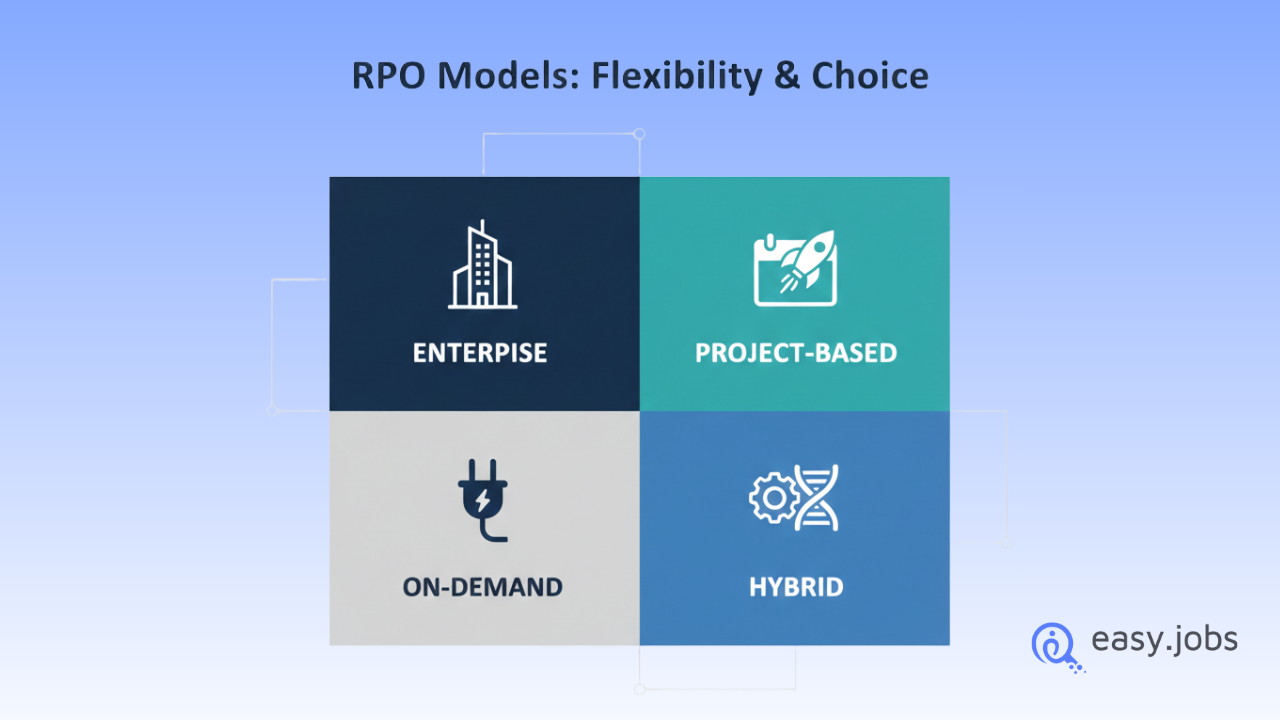
Common Recruitment Process Outsourcing Model Types
To maximize ROI, you must align the RPO model with your current business trajectory.
Enterprise RPO
This is a long-term, multi-year partnership where the provider manages the recruitment for the entire organization or a specific department.
When to use: Best for large organizations seeking a permanent, scalable recruitment infrastructure and total process optimization.
Project-Based RPO
A short-term engagement designed to achieve a specific hiring goal within a defined timeframe (e.g., 3–9 months).
When to use: Ideal for product launches, expanding into a new geographic market, or seasonal hiring surges.
On-Demand / Modular RPO
Also known as “Recruiter on Demand,” this model allows you to “plug in” expert recruiters to your existing team during unexpected spikes in volume.
When to use: Perfect for mid-sized companies that need immediate capacity without a long-term contractual commitment.
Hybrid RPO Model
A blended approach where your internal team handles high-level or executive roles, while the RPO provider manages high-volume or administrative hiring.
When to use: Use this when you want to retain internal control over “culture-critical” roles but need to offload the repetitive, high-volume tasks.
| RPO Model | Best For | Typical Engagement |
|---|---|---|
| Enterprise RPO | Large firms needing permanent hiring infrastructure | Multi-year, organization-wide |
| Project-Based RPO | Launches, expansions, seasonal surges | 3–9 months, defined scope |
| On-Demand / Modular | Mid-sized teams needing fast, flexible capacity | Short-term, per-recruiter |
| Hybrid RPO | Teams splitting executive and high-volume hiring | Ongoing, shared ownership |
By identifying which of these frameworks aligns with your current growth phase, you can ensure that your recruitment engine remains both agile and cost-effective.
Benefits of Recruitment Process Outsourcing
By offloading the administrative and operational burdens of talent acquisition, organizations can transform their recruitment function into a high-performance engine that fuels sustainable growth.
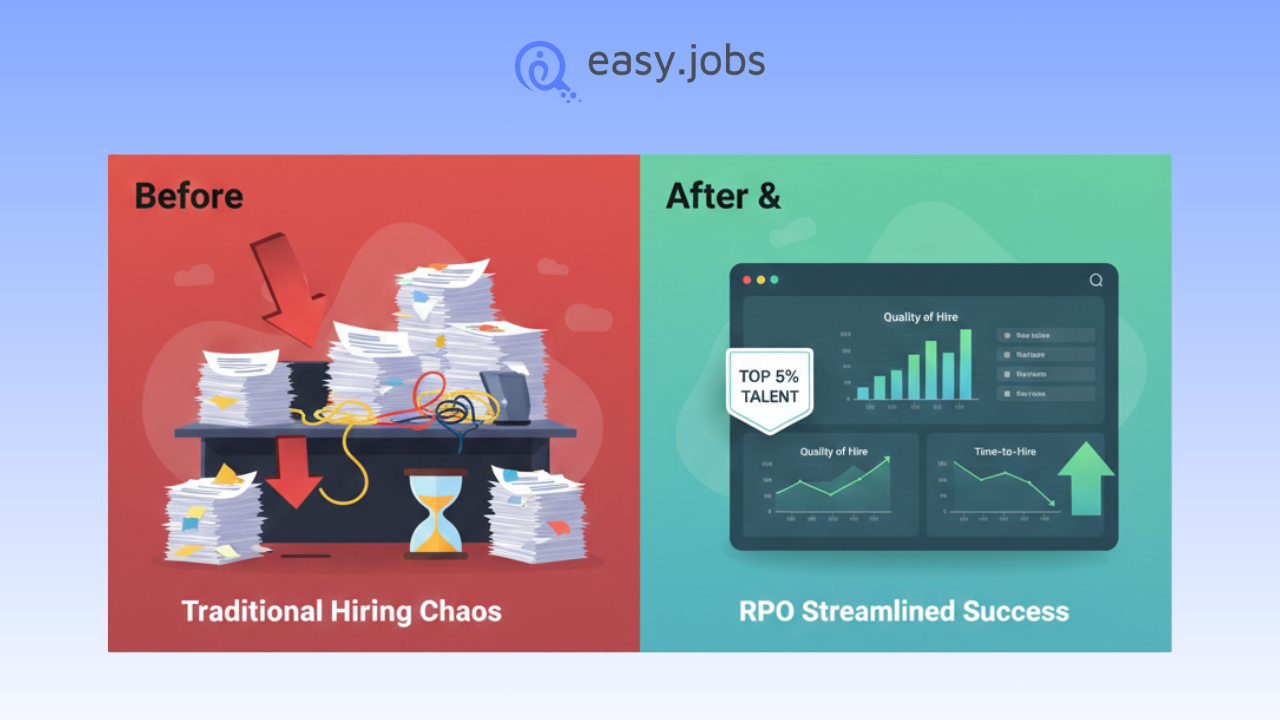
Key Benefits of Recruitment Process Outsourcing
The main benefits of recruitment process outsourcing include:
- Scalability: ramp hiring up during a surge and scale back in slow periods, protecting you from fixed overhead.
- Faster hiring cycles: dedicated sourcing experts and pre-built pipelines keep critical roles from sitting vacant. Organizations using RPO commonly report up to 40% faster hiring.
- Lower cost-per-hire: consolidating job-board spend and headhunter fees into a predictable budget typically cuts cost-per-hire by 25–40%.
- Access to expertise and technology: benefit from AI sourcing tools and assessment frameworks that would be too costly to license alone.
- Reduced HR workload: free your internal team to focus on retention, culture and strategy rather than administrative screening.
- Improved candidate quality: standardized, rigorous assessment ensures stronger shortlists reach the final stage.
- Consistent, compliant hiring: professional firms keep every hire aligned with local labor laws and your diversity and inclusion targets.
- Better data and insight: move from gut-feeling hiring to data-driven decisions with reporting on every stage of the funnel.
In short, RPO enables a skills-first hiring approach, building a resilient, future-ready workforce rather than simply filling seats.
Recruitment Process Outsourcing Pricing & Cost
RPO pricing is far more flexible than the fixed-percentage model used by staffing agencies. As a benchmark, RPO commonly costs $3,000–$10,000 per hire, or roughly $8,000–$15,000 per embedded recruiter per month, depending on volume and complexity. Most engagements use one of four pricing structures.
RPO Pricing Models
- Monthly management fee (retainer): a recurring fee to manage a function or department. Best for large enterprises with steady, predictable hiring.
- Cost-per-hire (CPH): a fixed fee paid only for each successful hire. Best for project hiring or seasonal needs, where you pay only for results.
- Management fee plus performance bonus: a base fee covers the infrastructure, with success fees triggered when KPIs (such as 30-day retention) are met.
- Hybrid/modular pricing: a reduced base fee for technology and strategy plus a smaller per-hire fee, balancing provider risk and client cost.
Building an RPO proposal? Ask each provider to map its pricing model to your projected hiring volume so you can compare like-for-like rather than on headline rates alone.
What Affects RPO Cost
On average, RPO can be 30–50% more cost-effective than maintaining a full internal team, but the final quote depends on several factors:
- Hiring volume: high-volume roles (retail, call centers) usually carry a lower cost-per-hire than executive or niche technical roles.
- Role complexity: sourcing a senior DevOps engineer in a competitive market takes more specialist effort than entry-level roles.
- Geographic scope: global engagements spanning multiple labor laws and languages carry higher administrative cost.
- Technology requirements: costs shift depending on whether you use your own ATS or the provider’s proprietary stack.
Disclaimer: RPO pricing is highly situational. A pilot for 10 hires has a very different cost structure from an enterprise transformation of 1,000+ annual hires.
RPO Market Size And Industry Trends
The RPO industry is expanding quickly. According to Grand View Research, the global recruitment process outsourcing market was valued at roughly $7.33 billion in 2022 and is projected to reach about $24.32 billion by 2030, growing at a compound annual growth rate (CAGR) of 16.1% from 2023 to 2030.
- Regional split: North America held the largest share at 41.2% in 2022, while Asia Pacific is forecast to grow fastest at an 18.8% CAGR.
- Enterprise demand leads: the enterprise segment accounted for 55.7% of revenue, reflecting how large organizations anchor RPO adoption.
- Efficiency gains: organizations implementing RPO routinely report a 25–40% reduction in cost-per-hire and meaningful improvements in time-to-fill.
- Scalability advantage: the RPO Association notes that while internal HR teams often need a month or more to scale recruitment capacity, RPO partners can scale up far more quickly to meet sudden demand.
Together, these figures point to a clear shift: RPO is becoming the default choice for organizations that prioritize data-driven decisions and operational flexibility.
Challenges Of Recruitment Process Outsourcing And How To Solve Them
RPO is not a set-and-forget solution. Most challenges are predictable and solvable with the right governance.
| Common Challenge | How To Overcome It |
|---|---|
| Loss of control over the hiring funnel | Demand real-time dashboard access so you never wait for a monthly report. |
| Employer-brand misalignment | Onboard the RPO team like employees, share your mission, values and internal lingo. |
| Data and system integration gaps | Use a shared, unified ATS to avoid data silos and ensure transparency. |
| Communication and feedback delays | Set clear SLAs (e.g. résumés reviewed within 48 hours) and weekly tactical huddles. |
Addressed through a collaborative governance framework, these risks shrink and the RPO partner becomes a seamless, high-performing extension of your culture.
Best Recruitment Process Outsourcing Companies For 2026
With the RPO market on track to exceed $24 billion by 2030, the challenge has shifted from finding a provider to choosing the one whose technology and geographic reach match your growth targets.
How To Evaluate RPO Companies
- Industry focus: Does the provider have a proven record in your sector (tech, healthcare, manufacturing)? Specialists understand your niche language and candidate expectations.
- Technology and ATS compatibility: can it work within your existing ecosystem, or does it offer an AI-driven platform that integrates with your HRIS?
- Geographic reach: for global hiring, your partner needs local expertise in labor law, compliance and culture.
- Compliance and data security: verify GDPR and CCPA compliance and robust handling of sensitive candidate data.
Top RPO Providers At A Glance
The market ranges from global giants to specialized boutiques. Here is a neutral look at some of the most recognized RPO companies:
| Provider | Best For | Key Strength |
|---|---|---|
| Cielo | Global enterprise | High-touch candidate experience and scale across 100+ countries |
| Korn Ferry | Leadership and strategy | Blends RPO with executive search and organizational consulting |
| PeopleScout | Tech-enabled RPO | Affinix platform uses AI to streamline sourcing |
| Orion Talent | Specialized talent | Leader in military/veteran recruitment and technical manufacturing |
| Randstad Sourceright | High-volume and DEI | Massive global reach with strong diversity focus |
| Sevenstep | Mid-market flexibility | Highly customizable, modular support |
Note: vendor capabilities change frequently. Treat this as a starting shortlist and validate current offerings, references and compliance directly with each provider.
When Should You Use Recruitment Process Outsourcing?
Consider moving beyond traditional hiring when you recognize these pain points:
- Rapid scaling: you need to double headcount in six months and your team is already at full capacity.
- High-volume or specialized hiring: you constantly hire for the same roles, or cannot find candidates for niche technical positions.
- Inconsistent candidate quality: you receive hundreds of résumés but your interview-to-offer ratio is low.
- Lack of data: you cannot answer basic questions about cost-per-hire or where your best candidates come from.
The bottom line: in-house teams remain the gold standard for cultural depth, and agencies are useful for emergency fills. But RPO is the most resilient model for companies that want to own the process and build a permanent, tech-enabled hiring engine without the fixed cost of a large internal department.
How To Prepare Before Choosing An RPO Provider
A successful engagement depends as much on your readiness as on the vendor. Before you sign:
- Define hiring goals and volume clearly: set specific targets (e.g. “50 engineers in Q3”), not “we need to hire more.”
- Choose the right model: don’t buy an enterprise solution when a project-based model fits the need.
- Demand transparency in reporting: insist on real-time dashboard access from day one.
- Align on employer branding: your partner is the face of your company, so agree on brand voice for every message.
- Start with a pilot: run a 90-day pilot on one department to test cultural fit before scaling.
The Future Of Recruitment Process Outsourcing
RPO is shifting from a service-based model to an intelligence-based one, anchored by the “Human-in-the-Loop” (HITL) approach, where AI amplifies recruiter judgment rather than replacing it. Key trends shaping 2026 and beyond:
- Agentic AI and automation: autonomous agents coordinate interview schedules and run initial conversational assessments, freeing recruiters for strategic work.
- Predictive hiring analytics: providers forecast attrition risk and future skill gaps before they hit the business.
- Global and remote workforce support: RPO partners act as talent hubs that navigate compliance, payroll and culture for borderless hiring.
- Skills-first hiring: capability mapping replaces résumé screening, reducing bias and improving long-term retention.
As these trends converge, RPO is maturing into a total-talent solution that manages permanent hires and the wider blended workforce alike.
Where An ATS Fits Into Your RPO Strategy
Whether you run recruitment in-house or through an RPO partner, the process is only as good as the technology behind it. A modern applicant tracking system gives both your team and your provider a single, transparent source of truth.
Exactly the shared-platform best practice that prevents the data silos and visibility gaps discussed earlier. easy.jobs is an AI-powered recruitment and ATS platform that lets you publish jobs, build a branded career page and manage your entire hiring pipeline with AI-assisted screening and interview scheduling built in.
For teams evaluating or running an RPO engagement, that kind of shared, real-time pipeline makes it easier to keep ownership and visibility of the process, even when sourcing is outsourced. It is a practical foundation, whether you are scaling an internal team or collaborating with an external partner.
Frequently Asked Questions About RPO
To assist HR leaders in making rapid, informed decisions, we have compiled the most critical inquiries regarding the implementation and impact of RPO in the talent market.
What is Recruitment Process Outsourcing in Simple Terms?
Recruitment Process Outsourcing (RPO) is a partnership where a business hires an external firm to handle all or part of its hiring activities. Essentially, the RPO provider acts as an “internal” recruitment team, managing everything from finding candidates to onboarding them, often using the company’s own brand.
What Services are Included in Recruitment Process Outsourcing?
Standard RPO services include talent sourcing, candidate screening, employer branding, interview scheduling and offer management. Advanced providers also offer recruitment analytics, technology integration, and strategic workforce planning to help companies optimize their long-term hiring efficiency and talent quality.
How Much Does Recruitment Process Outsourcing Cost?
RPO pricing varies based on volume and complexity. Common models include a monthly management fee, a cost-per-hire fee, or a performance-based hybrid model. On average, RPO can reduce recruitment costs by 30–50% compared to traditional staffing agencies or maintaining a large internal team.
What Are the Main Benefits of Recruitment Process Outsourcing?
The primary benefits include increased scalability, faster time-to-hire, and improved candidate quality. RPO also provides companies with access to advanced recruitment technology and data-driven insights that help reduce the cost-per-hire and ensure a more consistent, professional candidate experience.
What Are the Challenges of Recruitment Process Outsourcing?
Common challenges include potential loss of control over the hiring process and the need for tight brand alignment between the company and the provider. Effective communication and clear Service Level Agreements (SLAs) are essential to ensure the RPO team accurately represents the company culture.
Is Recruitment Process Outsourcing Suitable for Small Businesses?
Yes, RPO is highly effective for small and mid-sized businesses (SMBs) through “Project-Based” or “On-Demand” models. It allows smaller companies to access enterprise-level recruitment expertise and technology without the overhead of a full-time, in-house HR department.
How is RPO Different from A Recruitment Agency?
A recruitment agency is transactional, focusing on filling a specific role for a one-time fee. In contrast, an RPO provider is a strategic partner that manages the entire process, operates under your brand, and focuses on long-term goals like reducing turnover and improving hiring efficiency.
Turn Recruitment Into A Competitive Advantage
Recruitment Process Outsourcing has evolved into a vital strategic lever for modern business. By combining expert human insight with AI and data analytics, RPO lets organizations scale talent acquisition with a speed and precision that was previously out of reach.
Whether you are an enterprise looking for a total hiring transformation or a growing business needing surge support for a specific project, the right RPO partner can turn your recruitment process from a cost center into a competitive advantage.
If you found this guide to recruitment process outsourcing valuable, subscribe to our blog for the latest insights on AI-driven hiring and talent strategy. Join our Facebook Community to exchange ideas with fellow HR leaders and stay updated on the evolving world of recruitment technology.