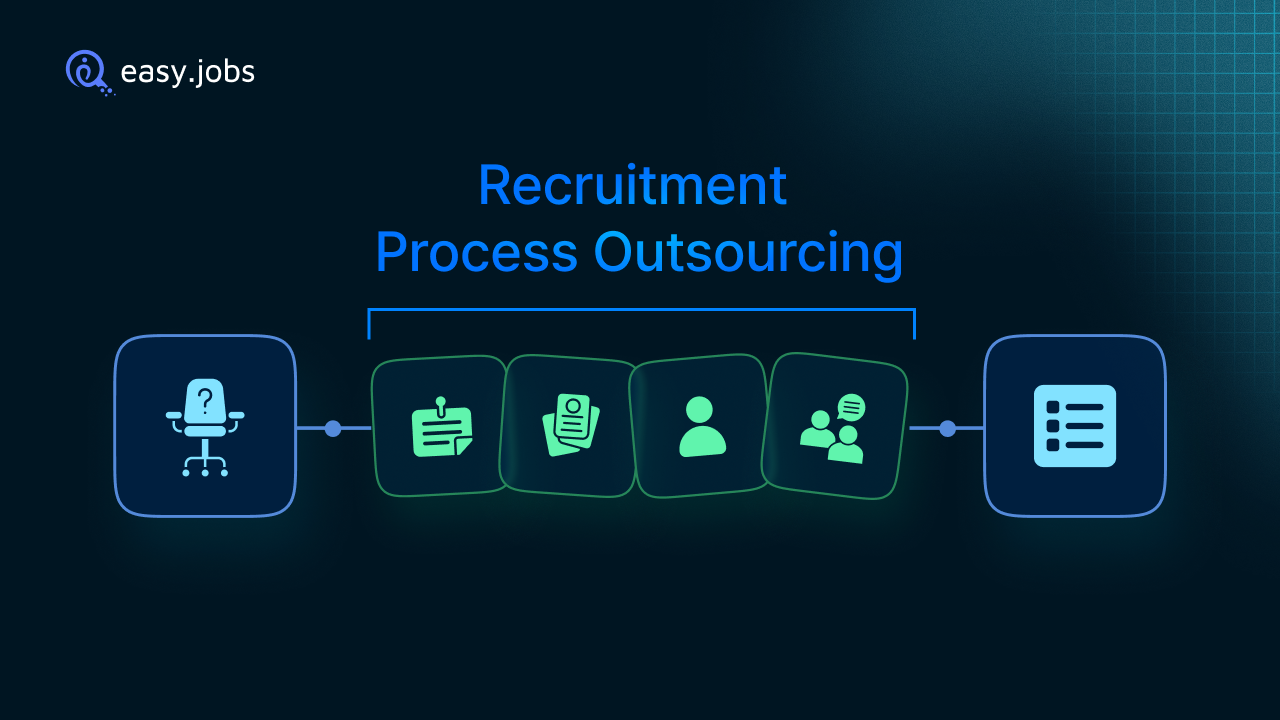
Recruitment Process Outsourcing (RPO) is a strategic business process where an employer transfers all or part of its recruitment functions to an external service provider. By integrating with a company’s internal HR team and technology, an RPO provider manages the end-to-end hiring lifecycle from sourcing and screening to onboarding.
This model is designed to improve hiring quality, reduce time-to-fill and provide the scalability necessary for modern business growth.
Recruitment Process Outsourcing (RPO) — TL;DR
- What it is: A form of business process outsourcing (BPO) where a provider acts as an extension of your HR department.
- Who it is for: Companies scaling rapidly, enterprise firms with high-volume needs, or SMBs lacking internal recruitment infrastructure.
- Key Benefits: Enhanced candidate quality, reduced cost-per-hire, and access to advanced recruitment technology.
- Pricing Models: Common structures include monthly management fees, cost-per-hire, or hybrid models.
- When to Use: When internal teams are overwhelmed, hiring quality is declining, or global expansion is required.
What Is Recruitment Process Outsourcing?
To navigate the complexities of modern talent acquisition, it is essential to first establish a clear understanding of how RPO fundamentally reshapes the hiring landscape. If you want a clear view on what is recruitment process outsourcing read on to the following:
Definition of Recruitment Process Outsourcing
Recruitment Process Outsourcing (RPO) is a workforce solution where an organization transfers the ownership of all or part of its recruitment process to a third-party vendor. Unlike traditional staffing, the RPO provider assumes responsibility for the strategy, technology, and results of the entire hiring function.
How Recruitment Process Outsourcing Works
The RPO process begins with a deep integration into the client’s culture and business goals. The provider does not just “send resumes“; they manage the process using the company’s brand and often their own Applicant Tracking System (ATS).
- Discovery & Alignment: The provider analyzes existing hiring workflows and identifies gaps.
- Implementation: Recruiters from the RPO firm are embedded into the client’s ecosystem, often working onsite or as a seamless remote extension.
- Execution: The provider manages sourcing, screening, interviewing, and offer management.
- Optimization: Continuous data reporting and analytics are used to refine the process and improve employer branding.
Recruitment Process Outsourcing vs. Traditional Hiring
While traditional hiring relies on internal HR staff or high-commission staffing agencies, RPO focuses on long-term process improvement.
| Feature | Internal Hiring | Staffing Agency | RPO Provider |
| Focus | General HR tasks | Filling specific roles | End-to-end process |
| Branding | Direct | Agency-led | Client-led (White label) |
| Cost | Fixed (Salaries) | High (Per placement) | Scalable (Management fees) |
| Scalability | Low | Medium | High |
By contrasting these models, it becomes evident that RPO is built for sustained scalability rather than the transactional, one-off placements seen in traditional staffing.
Recruitment Process Outsourcing Services
Beyond simple talent acquisition, modern RPO providers offer a sophisticated ecosystem of services designed to transform how an organization identifies, attracts, and retains top-tier professionals.
Core Recruitment Process Outsourcing Services
RPO providers offer a suite of services designed to modernize and streamline the talent acquisition lifecycle. These services are typically delivered as a “white-label” extension of your brand:
- Talent Sourcing and Screening: Using AI-driven tools and deep-web searching to identify both active and passive candidates.
- Employer Branding: Enhancing your market reputation through targeted messaging, career page optimization, and social media presence.
- Candidate Experience Management: Ensuring every applicant—whether hired or not—has a professional, timely, and positive interaction with your company.
- Interview Coordination: Managing the logistical burden of scheduling, feedback loops, and panel alignments.
- Offer Management: Handling negotiations, background checks, and the administrative transition from “candidate” to “new hire.“
- Recruitment Analytics and Reporting: Providing real-time dashboards on key metrics like time-to-fill, quality-of-hire and cost-per-hire.
End-to-End vs. Partial RPO Services
Organizations must choose between a complete overhaul or targeted support depending on their internal bandwidth and specific hiring hurdles:
End-to-End (Full-Cycle):
The provider manages the entire process from workforce planning to post-onboard follow-ups.
Use Case: An enterprise company launching a new global division that requires a standardized, high-volume hiring engine from scratch.
Partial (Modular) Services:
You outsource specific “modules” of the process while keeping others in-house.
Use Case: An established HR team that handles interviews and offers internally but lacks the technology or time to perform deep-funnel sourcing for technical roles.
Whether you require a total departmental transformation or surgical support for a niche hiring spike, the modularity of these services ensures that the RPO partnership can be precisely calibrated to your organizational goals.
Recruitment Process Outsourcing Models
Selecting the right RPO model is a strategic decision that must balance your immediate hiring volume with your long-term organizational maturity and budgetary constraints.
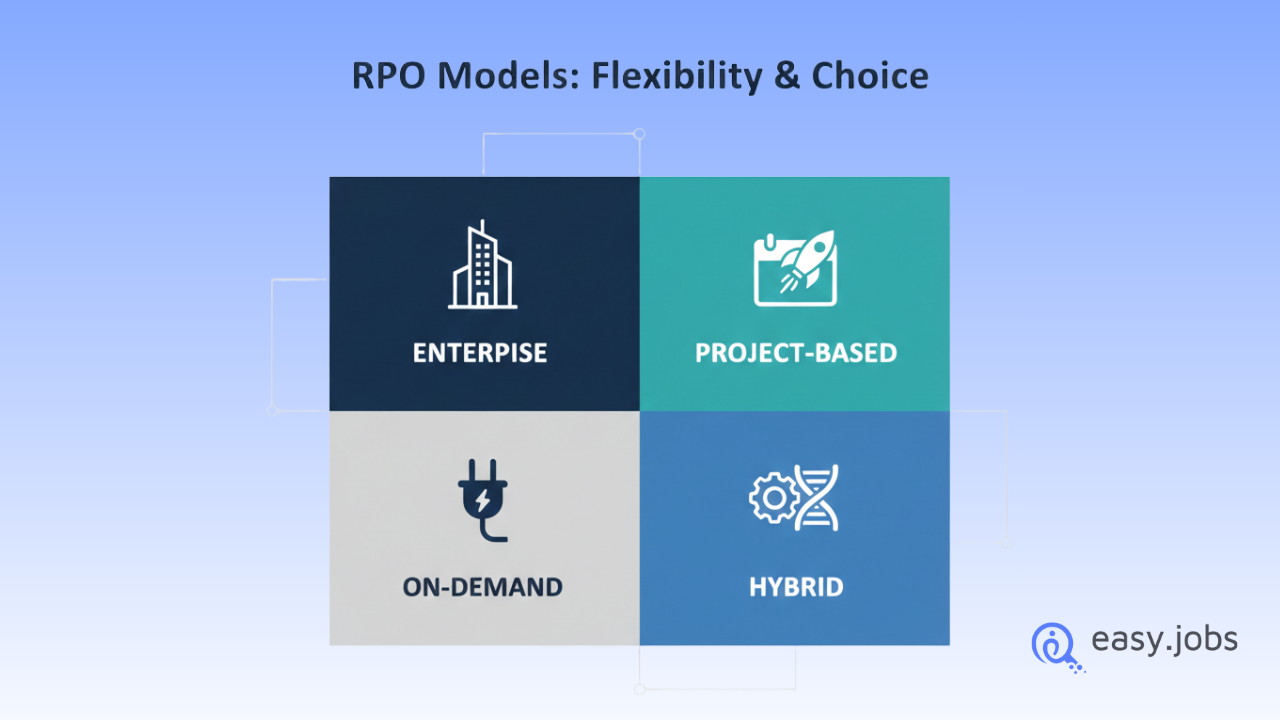
Common Recruitment Process Outsourcing Model Types
To maximize ROI, you must align the RPO model with your current business trajectory.
Enterprise RPO
This is a long-term, multi-year partnership where the provider manages the recruitment for the entire organization or a specific department.
When to use: Best for large organizations seeking a permanent, scalable recruitment infrastructure and total process optimization.
Project-Based RPO
A short-term engagement designed to achieve a specific hiring goal within a defined timeframe (e.g., 3–9 months).
When to use: Ideal for product launches, expanding into a new geographic market, or seasonal hiring surges.
On-Demand / Modular RPO
Also known as “Recruiter on Demand,” this model allows you to “plug in” expert recruiters to your existing team during unexpected spikes in volume.
When to use: Perfect for mid-sized companies that need immediate capacity without a long-term contractual commitment.
Hybrid RPO Model
A blended approach where your internal team handles high-level or executive roles, while the RPO provider manages high-volume or administrative hiring.
When to use: Use this when you want to retain internal control over “culture-critical” roles but need to offload the repetitive, high-volume tasks.
By identifying which of these frameworks aligns with your current growth phase, you can ensure that your recruitment engine remains both agile and cost-effective.
Industry Perspective on Recruitment Process Outsourcing
Understanding the macro-trends and market data behind RPO adoption allows business leaders to move beyond tactical hiring and view talent acquisition as a core driver of competitive advantage.
What Industry Experts Say About RPO
Industry leaders increasingly categorize RPO not as a simple outsourcing contract, but as a strategic workforce engine.
“RPO is increasingly viewed as a strategic workforce solution rather than a cost-saving tactic. It allows HR leaders to shift from reactive hiring to proactive talent planning, ensuring the business is ready for future growth cycles.”
Expert consensus suggests that the modern RPO partner acts as a “talent consultant,” providing the data and employer branding strategy that internal teams often lack the bandwidth to develop.
Recruitment Process Outsourcing Market Stats & Trends
To understand the scale of RPO adoption, consider these recent industry benchmarks:
- Rapid Market Growth: The global RPO market is projected to reach approximately $22.9 billion to $26.4 billion by 2030, growing at a CAGR of roughly 14–16% as companies seek more agile hiring models.
- Efficiency Gains: Organizations implementing RPO solutions routinely see a 30% to 50% reduction in cost-per-hire and a 25% to 40% improvement in time-to-fill metrics.
- Scalability: A recent RPOA study found that while 80% of internal HR teams would take over a month to scale their recruitment capacity, RPO partners can scale up almost instantly to meet sudden demand.
- Remote Work Influence: It is projected that there will be 32.6 million remote workers by 2025, driving companies to use RPO providers for their expertise in sourcing and onboarding borderless talent.
These statistics highlight a fundamental shift: RPO is becoming the default choice for organizations that prioritize data-driven decision-making and operational flexibility in a volatile global economy.
Benefits of Recruitment Process Outsourcing
By offloading the administrative and operational burdens of talent acquisition, organizations can transform their recruitment function into a high-performance engine that fuels sustainable growth.
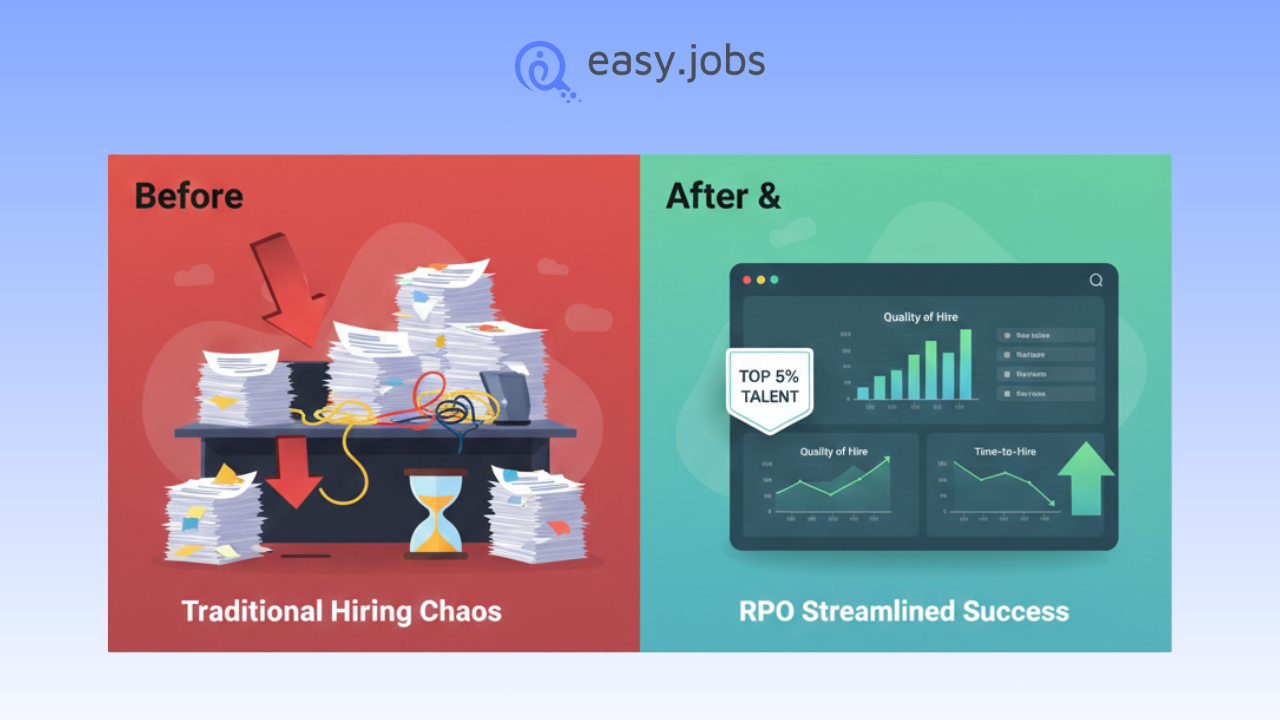
Key Benefits of Recruitment Process Outsourcing
- Scalability: The ability to ramp up during a hiring surge and scale back during slow periods protects your bottom line from fixed overhead.
- Faster Hiring Cycles: Dedicated sourcing experts and pre-built talent pipelines ensure that critical roles do not sit vacant, costing the company productivity.
- Lower Cost Per Hire: By eliminating expensive job board overkill and high-fee headhunters, RPO consolidates spend into a predictable, manageable budget.
- Access to Recruitment Expertise: Benefit from the latest AI sourcing tools and psychological assessment frameworks that would be too costly for an individual company to license.
Benefits of Outsourcing Recruitment and Selection Process
- Reduced HR Workload: Frees your internal HR team to focus on employee retention, culture, and high-level strategy rather than administrative screening.
- Recruitment SEO: External teams often bring proper visibility of your circulars which might be missing in your existing team or may need a new hire for that.
- Improved Candidate Quality: Rigorous, standardized assessment protocols ensure only the top 5% of talent reach the final interview stage.
- Consistent and Compliant Hiring: Professional RPO firms ensure every hire meets local labor laws and internal D&I (Diversity & Inclusion) targets.
- Better Data and Insights: Move from “gut feeling” hiring to data-driven decisions with detailed reporting on every stage of your recruitment funnel.
Collectively, these advantages enable a “skills-first” hiring approach, ensuring that your organization is not just filling seats but building a resilient, future-ready workforce.
Recruitment Process Outsourcing Pricing & Cost
Developing a sustainable talent strategy requires a shift from viewing recruitment as an overhead expense to managing it as a scalable, performance-driven investment.
Recruitment Process Outsourcing Pricing Models
RPO pricing is far more flexible than the fixed-percentage models used by staffing agencies. Depending on your hiring volume and goals, you will likely encounter one of these four structures:
Monthly Management Fee (Retainer): A consistent, recurring fee paid for the RPO provider to manage a specific function or department.
Best for: Large enterprises with steady, predictable hiring needs.
Cost Per Hire (CPH): A fixed fee paid only for each successful hire.
Best for: Project-based hiring or businesses with fluctuating seasonal needs where you only want to pay for results.
Management Fee + Performance Bonus: A base monthly fee covers the infrastructure, with “success fees” triggered when specific hiring targets or KPIs (like 30-day retention) are met.
Hybrid / Modular Pricing: You pay a reduced base fee for the technology and strategy, plus a smaller per-hire fee. This balances the provider’s risk and the client’s cost.
Recruitment Process Outsourcing Cost Factors
Several variables dictate where your final quote will land. On average, RPO can be 30–50% more cost-effective than maintaining a full internal team, but costs vary based on:
Hiring Volume: High-volume roles (e.g., retail or call centers) typically have a lower cost-per-hire than executive or niche technical roles.
Role Complexity: Sourcing a Senior DevOps Engineer in a competitive market requires more specialized labor than entry-level administrative roles.
Geographic Scope: Global RPO engagements involving multiple labor laws and languages carry higher administrative costs.
Technology Requirements: Costs will shift depending on whether you use your own ATS (like easy.jobs) or leverage the provider’s proprietary tech stack.
Disclaimer: RPO pricing is highly subjective. A pilot project for 10 hires will have a significantly different cost structure than an enterprise-wide transformation for 1,000+ annual hires.
By aligning these pricing models with your specific hiring velocity, you can achieve a level of financial predictability that traditional agency or in-house models rarely provide.
Challenges of Recruitment Process Outsourcing
While RPO provides a powerful engine for growth, its success depends on a proactive approach to integration, transparency, and cultural alignment between the provider and the parent organization.
Common Challenges of Recruitment Process Outsourcing
While RPO offers massive benefits, it is not a “set it and forget it” solution. Organizations often face these initial hurdles:
- Loss of Control: HR leaders may fear losing the “final say” or visibility into the daily recruitment funnel.
- Employer Brand Alignment: If the RPO team does not perfectly mirror your company culture, the candidate experience may feel “generic” or disconnected.
- Data and System Integration: Aligning an external provider’s tools with your internal HRIS or ATS can lead to data silos if not planned correctly.
- Communication Gaps: Misalignment between hiring managers and outsourced recruiters can lead to slow feedback loops and missed talent.
How Companies Can Overcome RPO Challenges
Successful partnerships mitigate these risks through structured Governance Models:
- Define SLAs and KPIs: Establish clear Service Level Agreements (e.g., “All resumes reviewed within 48 hours”) and Key Performance Indicators (e.g., “90% hiring manager satisfaction”).
- Regular Reporting Cadence: Move beyond monthly reports. Implement weekly tactical “huddles” to address immediate bottlenecks and monthly strategic reviews.
- Strong Onboarding: Treat your RPO team like new employees. Give them deep-dive sessions into your mission, values, and even “internal lingo” so they can represent your brand authentically.
- Shared Technology: Use a unified platform for tracking candidates to ensure total transparency.
By addressing these challenges through a collaborative governance framework, organizations can ensure that their RPO partner acts as a seamless and high-performing extension of their own internal culture.
Top Recruitment Process Outsourcing Companies
As the RPO market is projected to exceed $26 billion by 2030, the challenge for HR leaders has shifted from finding a provider to identifying the specific partner whose technological stack and geographic reach align with their upcoming year growth targets.
How to Evaluate Top Recruitment Process Outsourcing Companies
Choosing an RPO partner is a high-stakes decision. To ensure long-term success, evaluate potential providers against these four pillars:
- Industry Focus: Does the provider have a proven track record in your specific sector (e.g., Tech, Healthcare, Manufacturing)? Specialized recruiters understand the “niche” language and candidate expectations of your field.
- Technology & ATS Compatibility: Ensure the provider can work within your existing ecosystem (like easy.jobs or Greenhouse) or offers a proprietary AI-driven platform that integrates seamlessly with your HRIS.
- Geographic Reach: If you are hiring globally, your partner must have “boots on the ground” expertise in local labor laws, compliance, and cultural nuances in those specific regions.
- Compliance and Data Security: In this year, data privacy is paramount. Verify that the provider is GDPR/CCPA compliant and has robust protocols for handling sensitive candidate information.
Examples of Leading RPO Providers
The RPO market is diverse, ranging from global giants to specialized boutiques. Here is a neutral look at some of the industry’s most recognized names:
| Provider | Best For… | Key Feature |
| Cielo | Global Enterprise | High-touch candidate experience and global scale across 100+ countries. |
| Korn Ferry | Leadership & Strategy | Blends RPO with executive search and organizational consulting. |
| PeopleScout | Tech-Enabled RPO | Known for their Affinix platform, which uses AI to streamline sourcing. |
| Orion Talent | Specialized Talent | A leader in military/veteran recruitment and technical manufacturing roles. |
| Randstad Sourceright | High-Volume & DEI | Massive global reach with a strong focus on diversity and inclusion metrics. |
| Sevenstep | Mid-Market Flexibility | Highly customizable models for companies that need “modular” support. |
Whether you prioritize the massive reach of a global firm or the agile, tech-forward approach of a mid-market specialist, your choice of partner will ultimately dictate the speed and quality of your talent pipeline.
When Should a Company Use Recruitment Process Outsourcing?
Determining the right moment to transition to an RPO model requires an honest audit of your current hiring velocity and whether your internal infrastructure can keep pace with your latest business objectives.
Signs RPO Is the Right Choice
You should consider moving beyond traditional hiring when you recognize these “pain points” in your organization:
- Rapid Scaling: Your business needs to double its headcount in 6 months, and your internal team is already at 100% capacity.
- High-Volume or Specialized Hiring: You are constantly hiring for the same roles or, conversely, can not find a single candidate for highly niche technical positions.
- Inconsistent Candidate Quality: You are receiving hundreds of resumes, but your “interview-to-offer” ratio is alarmingly low.
- Lack of Data: You cannot answer basic questions about your cost-per-hire or where your best candidates are coming from.
RPO vs. Staffing Agencies vs. In-House Recruitment
The best choice often depends on your long-term goals.
- In-House: Best for culture-building and steady, low-volume hiring.
- Staffing Agencies: Best for one-off, “hard-to-fill” executive roles or temporary labor.
- RPO: Best for companies that want to own the process, reduce long-term costs, and build a permanent talent engine.
While in-house teams remain the gold standard for cultural depth and agencies are useful for “emergency” fills, RPO has emerged as the most resilient model for companies that want to build a permanent, tech-enabled hiring engine without the fixed costs of a massive internal department.
Practical Recommendations Before Choosing an RPO Provider
A successful RPO engagement is not just about choosing the right vendor; it is about preparing your internal organization to collaborate effectively with an external talent partner.
Key Recommendations for HR And Business Leaders
To ensure your RPO implementation does not fail, follow these strategic steps:
- Define Hiring Goals and Volume Clearly: Don’t just say “we need to hire more.” Set specific targets (e.g., “50 engineers in Q3”).
- Choose the Right RPO Model: Don’t buy an Enterprise solution if a Project-Based model is all you need for a specific expansion.
- Demand Transparency in Reporting: Ensure you have real-time access to the recruitment dashboard. You should never have to wait until a monthly meeting to see your progress.
- Align on Employer Branding: Your RPO partner is the “face” of your company. Ensure they use your brand voice in every email and LinkedIn message.
- Start with a Pilot: If you are hesitant, run a 90-day pilot on a specific department or project to test the partnership’s “cultural fit.”
By following these foundational steps, leadership teams can mitigate the risks of outsourcing and build a recruitment engine that is as culturally aligned as it is operationally efficient.
Future Outlook of Recruitment Process Outsourcing
The next era of RPO will be defined by the seamless integration of autonomous technology and human strategy, where the “Human-in-the-Loop” (HITL) model ensures that AI amplifies, rather than replaces, the critical element of human judgment.

Emerging Trends in RPO
As we move through upcoming year, RPO is shifting from a service-based model to an intelligence-based model. The “Human-in-the-Loop” (HITL) approach is now the industry standard, where recruiters use AI to amplify their strategic impact rather than replace their judgment.
- Agentic AI and Automation: RPO providers are deploying autonomous AI agents that do not just screen resumes but manage complex workflows—such as coordinating multi-panel interview schedules and conducting initial conversational assessments—without human intervention.
- Predictive Hiring Analytics: By leveraging historical data and market intelligence, RPO partners can now forecast attrition risks and future skill gaps before they impact the business, moving recruitment from a reactive to a proactive function.
- Global and Remote Workforce Support: With remote work becoming a permanent fixture, RPO providers are acting as global “Talent Hubs,” helping companies navigate the compliance, payroll, and cultural complexities of borderless hiring.
- Skills-First Hiring: Moving away from traditional resumes, the future of RPO focuses on capability mapping. AI tools assess candidates based on their verified skills and potential to learn, which significantly reduces bias and improves long-term retention.
As these trends converge, RPO is maturing into a “Total Talent” solution that manages not just permanent hires, but the entire blended workforce of humans and AI agents alike.
Frequently Asked Questions About Recruitment Process Outsourcing
To assist HR leaders in making rapid, informed decisions, we have compiled the most critical inquiries regarding the implementation and impact of RPO in the talent market.
What is Recruitment Process Outsourcing in Simple Terms?
Recruitment Process Outsourcing (RPO) is a partnership where a business hires an external firm to handle all or part of its hiring activities. Essentially, the RPO provider acts as an “internal” recruitment team, managing everything from finding candidates to onboarding them, often using the company’s own brand.
What Services are Included in Recruitment Process Outsourcing?
Standard RPO services include talent sourcing, candidate screening, employer branding, interview scheduling and offer management. Advanced providers also offer recruitment analytics, technology integration, and strategic workforce planning to help companies optimize their long-term hiring efficiency and talent quality.
How Much Does Recruitment Process Outsourcing Cost?
RPO pricing varies based on volume and complexity. Common models include a monthly management fee, a cost-per-hire fee, or a performance-based hybrid model. On average, RPO can reduce recruitment costs by 30–50% compared to traditional staffing agencies or maintaining a large internal team.
What Are the Main Benefits of Recruitment Process Outsourcing?
The primary benefits include increased scalability, faster time-to-hire, and improved candidate quality. RPO also provides companies with access to advanced recruitment technology and data-driven insights that help reduce the cost-per-hire and ensure a more consistent, professional candidate experience.
What Are the Challenges of Recruitment Process Outsourcing?
Common challenges include potential loss of control over the hiring process and the need for tight brand alignment between the company and the provider. Effective communication and clear Service Level Agreements (SLAs) are essential to ensure the RPO team accurately represents the company culture.
Is Recruitment Process Outsourcing Suitable for Small Businesses?
Yes, RPO is highly effective for small and mid-sized businesses (SMBs) through “Project-Based” or “On-Demand” models. It allows smaller companies to access enterprise-level recruitment expertise and technology without the overhead of a full-time, in-house HR department.
How is RPO Different from A Recruitment Agency?
A recruitment agency is transactional, focusing on filling a specific role for a one-time fee. In contrast, an RPO provider is a strategic partner that manages the entire process, operates under your brand, and focuses on long-term goals like reducing turnover and improving hiring efficiency.
Scale Your Workforce with Data-Driven Hiring Precision
Recruitment Process Outsourcing has evolved into a vital strategic lever for modern businesses. By combining expert human insight with cutting-edge AI and data analytics, RPO allows organizations to scale their talent acquisition with a level of speed and precision that was previously impossible.
Whether you are an enterprise looking for a total hiring transformation or a growing business needing surge support for a specific project, the right RPO partner can turn your recruitment process from a cost center into a competitive advantage.
If you found this guide to recruitment process outsourcing valuable, subscribe to our blog for the latest insights on AI-driven hiring and talent strategy. Join our Facebook Community to exchange ideas with fellow HR leaders and stay updated on the evolving world of recruitment technology.