The best candidates are not scrolling job boards. They are already killing it elsewhere. If your “Strategy” is just posting and praying, you are losing the war for talent before it even starts.
Stop playing catch-up and start hunting. We have decoded the candidate sourcing framework from high-conversion outreach strategies to the tech stack used by elite talent acquisition teams. Dive in to learn how to build a self-sustaining pipeline that delivers top-tier hires while your competitors are still stuck on LinkedIn filters.
TL;DR: The Candidate Sourcing Essentials
In a hurry? Here is the high-level breakdown of how to master candidate sourcing and build a high-conversion candidate pipeline:
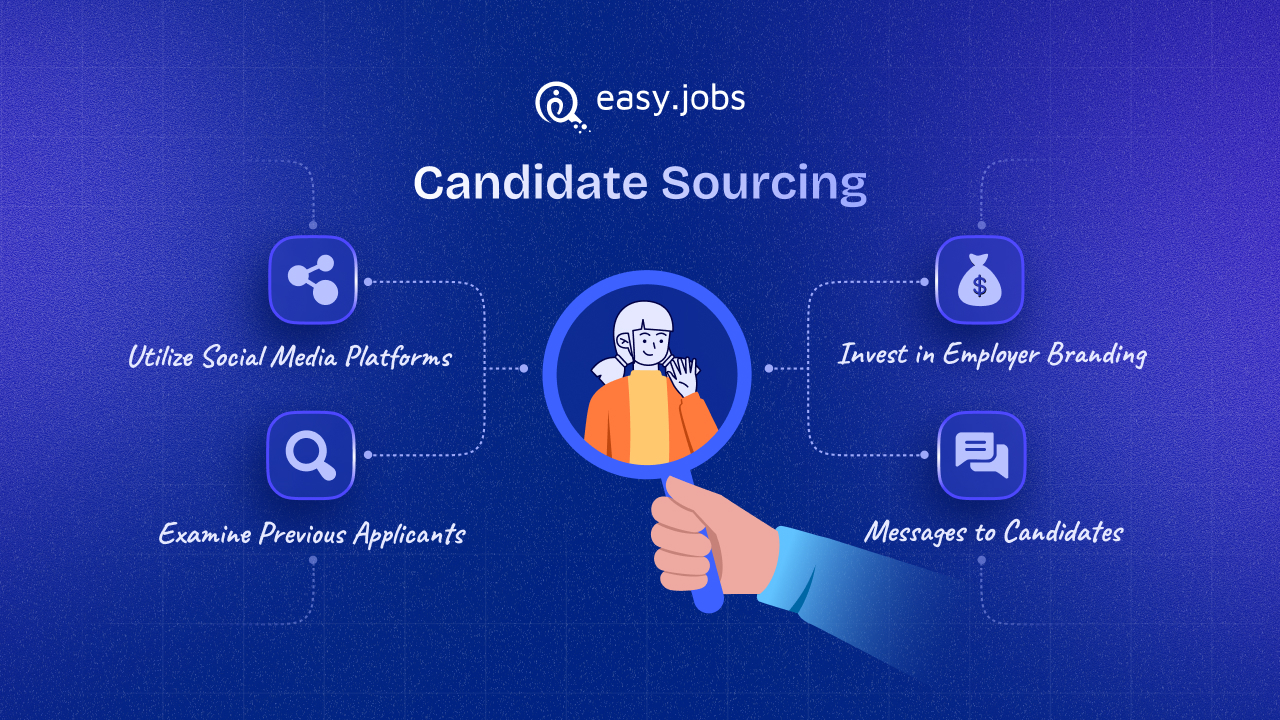
- Candidate sourcing is the proactive, outbound process of finding and engaging passive candidates before they even apply for a job.
- Sourcing vs. Recruiting: Sourcing is top-of-funnel (finding and engaging); recruiting is mid-to-bottom funnel (evaluating and hiring).
- Top 3 Candidate Sourcing Strategies:
- Boolean Search: Use advanced operators on LinkedIn and Google (X-Ray search) to find hidden talent.
- Platform Sourcing: Look beyond resumes on GitHub (devs), Dribbble (designers), and niche communities.
- Employee Referrals: Leverage your team’s network for the highest-quality, fastest-to-hire leads.
- Must-Have Sourcing Tools: Use an ATS like easy.jobs for pipeline management, and AI-powered tools like Apollo.io for automated discovery.
- The Future: AI and predictive analytics are making sourcing faster and more personalized, shifting the focus from manual searching to human relationship building.
Key Takeaway: Stop “posting and praying.” The best talent is not looking for you. You have to find them. By building a consistent talent sourcing habit, you reduce hiring costs and eliminate the panic of unexpected vacancies.
What Is Candidate Sourcing?
Candidate sourcing is the proactive process of identifying, researching and engaging individuals who may be a strong fit for current or future job openings, often before they have expressed interest in your company.
Unlike traditional recruiting, which primarily responds to applications, candidate sourcing is outbound. Sourcers seek out talent rather than waiting for talent to come to them.
The people found through sourcing are often referred to as passive candidates, professionals who are currently employed and not actively job hunting, but may be open to the right opportunity. Research consistently shows that passive candidates make up the majority of the workforce, making proactive sourcing a critical advantage.
What Does a Candidate Sourcer Do?
A candidate sourcer (or talent sourcer) typically:
- Searches professional networks, databases and communities to identify potential candidates
- Reviews resumes, portfolios, GitHub profiles, LinkedIn accounts and other public professional footprints
- Crafts personalized outreach messages to spark interest
- Pre-qualifies candidates based on skills, experience and culture fit indicators
- Builds and maintains a pipeline of talent for current and future roles
- Collaborates closely with recruiters and hiring managers to understand role requirements
In smaller organizations, the sourcer and recruiter may be the same person. In larger talent acquisition teams, there are often distinct roles. Each specialized in their part of the hiring funnel of their organized process.
Candidate Sourcing vs. Recruiting: What Is the Difference?
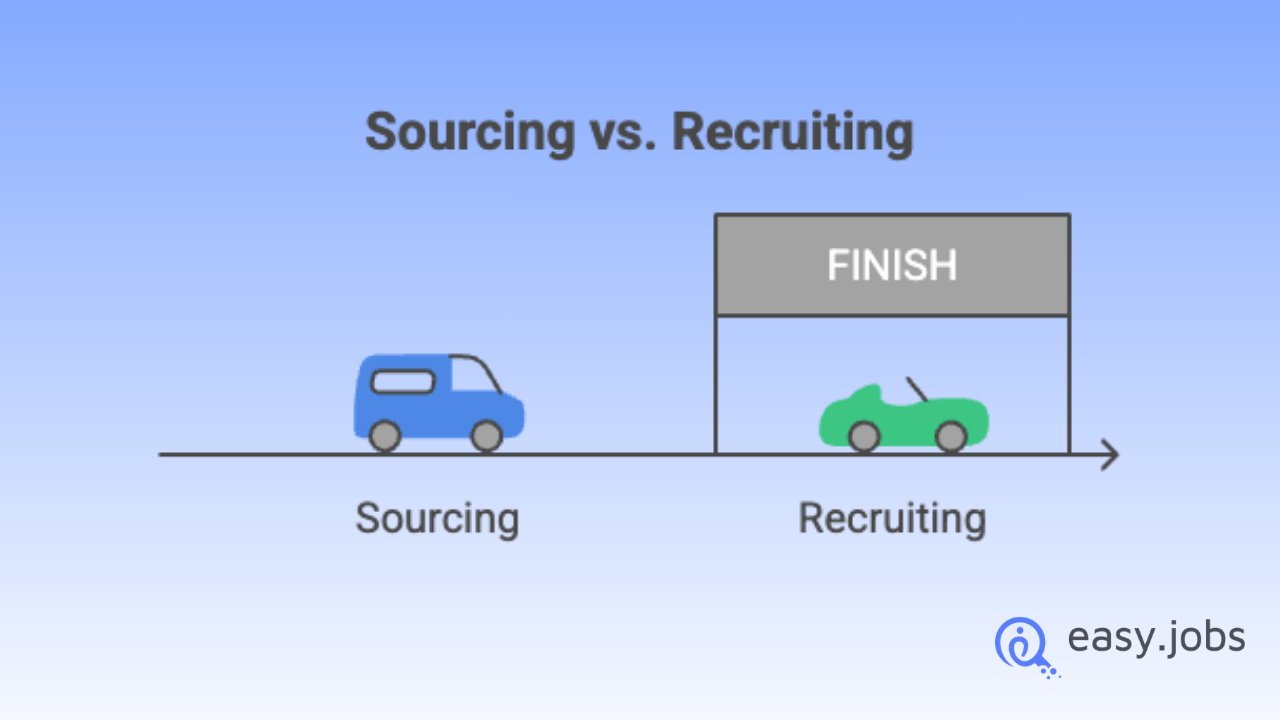
These two terms are often used interchangeably, but they describe different parts of the hiring process.
| Candidate Sourcing | Recruiting | |
| Nature | Proactive/outbound | Reactive/inbound |
| Focus | Finding & engaging candidates | Evaluating & hiring candidates |
| Candidates | Often passive | Often active job seekers |
| Stage | Top of funnel | Mid to bottom of funnel |
| Goal | Build a qualified pipeline | Convert pipeline into hires |
Think of sourcing as the scouting phase and recruiting as the selection phase. Strong sourcing feeds strong recruiting. Without a well-sourced pipeline, even the best recruiters are working with limited material.
Why Candidate Sourcing Matters More Than Ever
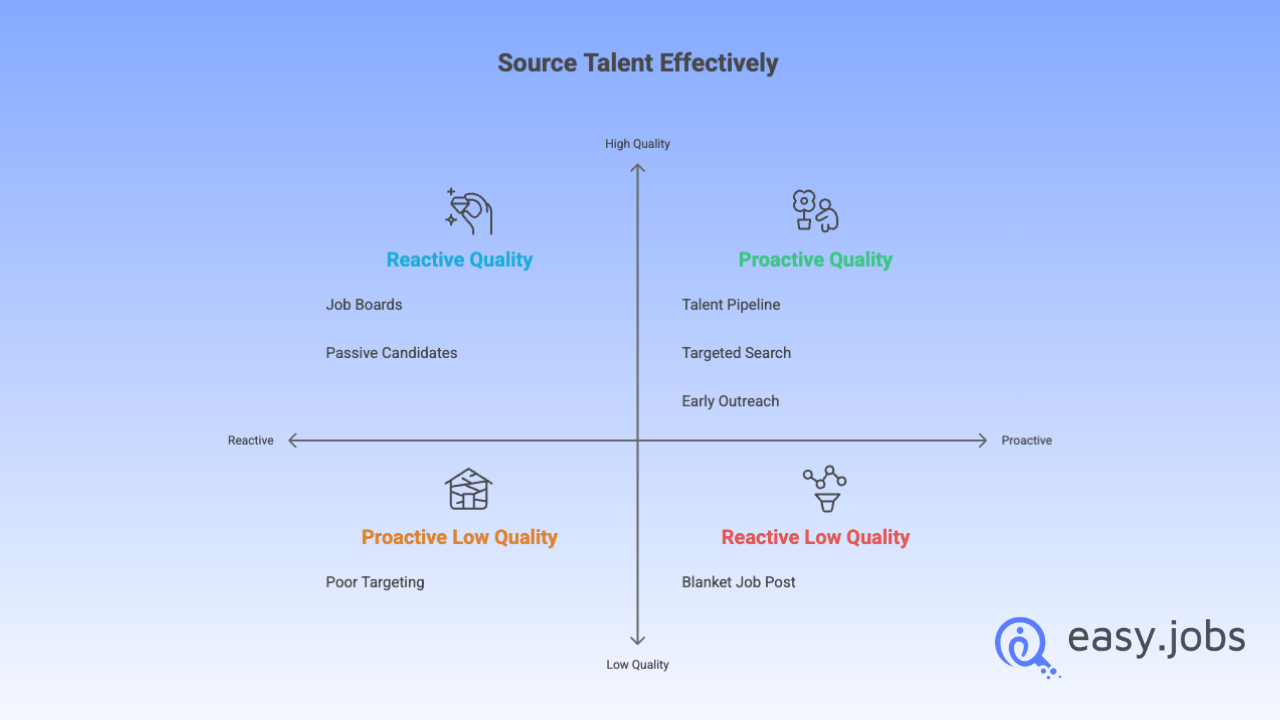
The hiring landscape has shifted dramatically. Here is why candidate sourcing has become a non-negotiable part of modern talent acquisition:
1. Passive Candidates Dominate the Talent Market
Studies estimate that up to 70–75% of the global workforce is made up of passive candidates. People who are not actively looking for jobs but are open to switching for the right offer. Sourcing is the only way to reach them.
2. Quality of Hire Improves With Proactive Sourcing
When you source candidates strategically, targeting people with specific skills, experience, or cultural indicators. You tend to attract higher-quality applicants than a blanket job post would yield.
3. Time-to-Hire Drops With a Pre-Built Pipeline
Companies with active talent pipelines can move from “open role” to “offer accepted” much faster because they are not starting from scratch every time a vacancy opens.
4. Competition for Talent Is Fierce
In high-demand fields like software engineering, data science, product management or healthcare, great candidates often have multiple offers. Reaching them early, before they are in full job-search mode, gives you a head start.
5. Reduces Dependence on Job Boards
Purely reactive hiring through job boards means you are competing on the same playing field as everyone else. Sourcing lets you go where the competition is not.
10 Proven Candidate Sourcing Strategies for Recruiters
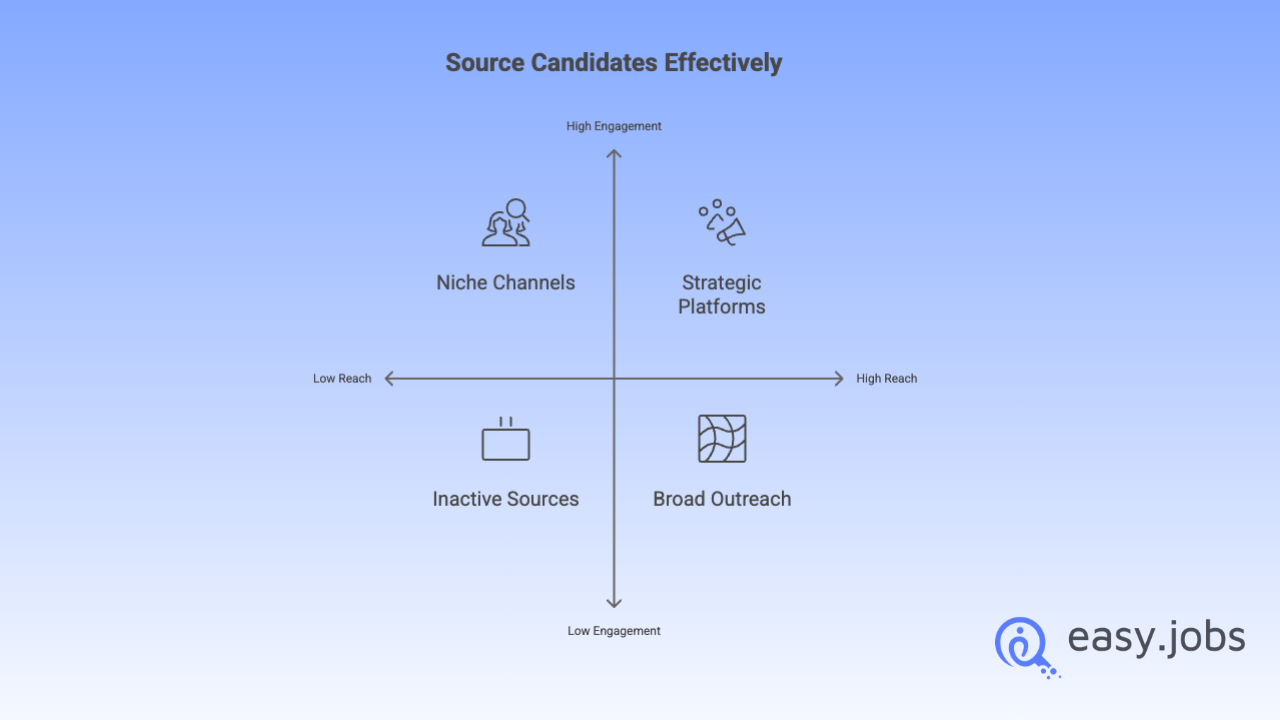
There is no single best way to source candidates. The most effective candidate sourcing strategies combine multiple channels and approaches. Here are the ten that consistently deliver results.
1. LinkedIn Sourcing (Advanced Search & Boolean Strings)
LinkedIn remains the most powerful platform for professional sourcing. With over 1 billion members globally, it offers unparalleled access to candidate profiles across industries.
How to use it effectively:
- Use LinkedIn Recruiter or LinkedIn Recruiter Lite for advanced filtering by skills, title, location, industry and more.
- Master Boolean search strings (AND, OR, NOT) to narrow down highly specific candidate profiles. Example: (“product manager” OR “product lead”) AND (“SaaS” OR “B2B”) AND “remote”.
- Engage with candidates who comment on relevant posts; they often signal their expertise and openness.
- Use InMail personalization, mention something specific about their work to dramatically improve response rates.
2. Boolean Search Across Search Engines
Boolean search is not limited to LinkedIn. You can apply it directly in Google and other search engines to find candidate profiles hosted on various platforms.
X-Ray search examples:
- site:linkedin.com/in “data engineer” “Dhaka” “Python”
- site:github.com “machine learning” “open to work”
- site:behance.net “UX designer” “mobile app”
This is a free, powerful technique that experienced sourcers use to surface profiles that never appear in standard searches.
3. GitHub, Dribbble & Portfolio Sourcing
For technical and creative roles, professional portfolios are goldmines.
- GitHub shows what developers actually build, not just what they claim on a resume
- Dribbble and Behance showcase designers’ real work, style, and creativity
- Medium and Substack reveal thought leadership. Useful for content, marketing, or strategy roles
These platforms tell you far more about a candidate’s actual capabilities than a CV alone.
4. Employee Referral Programs
Referrals consistently rank among the highest-quality and fastest-to-hire sourcing channels.
People refer candidates they genuinely believe are good, which means pre-screening happens naturally. Referred hires also tend to stay longer and perform better, according to multiple studies.
To make referrals work:
- Make it easy for employees to submit referrals (a dedicated form or tool helps)
- Offer meaningful incentives: bonuses, recognition or extra time off
- Keep referring employees updated on the status of their referral
- Ask specifically: “Who’s the best developer you’ve ever worked with?”
5. Talent Communities And Passive Candidate Pipelines
Rather than sourcing from scratch every time a role opens, smart companies build ongoing talent communities, groups of pre-engaged candidates who’ve shown interest in the company. These can be:
- A nurture email list for promising candidates who weren’t hired but impressed you
- A private Slack or Discord community around your industry
- A “stay in touch” follow-up sequence after strong interviews
Platforms like easy.jobs help companies build structured talent pipelines so that when a role opens, you already have a pool of vetted, warm candidates to draw from rather than starting cold every time.
6. Social Media Sourcing (Beyond LinkedIn)
LinkedIn is powerful, but it is not the only social network where talent hides.
- Twitter/X: Developers and tech professionals often share their work, opinions, and job status. Follow relevant hashtags (#opentowork, #hiring, your niche keywords)
- Reddit: Industry-specific subreddits (r/cscareerquestions, r/datascience, r/forhire) host candid conversations where talent self-identifies
- Facebook Groups: Niche professional communities are active on Facebook, especially in creative, marketing, and local business sectors
- Slack and Discord communities: Industry servers and professional communities often have dedicated job channels
7. Job Boards & Resume Databases
Active sourcing from job boards and resume databases remains valuable, especially for roles attracting active job seekers. Major platforms:
- Indeed Resume: large volume, broad industries
- Monster and CareerBuilder: established databases
- Dice: strong for tech roles
- Glassdoor: candidates often research before applying
The key is using advanced filters to surface relevant profiles quickly, then personalizing outreach rather than sending generic blasts.
8. University & College Recruiting
For entry-level roles or early career pipelines, building relationships with universities is a long-term sourcing strategy that pays consistent dividends.
- Attend or sponsor career fairs
- Offer internship programs that convert to full-time roles
- Build relationships with career counselors and professors
- Post on university job boards and alumni networks
This approach requires patience but builds a reliable, renewable talent pipeline for junior positions.
9. Professional Associations & Industry Events
Niche professional communities, whether in-person conferences, online summits or association directories, are rich sourcing grounds.
- Speak at events to attract talent who self-select based on your brand
- Browse attendee lists or member directories (where accessible)
- Network at industry meetups with the specific intent of relationship-building
Candidates met at industry events often have a higher signal-to-noise ratio than cold searches.
10. Competitive Intelligence & Talent Mapping
Talent mapping, is identifying the top performers at competitor companies. It is a sophisticated but highly effective sourcing strategy. This involves:
- Researching which companies have people with the exact skills or experience you need.
- Mapping out individuals in those organizations using LinkedIn, company websites, and industry sources.
- Building awareness campaigns (content, employer branding) that organically attract people from those organizations.
It is a longer game but positions you to make targeted moves when competitors lay off talent or when a key person signals openness.
Building a Repeatable Candidate Sourcing Process
Ad-hoc sourcing produces ad-hoc results. The best sourcing functions are built on a consistent, repeatable process. Here’s a framework you can implement:
Step 1: Define the Ideal Candidate Profile (ICP)
Before you source a single person, align with the hiring manager on exactly who you are looking for. Go beyond the job description:
- Must-have vs. nice-to-have skills
- Career trajectory and experience level
- Cultural attributes and work style
- Where do these people typically work or hang out online?
Step 2: Choose Your Sourcing Channels
Based on the role and ICP, decide which sourcing channels to prioritize. A developer role might lead with GitHub and LinkedIn Boolean search. A creative role might start with Dribbble and portfolio sites.
Step 3: Build & Execute Your Search
Run structured searches across your chosen channels. Document your search strings and filters so you can repeat or refine them.
Step 4: Qualify & Shortlist
Review the profiles you have found and shortlist those who best match your ICP. At this stage, you are not reaching out to everyone. You are selecting the strongest signals.
Step 5: Write & Send Personalized Outreach
Craft outreach messages that are concise, specific and genuinely interesting. Reference something specific about the candidate’s background. Make it clear why they specifically might be interested, not just why the role is great.
Good outreach formula:
- Hook: One specific thing about their background that caught your attention
- Bridge: Why that makes them interesting for this role
- Offer: A brief, compelling description of the opportunity
- CTA: A low-friction ask (a 15-minute call, not “please send your resume”)
Step 6: Follow Up (Without Spamming)
Most replies do not come from the first message. A two-to-three-touch follow-up sequence, spaced a week apart is appropriate. If there is no response after three attempts, move on.
Step 7: Track Everything & Iterate
Log every candidate you have sourced, their status and outcomes. Over time, this data reveals which channels and outreach approaches yield the best results.
Essential Candidate Sourcing Tools for Recruiters
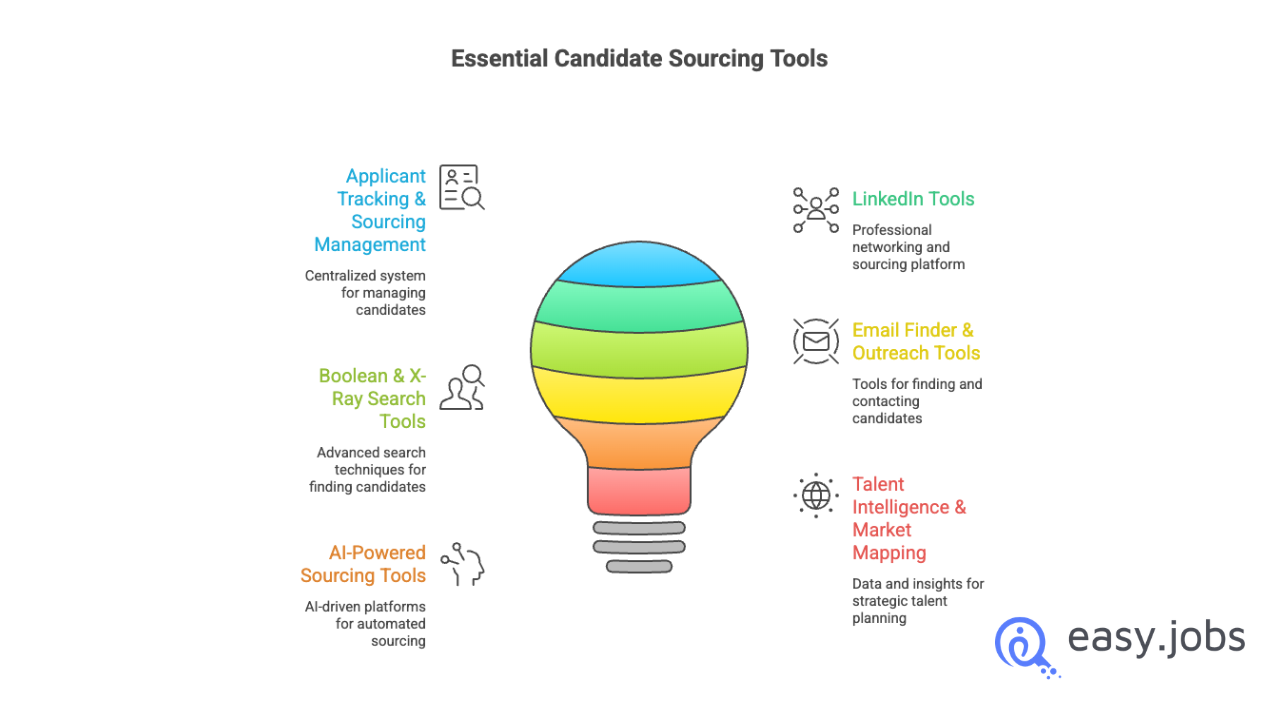
The right tools dramatically accelerate your sourcing efficiency. Here is a breakdown of the categories and key players:
Applicant Tracking & Sourcing Management
Managing candidates across channels requires a centralized system.
- easy.jobs: A modern recruitment platform that lets you manage job postings, track applicants, and organize your candidate pipeline from a single dashboard. It’s particularly useful for growing teams that need to scale their sourcing without losing visibility into each candidate’s status.
LinkedIn Tools
- LinkedIn Recruiter: The gold standard for professional sourcing
- LinkedIn Recruiter Lite: Budget-friendly option for smaller teams
- Dux-Soup / PhantomBuster — Automation tools for LinkedIn prospecting (use ethically and within platform guidelines)
Boolean & X-Ray Search Tools
- Sourcing.io: AI-assisted Boolean string builder
- RecruitEm: Free tool for generating X-ray searches across multiple platforms
- Google Hacks for Recruiters: Manual but powerful for advanced search
Email Finder & Outreach Tools
- Hunter.io: Find professional email addresses by domain
- Apollo.io: Large database with email finding and sequencing
- Lusha: Contact data enrichment for recruiters
- Snov.io: Email finder and cold outreach platform
AI-Powered Sourcing Tools
- HireEZ (formerly Hiretual): AI sourcing platform that aggregates profiles from 45+ platforms
- Findem: Attribute-based candidate discovery using AI
- SeekOut: Diversity-focused AI sourcing platform
- Fetcher: Automated sourcing and outreach with AI shortlisting
Talent Intelligence & Market Mapping
- Horsefly Analytics: Labor market data and talent supply insights
- Stratigens: Strategic talent intelligence platform
- LinkedIn Talent Insights: Aggregate workforce data and talent pool analysis
Candidate Sourcing Metrics That Actually Matter
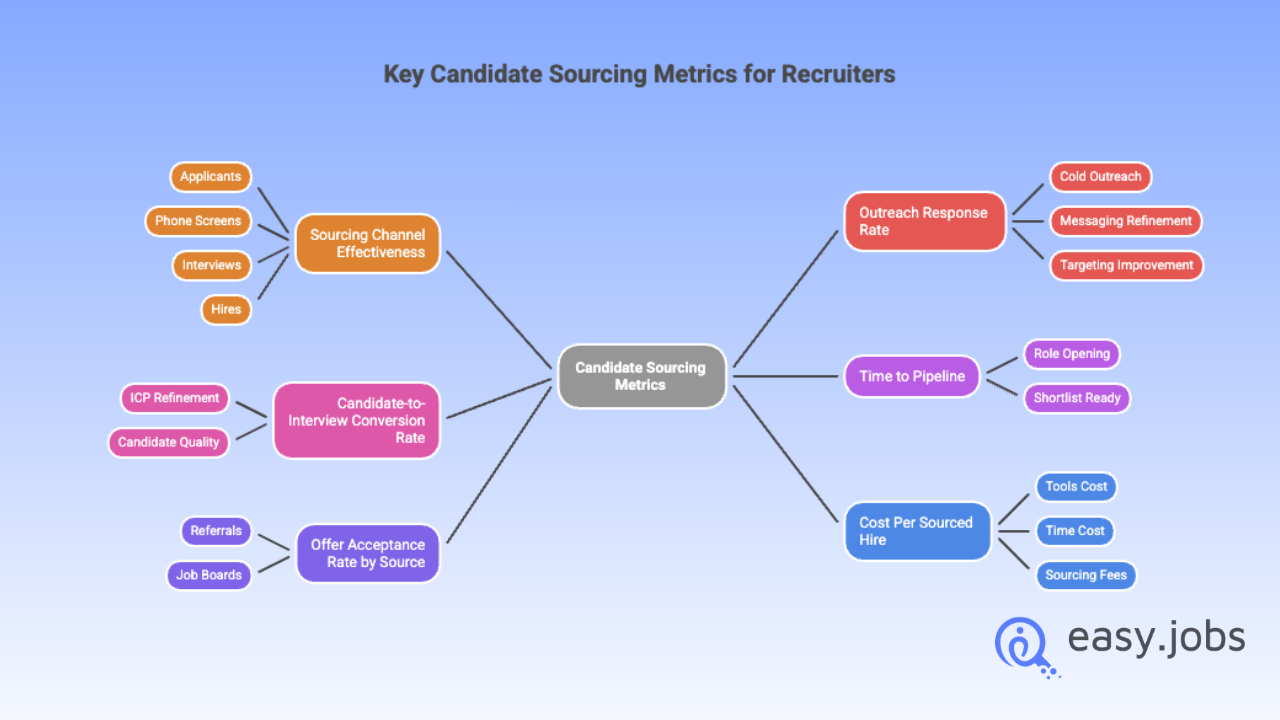
You can not improve what you do not measure. These are the key sourcing metrics every recruiter should track:
1. Sourcing Channel Effectiveness
Which channels are delivering the most qualified candidates? Break down applicants, phone screens, interviews and hires by source.
2. Outreach Response Rate
What percentage of candidates respond to your initial outreach? A healthy cold outreach response rate is typically 15–30%. Below that signals a need to refine your messaging or targeting.
3. Candidate-to-Interview Conversion Rate
Of all sourced candidates, how many advance to an interview? Low conversion may signal your ICP needs refinement.
4. Time to Pipeline
How long does it take from opening a role to having a shortlist of qualified candidates ready to engage?
5. Offer Acceptance Rate by Source
Are candidates sourced through referrals more likely to accept offers than those sourced from job boards? This data shapes where you invest your sourcing time.
6. Cost Per Sourced Hire
Include the cost of tools, time and any sourcing fees to understand the true cost of different sourcing approaches.
Common Candidate Sourcing Mistakes to Avoid
To master the hunt, you must first recognize the subtle errors that can derail even the most robust talent pipeline. Even experienced sourcers fall into these traps:
Sending generic outreach: Mass messages with no personalization get ignored. Always reference something specific about the individual.
Sourcing only when a role is open: The best pipelines are built continuously, not reactively. Sourcing should be ongoing, not episodic.
Ignoring silver medalists: Candidates who made it far in a previous process but were not hired are pre-qualified and warm. They should be the first call when a relevant role opens.
Neglecting employer brand: Sourcing is easier when candidates already know and admire your company. Investing in content, culture storytelling and Glassdoor reviews makes every outreach more effective.
Over-relying on a single channel: LinkedIn is powerful but limited. Diversified sourcing across multiple channels gives you access to a wider, less competitive talent pool.
Failing to track and improve: If you are not measuring which approaches work, you are guessing. Build tracking habits from day one.
The Future of Candidate Sourcing: AI, Automation & Personalization at Scale
To stay ahead of the competition, you must look beyond current best practices and anticipate the technological shifts redefining the talent hunt. Candidate sourcing is evolving rapidly. Here is where it is heading:
AI-Driven Profile Matching
AI sourcing tools can now scan millions of profiles and surface candidates who match a job description, including skills inferred from job titles, past employers, and career trajectories, in seconds. The manual search phase is shrinking.
Predictive Sourcing
Tools are beginning to predict which candidates are most likely to be open to new opportunities based on signals like tenure, company growth, layoff news and career progression patterns.
Hyper-Personalized Outreach at Scale
AI can now help craft personalized outreach based on individual candidate profiles. Combining the human feel of a personal note with the scale of automation. The bar for “good outreach” is rising as a result.
Diversity-First Sourcing
Modern sourcing tools are building in bias-reduction features. Helping recruiters target underrepresented talent pools and remove language from outreach that might inadvertently deter certain groups.
Sourcing Inside the ATS
Platforms like easy.jobs are integrating sourcing workflows directly into the applicant tracking experience. So candidate discovery, outreach and pipeline management happen in one place rather than across a dozen disconnected tools.
The sourcing function that wins in the next five years will combine AI efficiency with genuine human relationship-building, using technology to work smarter and people skills to close the gap.
Frequently Asked Questions (FAQs) About Candidate Sourcing
Here are a few of the most common queries regarding the tools, techniques and terminology used by top-tier sourcers today:
What is Candidate Sourcing In Recruitment?
Candidate sourcing is the proactive process of identifying and engaging potential job candidates, often before they apply or before a role is open. It focuses primarily on passive candidates who are not actively job hunting but may be open to the right opportunity.
What is the Difference Between Sourcing And Recruiting?
Sourcing is a top-of-funnel activity focused on finding and engaging candidates. Recruiting covers the broader hiring process: evaluation, interviews and offers. Sourcing feeds the recruiter pipeline; recruiting converts that pipeline into hires.
What are the Best Candidate Sourcing Strategies?
The most effective strategies include LinkedIn Boolean search, employee referrals, portfolio and GitHub sourcing, talent communities, social media sourcing and competitive talent mapping. Combining multiple channels consistently outperforms relying on any single source.
What Tools Do Recruiters Use for Candidate Sourcing?
Common tools include LinkedIn Recruiter, Apollo.io, Hunter.io, SeekOut, Fetcher and applicant tracking systems like easy.jobs that centralize pipeline management. AI-powered sourcing tools are increasingly central to efficient sourcing workflows.
How Do You Source Passive Candidates?
Sourcing passive candidates involves identifying people who match your ideal candidate profile through platforms like LinkedIn, GitHub or portfolio sites, then reaching out with personalized, compelling messages that make a strong case for why they should consider your opportunity, even if they were not looking.
What Metrics Should I Track for Candidate Sourcing?
How Can I Improve My Candidate Sourcing Response Rate?
Personalize every message. Reference something specific about the candidate’s background. Keep messages short and focused. Lead with what is in it for them, not just why the role is great. Test different subject lines and follow up two to three times if needed.
Master the Hunt: Build a Pipeline That Never Runs Dry
Candidate sourcing is an ongoing discipline, not a one-time task. While the fundamentals of finding and engaging talent remain the same, modern tools have introduced a new level of speed and intelligence. To stay ahead, you must build authentic relationships with candidates long before a seat needs to be filled.
When done right, this proactive approach creates a competitive advantage for your organization. A robust pipeline ensures faster, higher-quality hires and lower recruitment costs, protecting you from the panic of unexpected vacancies. Start building your talent moat today, one relationship at a time.
Found this guide useful? Subscribe to our blog for weekly recruitment hacks and tech deep dives, and join our Facebook Community to swap strategies with elite recruiters and master the modern job market together.