Hiring in today’s competitive job market requires more than posting vacancies or screening resumes. Organizations in the United States are increasingly adopting 360 recruitment, also known as full-cycle or end-to-end hiring, to create a more structured, accountable, candidate-centric recruitment process.
The 360 recruitment process covers the entire hiring lifecycle, from workforce planning and talent sourcing to onboarding and post-placement follow-up. Unlike fragmented models, it assigns full-cycle ownership to a single recruiter or team, ensuring continuity, faster decisions, and stronger alignment with business goals.

As workforce demands evolve and talent shortages persist, companies prioritize recruitment process optimization and candidate experience enhancement. The 360 recruitment cycle addresses these needs by reducing handoffs, improving communication, and delivering a consistent experience for employers and candidates.
In this guide, we break down the 360 recruitment meaning, how the 360 recruitment cycle works, compare it with the 180 recruitment model, and walk through the 6 core stages of full-cycle hiring. Starting with workforce planning and ending with successful onboarding.
What Is 360 Recruitment?
360 recruitment is a full-cycle hiring approach where a recruiter or recruitment team manages the entire recruitment lifecycle. From workforce planning and talent sourcing to offer management and onboarding.
Instead of dividing responsibilities across different roles or departments, the 360 recruitment model centralizes ownership, ensuring consistency, accountability, and alignment throughout the hiring process.
The 360 recruitment meaning lies in its holistic scope. The term “360” represents complete coverage of the recruitment cycle, addressing every stage of hiring as an interconnected system rather than a series of disconnected tasks.
This includes understanding business objectives, aligning hiring needs with workforce planning, engaging candidates, coordinating interviews, negotiating offers and supporting onboarding. Each phase feeds into the next, forming a continuous 360-recruitment cycle that improves decision-making and long-term hiring outcomes.
The importance of 360-recruitment has grown significantly in today’s job market, particularly in the United States, where talent competition is high and candidate expectations continue to rise.
Organizations are under pressure to hire faster without compromising quality or candidate experience. The 360-recruitment process supports recruitment process optimization by reducing handoffs, improving communication, and enabling recruiters to act as strategic partners.
Additionally, 360-recruitment plays a critical role in candidate experience enhancement. With fewer touchpoints and more consistent communication, candidates experience greater transparency and engagement throughout the hiring journey.
At the same time, recruiters gain deeper insights into workforce needs, making 360-recruitment an effective model for organizations focused on sustainable growth and proactive workforce planning.
The 360 Recruitment Cycle Explained
The 360 recruitment cycle represents a continuous, end-to-end hiring framework that connects every stage of recruitment into a single, cohesive process. Unlike fragmented hiring models, this cycle ensures that insights, decisions, and feedback flow seamlessly from one stage to the next, enabling better hiring outcomes and long-term process improvement.
At its core, the 360-recruitment cycle is designed to support recruitment process optimization by reducing silos, minimizing delays, and maintaining consistent ownership throughout the hiring journey. This approach allows recruiters to balance speed, quality, and alignment with business objectives—especially in competitive U.S. job markets.
Key Components of the 360 Recruitment Cycle
The effectiveness of the 360 recruitment cycle depends on how well its core components work together. Each component plays a strategic role in creating a smooth and accountable hiring process.
End-to-End Ownership
A defining component of the 360-recruitment cycle is single-point accountability. One recruiter or recruitment team oversees the entire process, ensuring continuity, faster decision-making, and stronger collaboration with hiring managers.
Strategic Workforce Alignment
The cycle begins with a clear understanding of workforce planning needs. Recruiters align hiring goals with organizational strategy, team requirements, and future skill gaps, enabling proactive rather than reactive recruitment.
Integrated Candidate Journey
From first contact to onboarding, candidates move through a consistent and well-structured experience. This integration directly supports candidate experience enhancement, improving engagement, trust, and offer acceptance rates.
Continuous Feedback And Optimization
Each stage of the 360 recruitment cycle generates insights that inform future hiring efforts. Interview feedback, sourcing performance, and onboarding outcomes are analyzed to refine processes and improve overall recruitment effectiveness.
By treating recruitment as a connected cycle rather than isolated steps, organizations gain better visibility, control, and scalability in their hiring operations.
180 vs 360 Recruitment Process Differences
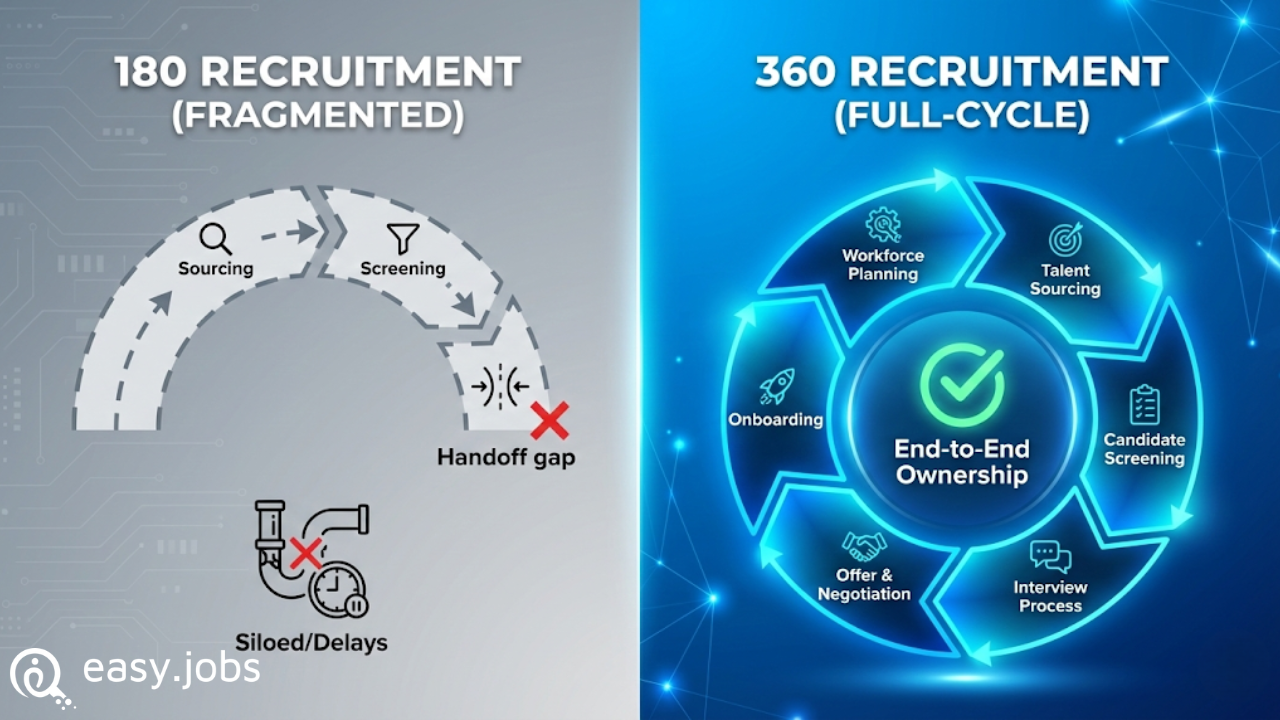
The differences between 180 and 360 recruitment are best understood when compared side by side. The table below highlights how each model operates across key dimensions of the recruitment process and why many organizations transition toward 360-recruitment for long-term hiring success.
| Aspect | 180 Recruitment | 360 Recruitment |
| Recruitment Scope | Covers only part of the hiring process, typically sourcing and screening | Covers the full recruitment lifecycle from workforce planning to onboarding |
| Ownership Model | Split ownership between recruiters, HR, and hiring managers | Single recruiter or team owns the entire recruitment cycle |
| Workforce Planning | Limited involvement in strategic workforce planning | Strong alignment with workforce planning and business goals |
| Candidate Experience | Can feel fragmented due to multiple handoffs | More consistent and personalized, supporting candidate experience enhancement |
| Process Efficiency | Higher risk of delays and miscommunication | Streamlined process with fewer handoffs and faster decision-making |
| Recruiter Role | Transactional and task-focused | Strategic partner involved in end-to-end hiring |
| Visibility Across Hiring Stages | Partial visibility into outcomes beyond screening | Full visibility across all stages of the 360 recruitment cycle |
| Scalability | Suitable for short-term or high-volume hiring | Ideal for sustainable growth and recruitment process optimization |
Benefits of Transitioning to 360 Recruitment
Transitioning from 180 to 360 recruitment enables organizations to move from a fragmented hiring approach to a fully integrated model. With end-to-end accountability, recruiters gain deeper insight into role requirements, hiring outcomes, and future talent needs.
This shift directly improves recruitment process optimization by reducing inefficiencies, improving stakeholder alignment, and enabling data-driven hiring decisions. It also enhances the candidate journey by ensuring consistent communication and clearer expectations throughout the process.
For organizations focused on long-term growth, employer branding, and proactive workforce planning, 360-recruitment provides a more strategic and scalable foundation than the 180 recruitment model.
The Six Stages of Full-Cycle Hiring
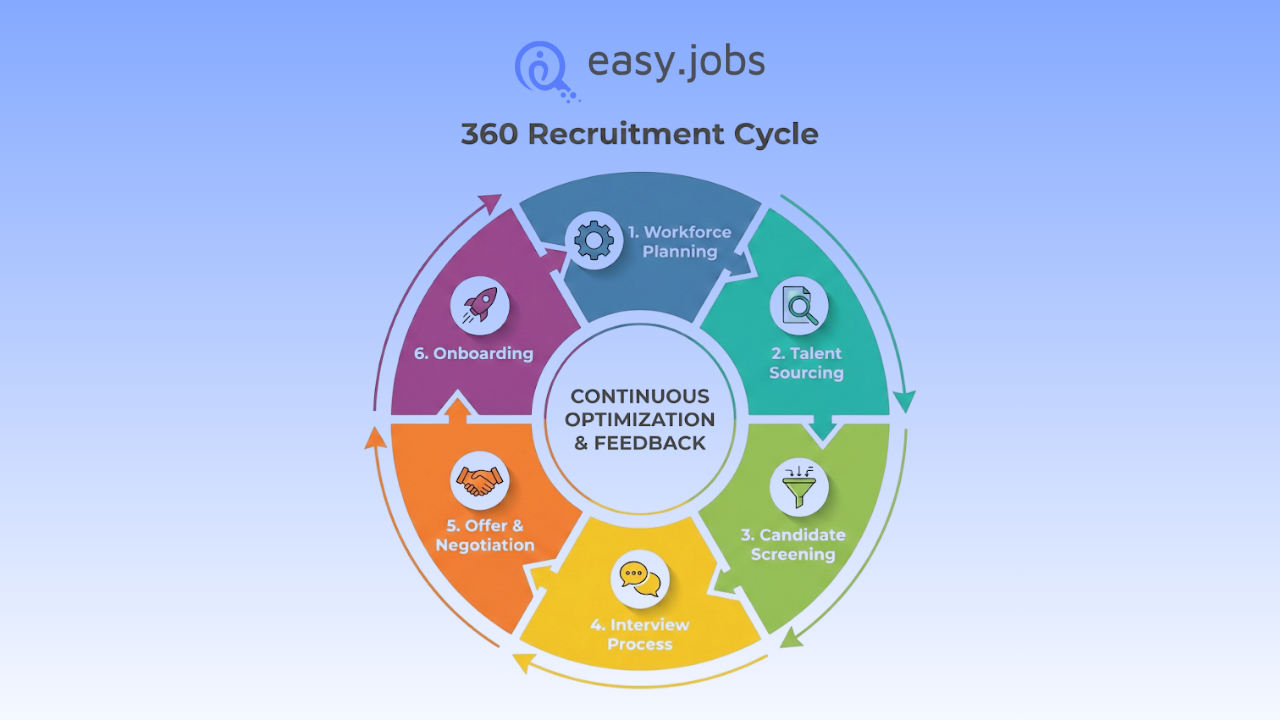
The 360 recruitment process is built around six interconnected stages that together form a complete full-cycle hiring framework. Each stage plays a distinct role, yet all are designed to work as part of a continuous 360 recruitment cycle, ensuring alignment between business needs, recruiter actions, and candidate expectations.
What differentiates full-cycle hiring from traditional recruitment models is not just the number of stages, but the end-to-end ownership and feedback loop between them. Decisions are made during the early stages, such as workforce planning or sourcing. Directly influence later outcomes like offer acceptance, onboarding success and long-term retention.
This structure enables ongoing recruitment process optimization rather than one-off hiring decisions. The six stages of full-cycle hiring include workforce planning, talent sourcing, candidate screening, the interview process, offer and negotiation, and onboarding.
Together, these stages provide a clear, repeatable framework that supports hiring at scale without compromising quality or consistency. At the same time, they enhance the candidate experience by offering a structured and transparent journey from initial engagement to successful integration within the organization.
Stage 1: Workforce Planning
Workforce planning is the foundation of the 360-recruitment process. It focuses on clearly defining what roles are needed, why they are needed, and when they should be filled, before any sourcing or hiring begins.
At this stage, recruiters work closely with hiring managers to understand business goals, team capacity, required skills, budget constraints, and future growth plans. This ensures hiring decisions are proactive rather than reactive and aligned with long-term organizational strategy.
In a 360 recruitment model, workforce planning helps prevent common hiring issues such as rushed decisions, role misalignment, and unnecessary turnover. By setting clear expectations early, recruiters can design more effective sourcing strategies, attract the right candidates, and optimize the overall recruitment process.
In simple terms, strong workforce planning ensures the right people are hired for the right roles at the right time, making the rest of the full-cycle hiring process more efficient and predictable.
Stage 2: Talent Sourcing
Talent sourcing is the stage where recruiters actively identify and attract candidates who match the role requirements defined during workforce planning. In the 360-recruitment process, sourcing is both strategic and ongoing, not limited to filling immediate vacancies.
At this stage, recruiters use a mix of channels such as job boards, professional networks, internal databases, referrals, and talent communities. The goal is to build a strong and relevant talent pipeline rather than relying solely on applicants who respond to job postings.
Effective talent sourcing supports recruitment process optimization by reducing time-to-hire and improving candidate quality. Because recruiters already understand the role, team, and business goals, they can target candidates more accurately and communicate the employer value proposition more clearly.
From a candidate perspective, thoughtful sourcing improves engagement and sets the tone for a positive hiring experience.
Stage 3: Candidate Screening
Candidate screening is the stage where recruiters evaluate sourced applicants to determine their suitability for the role. In the 360-recruitment process, screening goes beyond reviewing resumes—it focuses on identifying candidates who align with both the job requirements and the organization’s culture.
At this stage, recruiters assess skills, experience, qualifications, and role-specific criteria through resume reviews, phone screenings, or initial assessments. Because the recruiter has end-to-end ownership of the hiring cycle, screening decisions are more accurate and consistent with the original workforce planning goals.
Effective candidate screening improves recruitment process optimization by filtering out mismatches early, reducing unnecessary interviews, and saving time for hiring managers. It also contributes to candidate experience enhancement by ensuring only relevant candidates move forward and receive timely communication.
Stage 4: Interview Process
The interview process is the stage where shortlisted candidates are assessed in depth to determine their skills, competencies, and overall fit for the role. In the 360-recruitment process, interviews are structured, goal-driven, and closely aligned with the original hiring requirements.
Recruiters coordinate interviews between candidates and hiring managers, ensuring the right stakeholders are involved and that expectations are clear. Interview formats may include technical interviews, behavioral assessments, or panel discussions, depending on the role. Because the recruiter manages the entire cycle, feedback is collected efficiently and decisions are made faster.
A well-managed interview process supports recruitment process optimization by reducing delays and avoiding repeated or unstructured interviews. It also plays a key role in candidate experience enhancement, as clear communication, timely feedback, and a professional interview flow leave a positive impression on candidates.
Stage 5: Offer And Negotiation
The offer and negotiation stage is where the selected candidate is formally presented with the job offer and employment terms are finalized. In the 360 recruitment process, this stage is managed carefully to balance candidate expectations with business requirements.
Recruiters prepare the offer details, including compensation, benefits, start date, and role responsibilities, based on earlier discussions and market benchmarks. During negotiation, they act as a mediator between the candidate and the organization, addressing concerns and aligning expectations on both sides.
Effective handling of offers and negotiations improves offer acceptance rates and reduces the risk of last-minute drop-offs. It also contributes to candidate experience enhancement by ensuring transparency, fairness, and clear communication throughout the decision-making process.
Stage 6: Onboarding
Onboarding is the final stage of the 360-recruitment process and plays a critical role in turning a successful hire into a productive, engaged employee. This stage focuses on integrating the new hire into the organization smoothly and setting them up for long-term success.
In a full-cycle hiring model, recruiters remain involved through onboarding to ensure all documentation, system access, and role expectations are clearly communicated. They coordinate with HR and hiring managers to support a structured onboarding experience, reducing confusion and early attrition.
Effective onboarding reinforces candidate experience enhancement by maintaining continuity from the recruitment process into employment. It also supports better retention, faster ramp-up times, and stronger alignment between new hires and organizational goals.
With onboarding complete, the 360 recruitment cycle comes full circle, providing insights that can be used to further improve future hiring efforts.
Candidate Experience Enhancement in Recruitment
Candidate experience is a critical success factor in the 360 recruitment process. It reflects how candidates perceive an organization at every touchpoint, from the first interaction to onboarding. In competitive job markets, a positive candidate experience directly influences employer branding, offer acceptance rates, and long-term talent attraction.
Importance of Candidate Experience
A strong candidate experience builds trust and credibility with potential hires. When candidates receive clear communication, timely feedback, and a transparent hiring process, they are more likely to stay engaged and view the organization positively, even if they are not selected.
In a 360 recruitment model, consistent ownership across the recruitment cycle minimizes confusion and delays, which are common causes of candidate dissatisfaction. This structured approach ensures candidates experience a smooth, professional, and respectful hiring journey.
Strategies for Improving Candidate Experience
Improving candidate experience starts with clear expectations. Job descriptions, interview timelines, and role responsibilities should be communicated early and consistently. Regular updates and constructive feedback help candidates feel valued and informed throughout the process.
Technology also plays a key role. Applicant tracking systems, automated scheduling, and centralized communication tools support recruitment process optimization while reducing friction for candidates. Combined with human-led engagement, these strategies help organizations deliver a more personalized and efficient hiring experience.
Recruitment Process Optimization
Recruitment process optimization focuses on improving the efficiency, consistency, and effectiveness of hiring operations. Within the 360-recruitment model, optimization is not a one-time effort—it is an ongoing process driven by data, feedback, and continuous improvement across the full recruitment cycle.
By optimizing recruitment processes, organizations can reduce time-to-hire, improve candidate quality, and ensure better alignment between hiring outcomes and business goals.
Tools And Techniques for Optimization
Technology is a key enabler of recruitment process optimization. Applicant Tracking Systems (ATS) help centralize candidate data, automate workflows, and maintain visibility across the 360-recruitment cycle. These tools reduce manual effort and support better decision-making through reporting and analytics.
Standardized hiring frameworks also play an important role. Structured interviews, clear evaluation criteria, and consistent communication templates help reduce bias and ensure fair, repeatable hiring decisions.
Data-driven insights further support optimization efforts. Metrics such as time-to-fill, source performance, candidate drop-off rates, and offer acceptance rates allow recruiters to identify bottlenecks and refine their approach over time.
When combined with end-to-end ownership, these tools and techniques enable organizations to scale hiring efficiently while maintaining a strong focus on candidate experience enhancement.
Transform Your Hiring with a Smarter, End-to-End Recruitment Approach
The 360-recruitment process provides a structured, end-to-end approach to hiring that covers every stage of the talent acquisition lifecycle. From workforce planning to onboarding. By assigning full ownership of the recruitment cycle to a single recruiter or team, organizations gain greater consistency, visibility, and control over hiring outcomes.
Throughout the 360-recruitment cycle, each stage is interconnected, enabling better alignment with workforce planning goals, improved recruitment process optimization, and a stronger focus on candidate experience enhancement. Compared to partial recruitment models, 360-recruitment supports higher-quality hires, faster decision-making, and more sustainable talent strategies.
If your organization is looking to improve hiring efficiency, enhance candidate experience, and build a scalable recruitment framework, adopting a 360 recruitment approach can deliver long-term value. Evaluate your current hiring model, identify process gaps, and consider transitioning to full-cycle recruitment to stay competitive in today’s evolving job market. If you found this guide helpful, subscribe to our blog for practical insights and expert resources to support smarter, more effective hiring. You can also join our Facebook community to connect with industry professionals, share experiences, and collaborate on modern recruitment best practices.