Managing payroll in 2026 is no longer just about calculating salaries. Businesses now rely on AI payroll software to automate tax compliance, detect errors before they happen, process global payments and generate real-time workforce insights.
Whether you are a fast-growing startup, a remote-first company, or an enterprise managing complex compliance requirements, AI-driven payroll systems reduce manual work, minimize costly mistakes and improve operational accuracy.
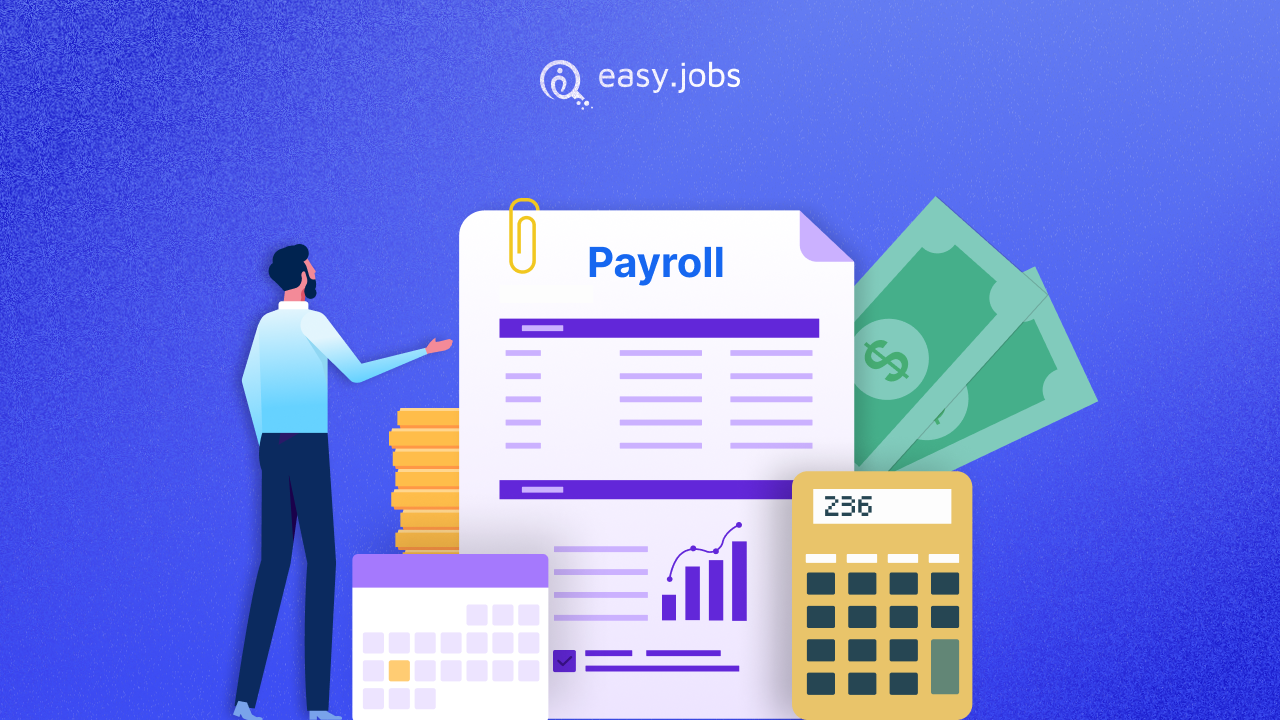
To help you choose the right solution, we compared the 10 best AI payroll software platforms in 2026 based on automation capabilities, compliance intelligence, integrations, scalability, and pricing transparency.
TL;DR: Best AI Payroll Software in 2026
If you need fast payroll automation, stronger compliance and fewer manual errors, AI payroll software is essential in 2026.
- 🏆 Best Overall: ADP Workforce Now – Advanced automation, enterprise-grade compliance
- 🌍 Best for Global Payroll: Workday Payroll – Built for multi-country operations
- 💼 Best for Small Businesses: Gusto – Simple, affordable, AI-enhanced payroll
- ⚙️ Best for Automation & Integrations: Rippling – Payroll + HR + IT in one AI-powered platform
- 💰 Best Budget Option: Patriot Software – Low-cost payroll for US-based teams
AI payroll systems use machine learning to automate calculations, monitor tax compliance, detect discrepancies and generate real-time workforce insights. For enterprises managing complex compliance, tools like ADP, UKG Pro and Oracle Payroll lead the market. Smaller teams prioritizing ease of use and affordability often prefer Gusto, OnPay, or Patriot.
Below is a quick comparison summary before we dive into detailed reviews.
🔎 Quick Comparison: Best AI Payroll Software in 2026
| Software | Best For | AI Automation Level | Global Payroll | Starting Price* |
| Paychex Flex | SMBs & growing businesses | High | Limited | Custom pricing |
| ADP Workforce Now | Mid-sized to enterprise | Advanced | Yes | Custom pricing |
| Gusto | Small businesses | Moderate | Limited | From $40/month |
| UKG Pro | Enterprise payroll | Advanced | Yes | Custom pricing |
| Workday Payroll | Large global enterprises | Advanced | Yes | Custom pricing |
| Rippling | HR + IT + Payroll automation | Advanced | Yes | From $8/user/month* |
| OnPay | Budget-friendly payroll | Moderate | No | From $40/month |
| Oracle Payroll | Enterprise compliance-heavy teams | Advanced | Yes | Custom pricing |
| Paycor | Mid-market companies | Moderate–High | Limited | Custom pricing |
| Patriot Software | Small US-based businesses | Basic–Moderate | No | From $17/month |
*Pricing subject to change. Always verify with the vendor.
What Is AI Payroll Software?
AI payroll software is a payroll management system that uses artificial intelligence and machine learning to automate salary calculations, tax deductions, compliance monitoring, reporting and payroll analytics.
Unlike traditional payroll systems that rely heavily on manual inputs and static rule-based automation, AI-powered payroll platforms continuously analyze data to:
- Detect anomalies in payroll calculations
- Predict tax liabilities and compliance risks
- Automate multi-country payroll processing
- Identify discrepancies before payroll is finalized
- Generate real-time workforce cost insights
In simple terms, an AI payroll system does more than process paychecks. It learns from historical payroll data to improve accuracy, reduce human errors and streamline compliance workflows.
How AI Improves Payroll Processing
Traditional payroll software:
- Requires manual validation
- Follows fixed tax tables
- Flags issues after they occur
AI payroll processing systems:
- Use machine learning to identify unusual payment patterns
- Automatically apply updated tax regulations
- Predict compliance gaps
- Reduce payroll errors before submission
- Provide intelligent reporting dashboards
For companies managing remote teams, contractors, or global employees, this level of automation significantly reduces operational risk and administrative workload.
Core Components of AI Payroll Systems
Most modern AI payroll software includes:
- Automated Payroll Calculations
Real-time computation of salaries, bonuses, deductions and taxes. - Compliance Intelligence
AI-driven monitoring of local, state and international tax regulations. - Fraud & Error Detection
Anomaly detection to flag unusual payroll activity. - Predictive Workforce Analytics
Insights into payroll costs, overtime trends and budget forecasting. - Smart Integrations
Syncing with HR, accounting, time tracking and benefits platforms.
AI in payroll is no longer optional for growing businesses. As regulations become more complex and remote work expands globally, companies increasingly rely on intelligent payroll automation to ensure accuracy, scalability and compliance.
Why AI in Payroll Is Growing Rapidly in 2026
Payroll is no longer just an administrative task. In 2026, it sits at the intersection of compliance, workforce analytics, global expansion and operational risk management. As a result, businesses are increasingly turning to AI-powered payroll software to handle complexity at scale. Several key trends are accelerating this shift.
1️⃣ Increasing Compliance Complexity
Tax regulations, labor laws and reporting requirements change frequently across regions. For companies operating in multiple states or countries, managing compliance manually is risky and resource-intensive.
AI payroll systems continuously monitor regulatory updates and automatically apply changes to payroll calculations. This reduces the risk of penalties, underpayments and filing errors.
Instead of reacting to compliance issues, organizations can proactively prevent them.
2️⃣ Growth of Remote And Global Teams
Hybrid and remote work models are now standard. Many companies hire across borders, which introduces:
- Multiple tax jurisdictions
- Currency conversions
- Country-specific benefits regulations
- Cross-border payroll compliance
AI-driven payroll platforms simplify multi-country payroll processing by automating region-specific tax calculations and compliance requirements in real time.
3️⃣ Demand for Payroll Automation
Manual payroll processes increase the likelihood of:
- Data entry errors
- Miscalculations
- Delayed salary payments
- Reporting inaccuracies
AI payroll automation reduces manual intervention by:
- Auto-validating payroll data
- Flagging inconsistencies before approval
- Streamlining recurring payroll cycles
- Generating automated tax filings
This improves both efficiency and employee trust.
4️⃣ Real-Time Workforce Analytics
Modern finance and HR teams need visibility into payroll costs, overtime trends, benefits expenses, and workforce distribution.
AI-powered payroll systems provide predictive analytics dashboards that help organizations:
- Forecast labor costs
- Identify budget anomalies
- Optimize staffing decisions
- Detect unusual compensation patterns
Payroll data becomes a strategic asset instead of a back-office function.
5️⃣ Rising Focus on Data Security and Fraud Detection
Payroll systems handle sensitive employee information. AI-enhanced platforms use anomaly detection algorithms to flag unusual payment behavior, unauthorized access attempts and suspicious transactions.
This layer of intelligent monitoring strengthens payroll security while reducing fraud risk.
As regulatory pressure increases and workforces become more distributed, traditional payroll systems struggle to keep up. AI payroll software offers:
- Greater automation
- Reduced compliance risk
- Improved accuracy
- Scalable global processing
- Actionable workforce insights
That is why AI in payroll is no longer a competitive advantage, it is becoming a business necessity.
How We Evaluated These AI Payroll Software Platforms
To identify the best AI payroll software, we evaluated each platform based on automation depth, compliance intelligence, scalability, integrations and overall business impact.
Our goal was not just to list popular tools but to assess how effectively each system uses artificial intelligence to improve payroll accuracy, efficiency and compliance.
Below are the key evaluation criteria we used.
1️⃣ AI Automation Capabilities
We examined how deeply AI is integrated into payroll workflows, including:
- Automated payroll calculations
- Smart tax filing and deductions
- Error detection and anomaly alerts
- Predictive payroll analytics
- Automated compliance updates
Platforms that go beyond rule-based automation and use machine learning to continuously improve payroll accuracy scored higher.
2️⃣ Compliance & Regulatory Intelligence
Payroll compliance is one of the biggest risk areas for businesses. We evaluated whether each tool:
- Automatically updates tax regulations
- Supports multi-state or multi-country compliance
- Flags regulatory risks before payroll processing
- Simplifies audit preparation
Solutions with strong compliance intelligence and global payroll support received higher rankings.
3️⃣ Global Payroll Support
For distributed and remote teams, global payroll capabilities are essential. We assessed:
- Multi-currency support
- Country-specific tax automation
- International contractor payments
- Local labor law compliance
Platforms with built-in global payroll infrastructure performed better in this category.
4️⃣ Integration Ecosystem
Modern payroll systems must integrate seamlessly with:
- HR management software
- Time tracking tools
- Accounting platforms
- Benefits administration systems
Tools offering broad API support and native integrations were rated more favorably.
5️⃣ Scalability & Company Fit
Not all payroll software suits every company size. We evaluated how well each solution supports:
- Small businesses
- Growing mid-market teams
- Enterprise organizations
- Global operations
Scalability, customization and workflow flexibility influenced final rankings.
6️⃣ Pricing Transparency & Value
Cost structure matters, especially for small and mid-sized businesses. We considered:
- Base pricing clarity
- Per-employee pricing models
- Hidden implementation fees
- Feature availability per pricing tier
Platforms offering clear pricing and strong value relative to features ranked higher.
7️⃣ User Experience & Reporting
Finally, we reviewed:
- Dashboard usability
- Payroll approval workflows
- Reporting depth
- Real-time workforce insights
AI payroll software should simplify payroll management not add complexity.
This evaluation framework ensures that each recommended AI payroll system delivers measurable automation, compliance reliability and operational efficiency, not just basic payroll processing features.
Now that you understand how we assessed each platform, let us dive into the detailed reviews of the best AI payroll software in 2026.
Payroll Software for AI in 2026: 10 Best Picks
AI companies need specialized payroll solutions to manage their unique workforce needs as artificial intelligence transforms industries. AI payroll software in 2026 combines automation, flexibility and compliance features tailored for tech-focused organizations. HR and project management systems can be integrated with these tools to handle complex compensation structures and global payrolls.
The best options offer AI-powered analytics, scalability and robust security to protect sensitive information. When evaluating solutions, AI companies need to look for payroll software that adapts to their changing business models. AI solutions should support traditional employees as well as contract workers. Take a look at these 10 excellent picks.
1. Paychex Flex – Best for Growing SMBs Needing Reliable Payroll Automation
A strong AI-enhanced payroll platform designed for small to mid-sized businesses that need compliance automation and scalable payroll management without enterprise complexity.
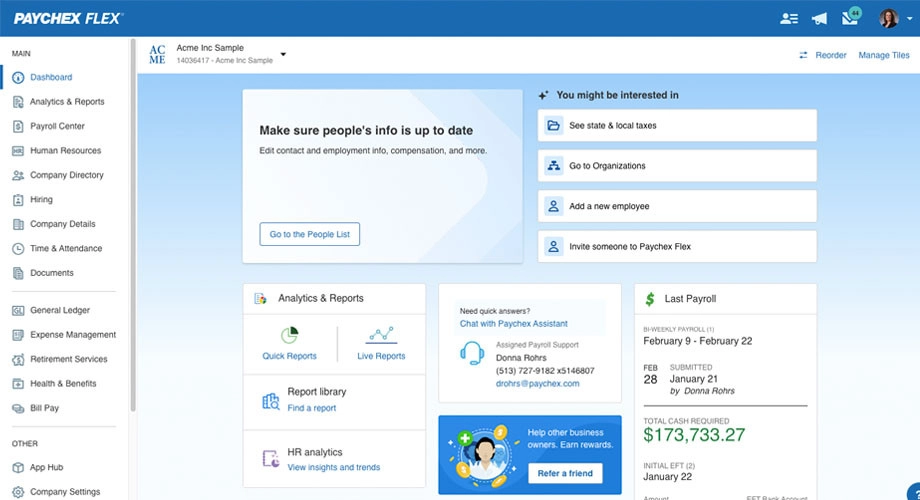
Paychex Flex is a cloud-based payroll and HR platform built primarily for small and growing businesses. While not marketed as a pure “AI-first” payroll system, it incorporates intelligent automation, compliance monitoring and workflow optimization to reduce manual payroll processing.
The platform combines payroll management, tax administration, benefits management, and HR tools in one unified system. For businesses that need dependable payroll automation with built-in compliance safeguards, Paychex Flex offers a practical and scalable solution.
It is especially well suited for companies operating across multiple states that require accurate tax filing and regulatory updates.
🔍 AI Capabilities & Automation Strength
Paychex Flex integrates intelligent automation into core payroll workflows, including:
- Automated payroll calculations with built-in validation
- Smart tax calculation and filing automation
- Real-time compliance monitoring for federal, state and local regulations
- Automated payroll alerts for discrepancies
- Customizable payroll approval workflows
While its AI features are more compliance and automation-focused rather than predictive analytics-heavy, the platform excels at minimizing payroll errors and ensuring timely tax filings.
For SMBs, this level of automation significantly reduces administrative burden without requiring complex configuration.
⭐ Key Features
- Full-service payroll processing
- Automated tax filing and payment
- Multi-state payroll support
- Employee self-service portal
- Direct deposit and pay card options
- Benefits administration tools
- Time and attendance tracking
- HR reporting and workforce analytics
The system integrates with accounting software and other HR tools, enabling streamlined financial and workforce data synchronization.
| 👍 Pros | 👎 Cons |
| Strong compliance and tax automation | Pricing not publicly transparent |
| Reliable payroll accuracy | Advanced analytics less robust than enterprise-focused platforms |
| Scalable for growing businesses | May require add-ons for full HR functionality |
| User-friendly dashboard | |
| Solid HR add-on capabilities |
💰 Pricing
Paychex Flex offers custom pricing based on company size, payroll frequency and selected features. Businesses typically need to request a quote for accurate cost estimates.
Because pricing is modular, costs can scale depending on HR and benefits add-ons.
🏢 Best For
Paychex Flex is ideal for:
- Small to mid-sized businesses
- Companies operating across multiple states
- Organizations prioritizing tax compliance automation
- Growing teams needing scalable payroll infrastructure
Paychex Flex is a dependable AI-enhanced payroll software solution for SMBs that value compliance accuracy and automation over complex predictive analytics. While it may not offer the deepest AI-driven forecasting tools, it provides reliable payroll processing, automated tax handling, and scalable HR integrations that support long-term growth.
2. ADP Workforce Now – Best Overall AI Payroll Software for Mid-Sized & Enterprise Businesses
A comprehensive AI-powered payroll and talent management platform built for organizations that require advanced automation, regulatory intelligence and enterprise-grade scalability.
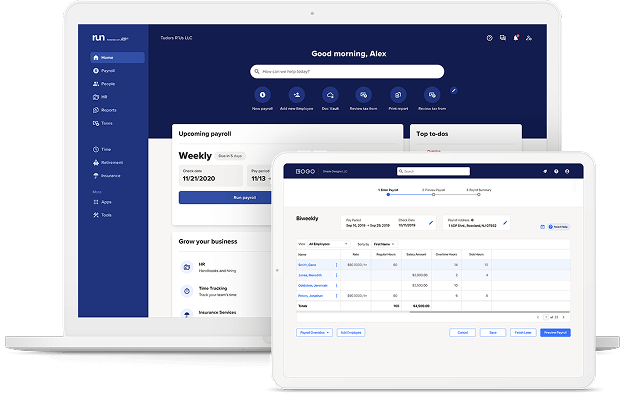
ADP Workforce Now is one of the most established payroll and HR platforms in the market, serving mid-sized and large organizations with complex workforce needs. The platform integrates payroll processing, tax compliance, benefits administration, talent management, and workforce analytics into a unified cloud-based system.
What differentiates ADP Workforce Now in 2026 is its intelligent automation engine, which combines machine learning, predictive analytics and compliance monitoring to reduce payroll risk and improve operational efficiency.
For companies operating across multiple states or countries, ADP provides infrastructure designed to handle regulatory complexity at scale.
🔍 AI Capabilities & Automation Strength
ADP Workforce Now integrates AI across payroll and workforce workflows, including:
- Automated payroll calculations with multi-layer validation
- AI-assisted compliance monitoring across jurisdictions
- Predictive analytics for workforce cost forecasting
- Anomaly detection for payroll discrepancies
- Automated tax filing and regulatory updates
- Intelligent reporting dashboards with workforce insights
ADP also leverages data modeling to help organizations anticipate labor costs, overtime trends, and compliance risks before they become operational issues.
Compared to SMB-focused platforms, ADP’s AI functionality is more advanced in analytics and regulatory automation.
| 👍 Pros | 👎 Cons |
| Enterprise-grade compliance automation | Custom pricing can be costly for small teams |
| Advanced workforce analytics | Implementation may require onboarding support |
| Scalable architecture for growing teams | Feature depth may exceed needs of very small businesses |
| Strong global payroll capabilities | |
| Deep integration ecosystem |
🏢 Best For
ADP Workforce Now is ideal for:
- Mid-sized to large organizations
- Multi-state or multinational companies
- Businesses with complex compliance requirements
- HR teams needing advanced workforce analytics
- Enterprises planning long-term scalability
ADP Workforce Now stands out as one of the most powerful AI payroll software platforms available this year. Its strength lies in enterprise automation, predictive workforce analytics, and regulatory intelligence.
While it may not be the most budget-friendly option, it offers a highly scalable and compliance-focused payroll system for organizations that need reliability, accuracy, and advanced AI-driven insights at scale.
3. Gusto – Best AI Payroll Software for Small Businesses
A user-friendly, automation-focused payroll platform built for small businesses that want reliable payroll processing, tax compliance, and HR tools without enterprise complexity.
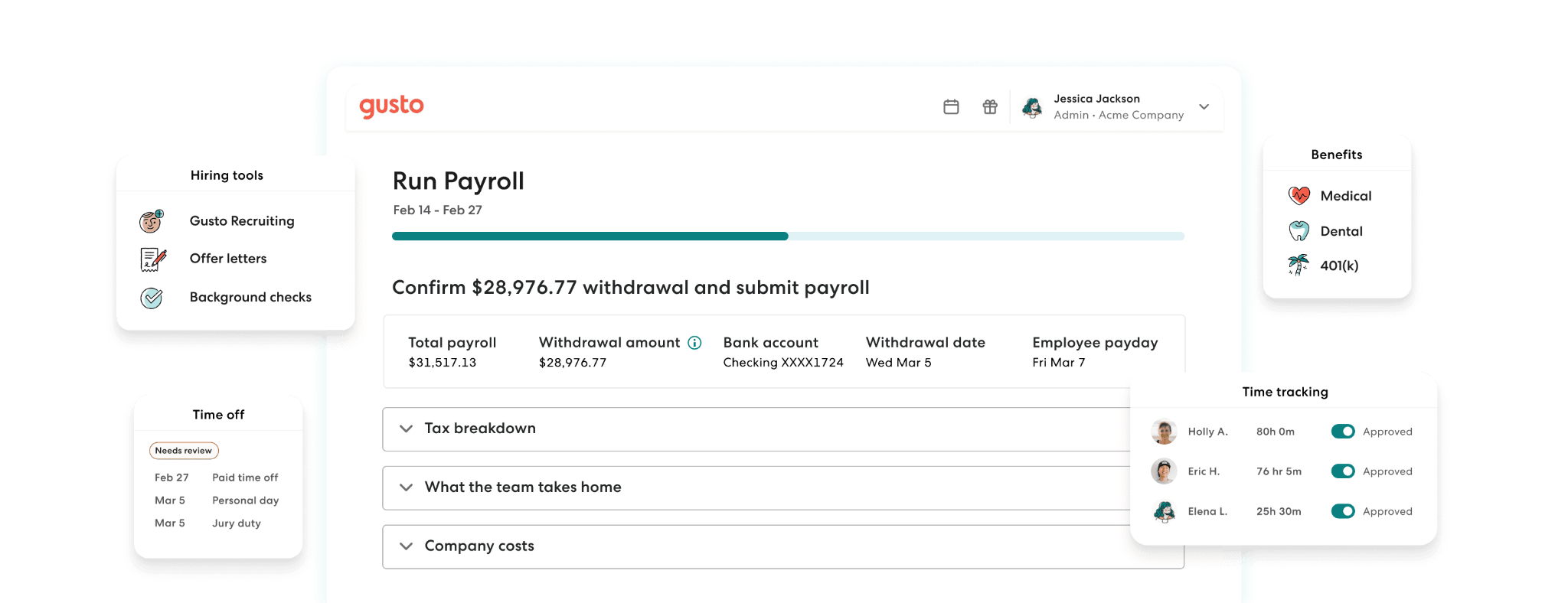
Gusto is a cloud-based payroll and HR platform designed primarily for small businesses and startups. It combines payroll automation, benefits administration, contractor payments and compliance support into a simple, intuitive interface.
While Gusto is not positioned as a highly technical AI-driven analytics platform, it incorporates intelligent automation throughout its payroll workflows. Its strength lies in simplifying payroll processing, automating tax filings and minimizing manual administrative tasks.
For companies that want fast setup, transparent pricing and dependable payroll automation, Gusto remains one of the most accessible AI-enhanced payroll solutions in 2026.
🔍 AI Capabilities & Automation Strength
Gusto focuses on practical payroll automation rather than complex predictive analytics. Its intelligent features include:
- Automated payroll calculations and deductions
- Automatic federal, state and local tax filing
- Built-in compliance updates
- Smart payroll reminders and workflow automation
- Employee onboarding automation
Although its AI depth is lighter than enterprise platforms like ADP or Workday, Gusto excels at reducing manual effort for small HR teams.
For startups and small businesses, this level of automation provides strong operational efficiency without technical overhead.
⭐ Key Features
- Full-service payroll processing
- Automated tax filing and compliance
- Contractor and W-2 employee payments
- Benefits administration (health, retirement, etc.)
- Time tracking integration
- Employee self-service portal
- Basic HR tools and onboarding workflows
Gusto integrates with accounting software and business tools, allowing smooth payroll-data synchronization.
| 👍 Pros | 👎 Cons |
| Transparent and affordable pricing | Limited global payroll capabilities |
| Easy-to-use interface | Advanced analytics less robust than enterprise platforms |
| Strong tax automation | May lack customization for complex payroll structures |
| Fast onboarding setup | |
| Ideal for startups and small teams |
💰 Pricing
Gusto offers transparent pricing starting at a base monthly fee plus a per-employee cost. Pricing varies depending on selected plans and additional HR features.
Compared to enterprise payroll systems, Gusto is significantly more affordable and predictable in cost structure.
🏢 Best For
Gusto is ideal for:
- Small businesses and startups
- Companies with under 100 employees
- US-based teams needing strong tax automation
- Businesses seeking affordable payroll software with built-in HR features
Gusto stands out as one of the best AI-enhanced payroll software options for small businesses in 2026. While it does not offer deep predictive analytics or global payroll infrastructure, it delivers reliable payroll automation, strong compliance support and an intuitive user experience at a competitive price point.
For startups and growing SMBs, Gusto provides a practical balance between automation, affordability and simplicity.
4. UKG Pro – Best AI Payroll Software for Enterprise Workforce Management
A powerful, AI-driven payroll and human capital management (HCM) platform built for large organizations that require advanced compliance automation, workforce analytics and scalability.
UKG Pro (formerly UltiPro) is a comprehensive payroll and human capital management platform designed for mid-sized and enterprise organizations. It combines payroll processing, HR management, talent administration, workforce planning and analytics within a unified system.
Right now, UKG Pro stands out for integrating artificial intelligence across workforce operations, not just payroll processing. Its strength lies in combining compliance automation with predictive analytics and employee experience tools.
For enterprises managing complex payroll structures, multi-state compliance and large employee populations, UKG Pro provides deep functionality and scalable infrastructure.
🔍 AI Capabilities & Automation Strength
UKG Pro integrates AI and machine learning into several payroll and workforce workflows, including:
- Automated payroll processing with built-in validation
- AI-driven compliance monitoring and regulatory updates
- Predictive workforce analytics
- Anomaly detection for payroll discrepancies
- Intelligent reporting dashboards
- Automation of recurring payroll cycles
Beyond payroll, UKG Pro uses data insights to support workforce planning, retention analysis, and labor cost forecasting.
Compared to SMB-focused tools, UKG Pro offers stronger analytics depth and enterprise-grade compliance automation.
⭐ Key Features
- End-to-end payroll management
- Multi-state and global payroll support
- Automated tax filing and compliance
- Workforce management tools
- Talent acquisition and performance modules
- Advanced analytics and reporting dashboards
- Employee self-service portal
- Integration with ERP and accounting systems
Its modular architecture allows organizations to configure payroll and HR capabilities based on operational needs.
| 👍 Pros | 👎 Cons |
| Enterprise-level compliance automation | Custom pricing may be costly |
| Advanced workforce analytics | Implementation can require onboarding support |
| Strong scalability for large teams | Feature depth may exceed small business needs |
| Integrated HR and payroll ecosystem | |
| Robust reporting capabilities |
💰 Pricing
UKG Pro operates on a custom pricing model based on company size, workforce complexity and selected modules. Organizations must request a quote for accurate cost estimates.
Given its enterprise focus, pricing reflects its extensive feature set and analytics capabilities.
🏢 Best For
UKG Pro is ideal for:
- Large organizations and enterprises
- Companies with complex compliance requirements
- Multi-state or multinational employers
- HR teams seeking predictive workforce analytics
- Businesses needing integrated payroll and HCM tools
UKG Pro is one of the most comprehensive AI payroll software solutions available in the market. Its strength lies in combining intelligent payroll automation with advanced workforce analytics and compliance management.
While it may not be suitable for very small teams due to pricing and complexity, it is a strong choice for enterprises seeking scalable, AI-driven payroll and HR infrastructure.
5. Workday Payroll – Best AI Payroll Software for Large Global Enterprises
A highly advanced, AI-driven payroll platform built for multinational enterprises that require deep compliance intelligence, global payroll capabilities and real-time workforce analytics.
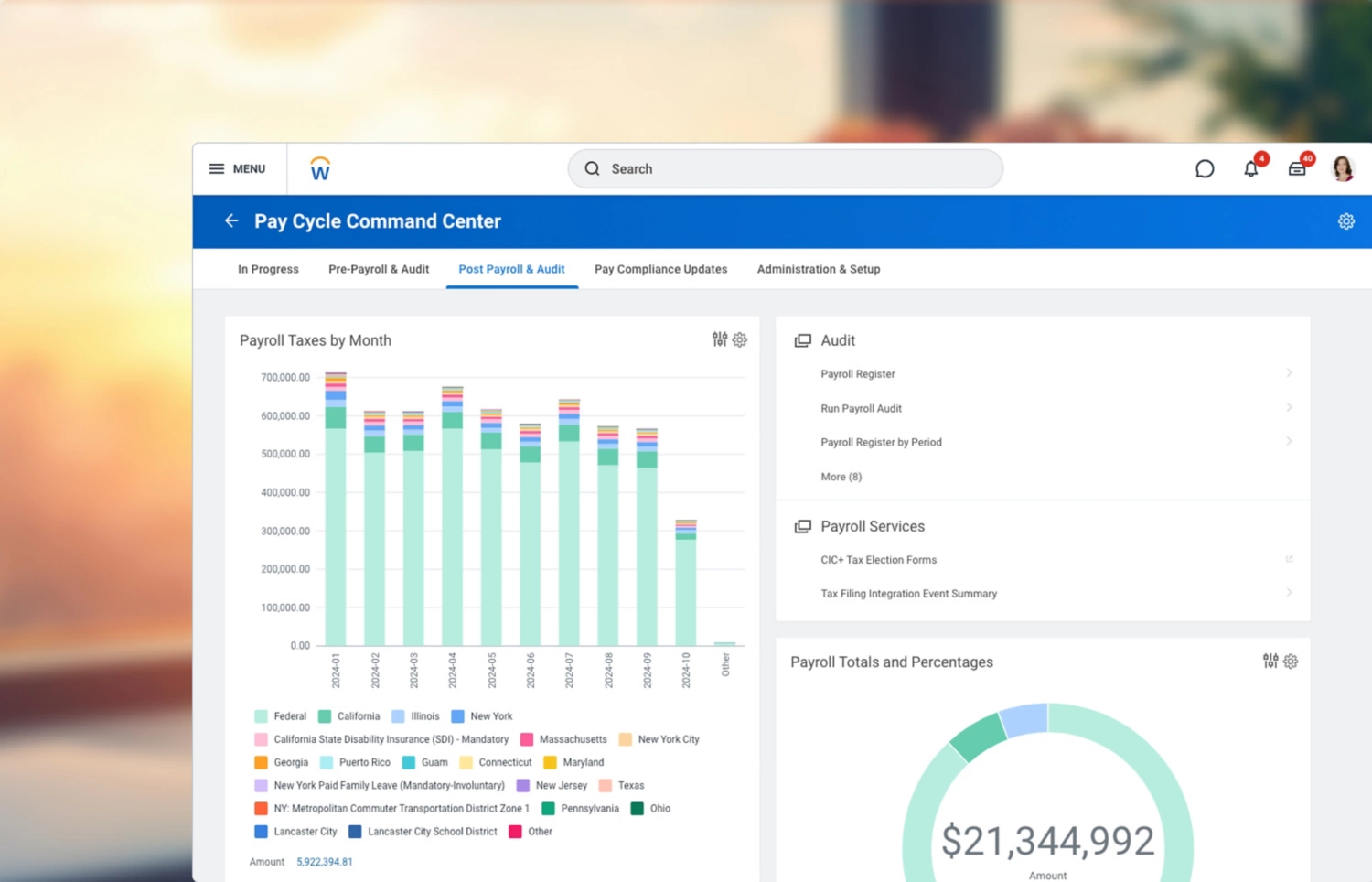
Workday Payroll is part of the broader Workday Human Capital Management (HCM) ecosystem, designed for large organizations operating across multiple countries and regulatory environments.
Unlike SMB-focused payroll tools, Workday is engineered for enterprise complexity. It combines payroll processing, compliance automation, workforce planning, financial management, and analytics into a unified cloud-based system.
This year, Workday stands out for integrating artificial intelligence across payroll, HR, and finance functions, enabling data-driven decision-making beyond simple paycheck processing.
🔍 AI Capabilities & Automation Strength
Workday integrates AI and machine learning throughout its payroll and workforce workflows, including:
- Automated payroll calculations with real-time validation
- AI-driven compliance updates across jurisdictions
- Predictive workforce cost forecasting
- Anomaly detection for payroll discrepancies
- Intelligent reporting and analytics dashboards
- Continuous payroll data synchronization with HR and finance
⭐ Key Features
- End-to-end payroll management
- Multi-country payroll support
- Automated tax compliance and filings
- Workforce planning and analytics
- Financial management integration
- Talent and performance management tools
- Customizable reporting dashboards
- Strong ERP and accounting integrations
Workday’s unified architecture eliminates data silos between payroll, HR and finance systems.
| 👍 Pros | 👎 Cons |
| Strong global payroll capabilities | Custom pricing suited for large enterprises |
| Advanced predictive analytics | Implementation may require significant onboarding |
| Enterprise-grade compliance automation | Overly complex for small or mid-sized businesses |
| Seamless integration with HR and finance | |
| Scalable for multinational organizations |
💰 Pricing
Workday Payroll operates on a custom pricing model based on organization size, geographic footprint and selected modules. Pricing is typically aligned with enterprise budgets and requires direct consultation.
Given its global infrastructure and analytics depth, it is positioned at the premium end of the payroll software market.
🏢 Best For
Workday Payroll is ideal for:
- Multinational enterprises
- Large organizations with complex compliance requirements
- Businesses requiring integrated HR, payroll, and finance systems
- Companies seeking advanced workforce analytics
- Enterprises planning long-term global scalability
Workday Payroll is one of the most sophisticated AI payroll software platforms available nowadays. Its strength lies in global payroll automation, predictive analytics and seamless integration across enterprise systems.
While not suitable for small teams due to cost and complexity, it is a top-tier choice for large organizations seeking scalable, AI-powered payroll and workforce intelligence at a global level.
6. Rippling – Best AI Payroll Software for Automation & System Integration
A highly automated payroll platform that combines AI-driven payroll processing with HR and IT management, making it ideal for fast-growing and tech-forward companies.
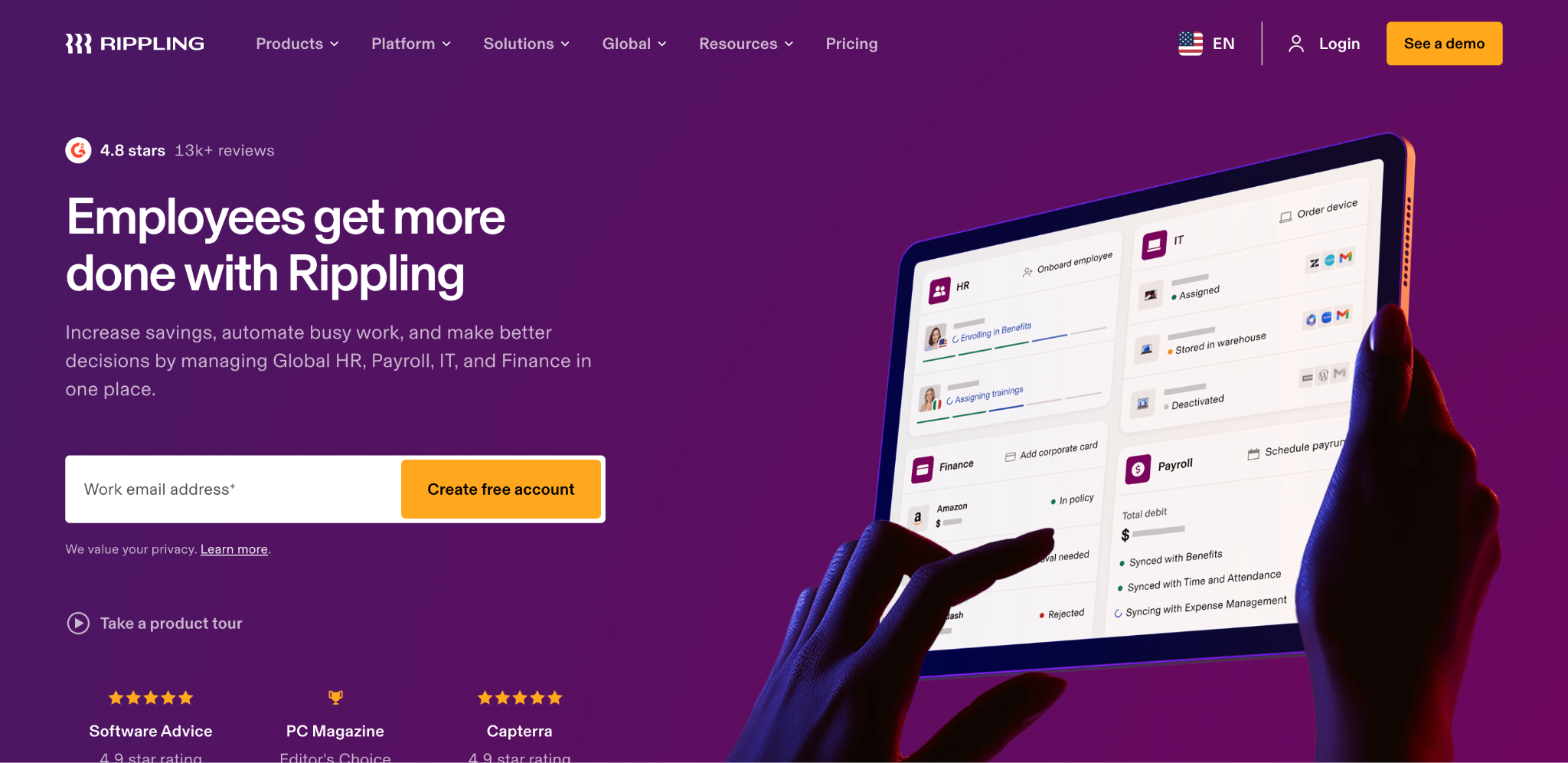
Rippling is a modern workforce management platform that unifies payroll, HR, benefits, device management and IT operations into a single system. Unlike traditional payroll software that focuses only on salary processing, Rippling automates employee lifecycle workflows from onboarding to offboarding.
Rippling stands out for its strong automation engine and system integrations. It is particularly well suited for growing companies that want payroll automation tightly connected with HR, accounting and IT infrastructure.
For businesses seeking a centralized operational platform rather than standalone payroll software, Rippling offers a compelling solution.
🔍 AI Capabilities & Automation Strength
Rippling leverages intelligent automation across payroll and workforce workflows, including:
- Automated payroll calculations and tax filings
- AI-assisted compliance updates across states and countries
- Workflow automation triggered by employee lifecycle events
- Real-time anomaly detection for payroll discrepancies
- Automated benefits deductions and contractor payments
- Predictive reporting dashboards
One of Rippling’s strongest differentiators is automation across systems. For example, when a new employee is onboarded, payroll, benefits, tax setup and even device provisioning can be triggered automatically.
This makes it particularly powerful for distributed and scaling teams.
⭐ Key Features
- Full-service payroll processing
- Multi-state and global payroll support
- Automated tax filing and compliance management
- Benefits administration
- HR management tools
- IT device and app management
- Workflow automation builder
- Deep integrations with accounting and business software
Rippling’s integration ecosystem allows businesses to connect payroll directly with financial systems, time tracking and workforce analytics tools.
| 👍 Pros | 👎 Cons |
| Strong automation across payroll, HR, and IT | Pricing structure can scale quickly with add-ons |
| Scalable for growing companies | Some advanced automation may require configuration |
| Global payroll support | May be more complex than needed for very small teams |
| Modern, intuitive interface | |
| Extensive integration ecosystem |
💰 Pricing
Rippling typically offers modular pricing, starting with a base platform fee plus per-user costs. Payroll functionality is often an add-on module.
Because pricing varies based on selected services, businesses must request a custom quote.
🏢 Best For
Rippling is ideal for:
- Fast-growing startups and mid-sized companies
- Remote and distributed teams
- Tech-forward businesses seeking workflow automation
- Companies wanting payroll, HR, and IT in one system
- Organizations prioritizing integration flexibility
Rippling is one of the most automation-focused AI payroll software platforms this year. Its strength lies in unifying payroll with HR and IT workflows, reducing manual tasks across the employee lifecycle.
While costs can increase depending on modules selected, it offers a highly scalable and integration-driven payroll solution for modern, growth-oriented companies.
7. OnPay – Best Affordable AI Payroll Software for Small Businesses
A cost-effective payroll platform that combines reliable automation, tax compliance support, and ease of use for small businesses and startups.
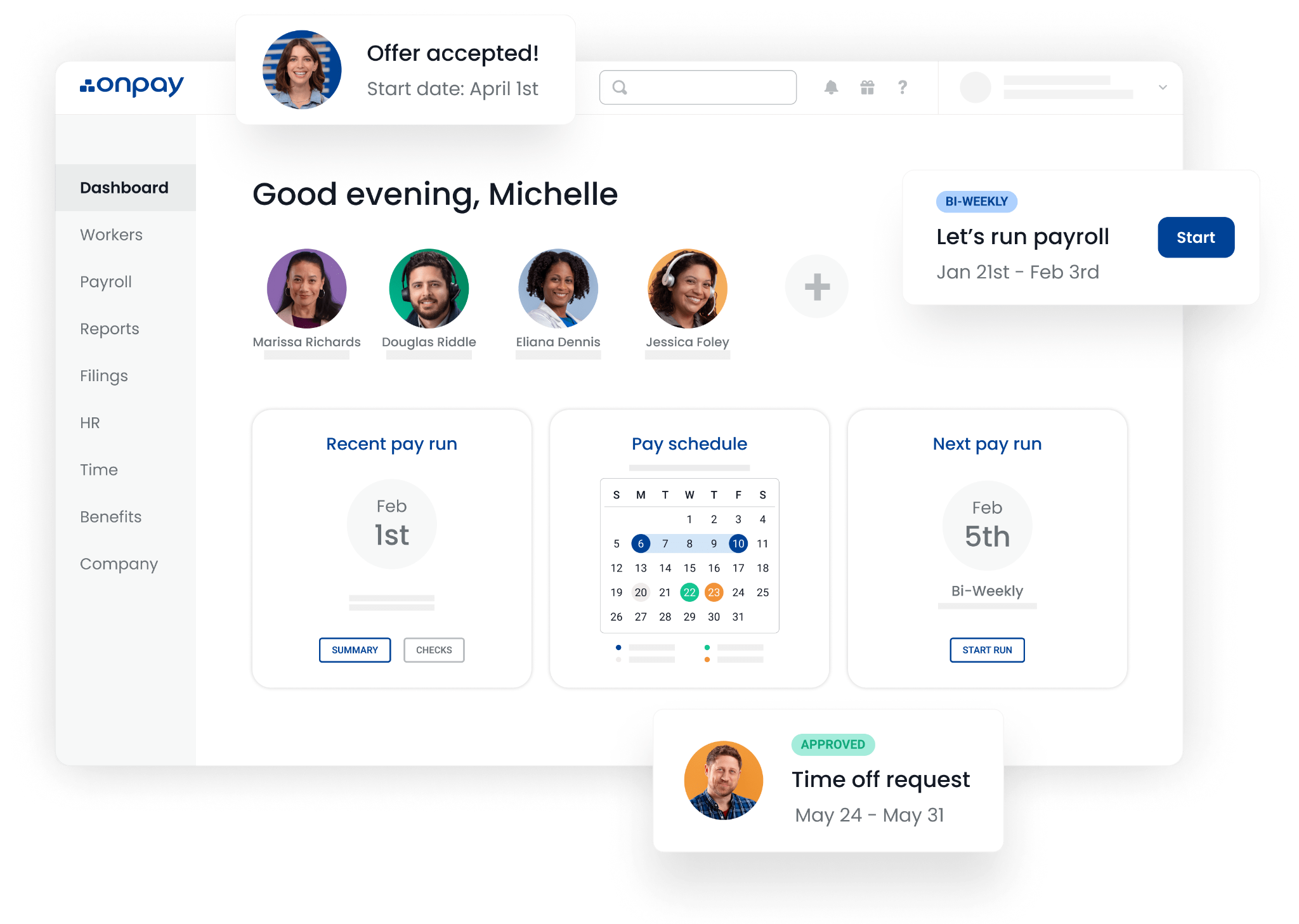
OnPay is a cloud-based payroll software designed primarily for small businesses that want simple, accurate, and affordable payroll processing. It offers full-service payroll, automated tax filings, and basic HR tools in a streamlined interface.
While it does not market itself as a highly advanced AI analytics platform, OnPay incorporates intelligent payroll automation to reduce manual effort and ensure compliance accuracy.
For small teams looking for predictable pricing and dependable payroll processing without enterprise-level complexity, OnPay is a strong contender.
🔍 AI Capabilities & Automation Strength
OnPay focuses on practical payroll automation rather than predictive workforce analytics. Its automation capabilities include:
- Automated payroll calculations
- Automatic federal, state and local tax filings
- Built-in compliance updates
- Recurring payroll scheduling
- Direct deposit automation
- Error-checking validation before payroll submission
Although it lacks advanced AI forecasting or anomaly modeling found in enterprise systems, OnPay excels at minimizing payroll errors and streamlining tax compliance for small teams.
For SMBs, this level of automation significantly reduces administrative workload while maintaining affordability.
⭐ Key Features
- Full-service payroll processing
- Automated tax filing and payments
- Multi-state payroll support
- Contractor and W-2 employee payments
- Benefits administration
- Employee self-service portal
- Time-off tracking
- Integration with accounting platforms
Its straightforward setup and flat pricing model make it particularly attractive to startups and small businesses.
| 👍 Pros | 👎 Cons |
| Transparent and affordable pricing | No global payroll infrastructure |
| Strong tax automation | Limited advanced AI analytics |
| Easy setup and intuitive interface | Fewer enterprise-grade integrations |
| Reliable compliance support | |
| Suitable for multi-state payroll |
💰 Pricing
OnPay offers transparent flat-rate pricing, typically consisting of a base monthly fee plus a per-employee charge. This predictable pricing model is one of its strongest advantages compared to custom-quoted enterprise solutions. There are generally no hidden fees for basic payroll processing and tax filing.
🏢 Best For
OnPay is ideal for:
- Small businesses and startups
- US-based companies managing multi-state payroll
- Organizations seeking affordable payroll automation
- Businesses that want simple, predictable pricing
- Teams that do not require global payroll features
OnPay is a practical and budget-friendly AI-enhanced payroll software solution for small businesses this year. While it does not offer enterprise-level predictive analytics or global payroll infrastructure, it delivers reliable payroll automation, automated tax filing and strong value for growing SMBs.
For cost-conscious teams prioritizing simplicity and compliance, OnPay remains a dependable option.
8. Oracle Payroll – Best AI Payroll Software for ERP-Integrated Enterprises
A robust, enterprise-level payroll solution designed for organizations that require deep compliance control, global scalability and seamless integration with finance and ERP systems.
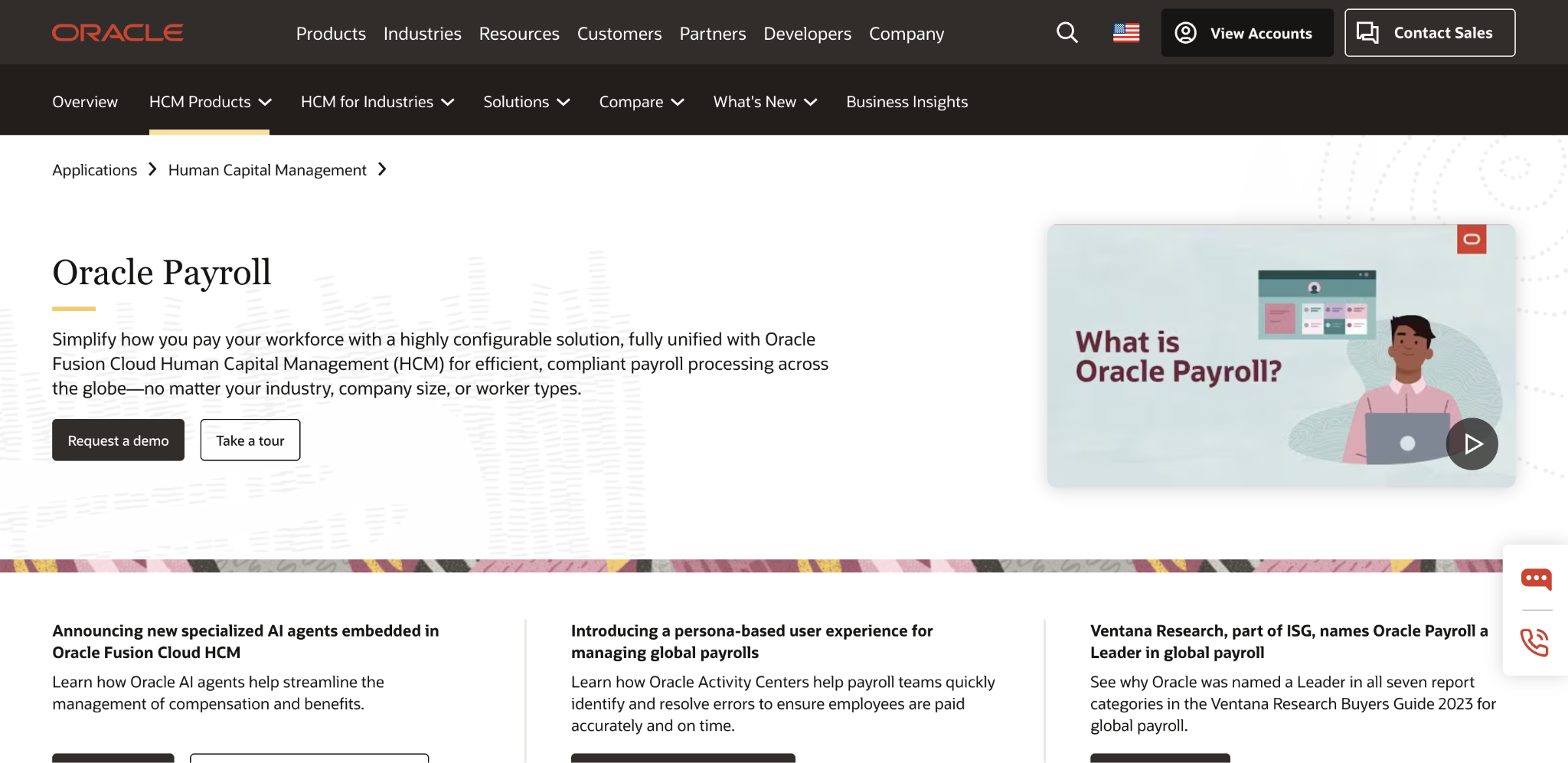
Oracle Payroll is part of the broader Oracle Human Capital Management (HCM) Cloud suite. It is built for mid-sized to large enterprises that need tightly integrated payroll, HR, and financial systems within a single cloud ecosystem.
Unlike SMB-focused payroll tools, Oracle Payroll is engineered for organizations with complex regulatory requirements, multinational operations, and advanced reporting needs. Its strength lies in compliance automation, financial integration, and scalable global payroll infrastructure.
For enterprises already using Oracle ERP or financial systems, Oracle Payroll provides a unified payroll solution that reduces data silos and enhances reporting accuracy.
🔍 AI Capabilities & Automation Strength
Oracle Payroll leverages artificial intelligence and automation across payroll and workforce management workflows, including:
- Automated payroll calculations with real-time validation
- AI-assisted regulatory compliance monitoring
- Multi-country tax automation
- Payroll anomaly detection
- Intelligent reporting dashboards
- Predictive workforce cost analytics
Oracle’s AI functionality extends beyond payroll processing by integrating payroll data into financial forecasting and enterprise reporting systems.
Compared to mid-market tools, Oracle Payroll offers stronger financial system alignment and enterprise-grade compliance intelligence.
⭐ Key Features
- End-to-end payroll processing
- Global payroll capabilities
- Automated tax filing and compliance management
- Deep ERP and financial integration
- Workforce analytics and reporting
- Benefits administration tools
- Employee self-service portal
- Customizable workflow automation
Oracle’s unified cloud architecture allows payroll data to sync seamlessly with finance, accounting and workforce planning modules.
| 👍 Pros | 👎 Cons |
| Strong ERP and financial integration | Custom enterprise pricing |
| Advanced compliance automation | Implementation may require dedicated onboarding |
| Global payroll infrastructure | Not suitable for small businesses |
| Scalable for multinational enterprises | |
| Comprehensive reporting capabilities |
💰 Pricing
Oracle Payroll operates on a custom enterprise pricing model based on company size, geographic coverage and selected modules. Organizations must request a consultation to receive accurate pricing.
Due to its enterprise positioning and ERP integration capabilities, pricing typically reflects a premium tier.
🏢 Best For
Oracle Payroll is ideal for:
- Large enterprises
- Multinational organizations
- Companies already using Oracle ERP or HCM systems
- Businesses with complex compliance requirements
- Finance-driven organizations requiring integrated payroll reporting
Oracle Payroll is a powerful AI-enabled payroll solution built for enterprise environments that demand compliance precision and deep financial integration. While it is not designed for small teams, it offers scalable global payroll infrastructure and advanced reporting capabilities for organizations operating at enterprise scale.
For businesses seeking payroll tightly connected with ERP and financial systems, Oracle Payroll remains a strong contender this year.
9. Paycor – Best AI Payroll Software for Mid-Sized Businesses
A scalable, automation-driven payroll and HR platform designed for mid-market companies that need compliance support, workforce analytics and operational efficiency.
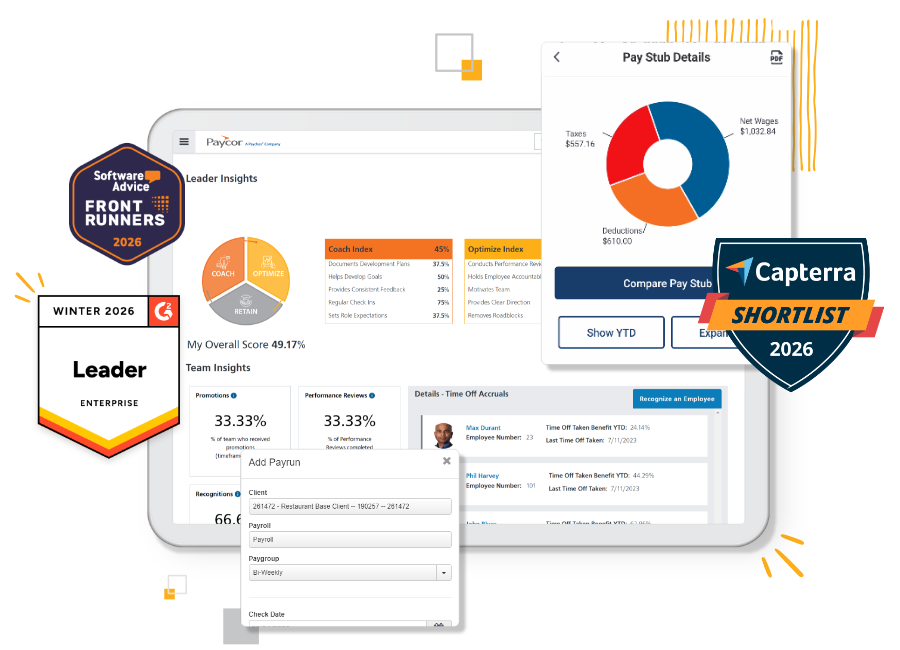
Paycor is a cloud-based payroll and human capital management (HCM) platform built for small to mid-sized businesses that are outgrowing basic payroll tools but do not require full enterprise infrastructure.
It combines payroll processing, tax compliance, workforce management, talent development, and reporting into a unified system. Paycor differentiated itself by focusing on automation, employee lifecycle management, and analytics-driven decision support.
For mid-sized companies balancing compliance requirements with growth, Paycor offers structured payroll automation without the complexity of enterprise ERP platforms.
🔍 AI Capabilities & Automation Strength
Paycor integrates intelligent automation across payroll and HR workflows, including:
- Automated payroll calculations with built-in validation
- Tax filing automation across multiple jurisdictions
- Compliance monitoring and regulatory updates
- Payroll discrepancy alerts and validation checks
- Workforce analytics dashboards
- Automated onboarding and employee lifecycle workflows
While it does not offer the same predictive modeling depth as enterprise-focused systems like Workday or Oracle, Paycor provides strong automation and reporting tools for mid-market organizations.
Its strength lies in simplifying payroll management while maintaining compliance reliability.
⭐ Key Features
- Full-service payroll processing
- Automated tax filing and compliance management
- Multi-state payroll support
- Time tracking and workforce scheduling
- Benefits administration tools
- Talent development and performance modules
- Customizable reporting dashboards
- Integration with accounting and business software
Its modular design allows companies to expand functionality as their workforce grows.
| 👍 Pros | 👎 Cons |
| Strong compliance automation | Limited global payroll infrastructure |
| Scalable for growing mid-sized teams | Custom pricing reduces upfront transparency |
| User-friendly dashboard | Advanced analytics not as deep as enterprise platforms |
| Integrated payroll and HR tools | |
| Solid reporting capabilities |
💰 Pricing
Paycor uses a custom pricing model based on company size, payroll frequency and selected modules. Businesses must request a quote for detailed pricing.
Costs typically scale with added HR and workforce management features.
🏢 Best For
Paycor is ideal for:
- Mid-sized businesses
- Companies managing multi-state payroll
- Growing organizations needing structured compliance support
- HR teams seeking integrated payroll and workforce tools
- Businesses transitioning from basic payroll software
Paycor is a reliable AI-enhanced payroll software platform for mid-market companies seeking structured automation and compliance support. While it may not offer enterprise-level predictive analytics or global payroll infrastructure, it provides a balanced solution for growing businesses that need scalability without excessive complexity.
For organizations looking to upgrade from basic payroll systems while avoiding full enterprise costs, Paycor is a practical middle-ground option.
10. Patriot Software Payroll – AI Payroll Software for Small US Businesses
A simple, affordable payroll solution built for small US-based businesses that need reliable automation and tax compliance without enterprise complexity.
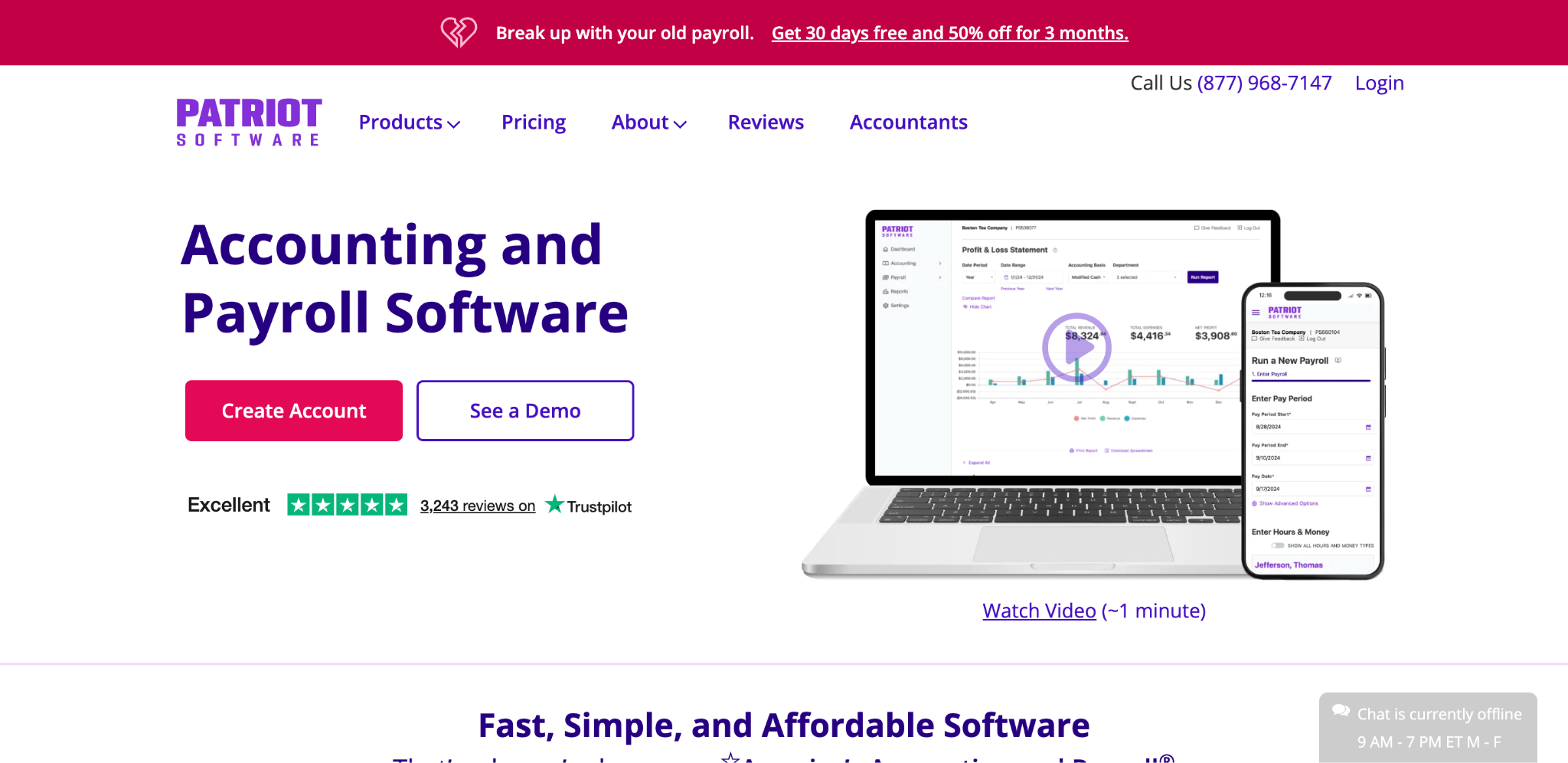
Patriot Software Payroll is a cloud-based payroll platform designed specifically for small businesses seeking an easy-to-use and cost-effective payroll solution. It focuses on core payroll functionality, tax compliance, and straightforward automation.
While it does not position itself as an advanced AI-driven analytics platform, Patriot integrates intelligent automation features that simplify payroll calculations and reduce manual errors.
For small US businesses prioritizing affordability and simplicity, Patriot offers dependable payroll processing without unnecessary complexity.
🔍 AI Capabilities & Automation Strength
Patriot Software Payroll emphasizes practical automation rather than predictive analytics. Its intelligent payroll features include:
- Automated payroll calculations
- Tax withholding calculations
- Federal, state, and local tax filing (Full-Service plan)
- Direct deposit automation
- Recurring payroll scheduling
- Built-in error checks before payroll submission
Although it lacks advanced machine learning analytics or global payroll infrastructure, Patriot excels at streamlining payroll tasks for small teams.
Its automation reduces manual workload while maintaining compliance accuracy.
⭐ Key Features
- Payroll processing for W-2 employees and contractors
- Automated tax calculations
- Federal, state and local tax filing (Full-Service option)
- Direct deposit and printed checks
- Employee self-service portal
- Basic time and attendance tools
- Integration with Patriot accounting software
The platform is intentionally streamlined, making it accessible for business owners without dedicated HR departments.
| 👍 Pros | 👎 Cons |
| Transparent and low-cost pricing | No global payroll capabilities |
| Easy setup and user-friendly interface | Limited advanced AI analytics |
| Reliable tax automation | Fewer enterprise integrations |
| Ideal for very small teams | Basic reporting compared to larger platforms |
| No long-term contracts required |
💰 Pricing
Patriot Software Payroll offers transparent tiered pricing:
- Basic Payroll plan (tax calculations only)
- Full-Service Payroll plan (includes tax filing and payments)
Pricing typically includes a base monthly fee plus a per-employee cost, making it one of the most affordable payroll solutions available.
🏢 Best For
Patriot Software Payroll is ideal for:
- Small US-based businesses
- Companies with under 50 employees
- Startups with tight budgets
- Businesses seeking straightforward payroll automation
- Owners managing payroll without dedicated HR teams
Patriot Software Payroll is one of the most affordable AI-enhanced payroll software options. While it does not offer advanced predictive analytics or global payroll support, it provides dependable payroll automation and tax compliance for small US businesses.
For budget-conscious teams prioritizing simplicity and transparency, Patriot remains a practical and accessible choice.
Full Feature Comparison: Best AI Payroll Software in 2026
Choosing the right AI payroll software depends on your company size, compliance complexity, global presence and automation needs. To simplify your decision, we compared the top platforms across the features that matter most in 2026.
This matrix highlights differences in automation depth, global payroll support, compliance intelligence, and scalability.
📊 AI Payroll Software Comparison Matrix
| Software | AI Automation Depth | Global Payroll | Compliance Automation | Workforce Analytics | Best For |
| ADP Workforce Now | Advanced | Yes | Enterprise-Grade | Advanced | Mid-size & Enterprise |
| Workday Payroll | Advanced | Yes | Enterprise-Grade | Advanced Predictive | Global Enterprises |
| UKG Pro | Advanced | Yes | Strong | Advanced | Large Enterprises |
| Oracle Payroll | Advanced | Yes | Strong | Advanced | ERP-Integrated Enterprises |
| Rippling | High | Yes | Strong | Moderate–Advanced | Growing Tech-Driven Teams |
| Paychex Flex | High | Limited | Strong | Moderate | Growing SMBs |
| Paycor | Moderate–High | Limited | Strong | Moderate | Mid-Market Companies |
| Gusto | Moderate | Limited | Strong (US) | Basic–Moderate | Small Businesses |
| OnPay | Moderate | No | Strong (US) | Basic | Budget-Conscious SMBs |
| Patriot Software | Basic–Moderate | No | Strong (US) | Basic | Very Small US Businesses |
🧠 What This Comparison Reveals
🏢 For Enterprises
If your organization operates globally or requires predictive workforce analytics, Workday, ADP, UKG Pro, and Oracle offer the most advanced AI payroll infrastructure.
🚀 For Growing Companies
Businesses scaling quickly and needing automation plus system integrations should consider Rippling or Paychex Flex.
💼 For Small Businesses
If affordability and simplicity are priorities, Gusto, OnPay, and Patriot Software provide reliable payroll automation without enterprise-level complexity.
🔍 Key Differences Explained
AI Automation Depth
Enterprise tools use predictive modeling and anomaly detection. SMB-focused platforms emphasize rule-based automation and compliance accuracy.
Global Payroll Support
Only enterprise and select mid-market platforms provide true multi-country payroll infrastructure.
Compliance Intelligence
Nearly all tools offer tax automation, but enterprise systems provide deeper regulatory risk monitoring.
Workforce Analytics
Advanced platforms offer predictive forecasting, labor cost modeling and executive dashboards. SMB tools typically provide reporting rather than predictive analytics.
AI Payroll vs Traditional Payroll Software: What’s the Difference?
As payroll complexity increases, many organizations are transitioning from traditional payroll systems to AI-powered payroll software. While both systems process employee payments and tax deductions, the level of automation, intelligence and compliance support differs significantly.
Below is a side-by-side comparison to clarify the distinction.
📊 Traditional Payroll vs AI Payroll Systems
| Traditional Payroll Software | AI-Powered Payroll Software |
| Rule-based automation | Machine learning-driven automation |
| Manual data validation | Automated anomaly detection |
| Static tax tables | Real-time compliance updates |
| Reactive reporting | Predictive workforce analytics |
| Limited workflow automation | Intelligent payroll workflows |
| Manual error corrections | Pre-processing error alerts |
| Basic reporting dashboards | Advanced analytics & forecasting |
🔍 How Traditional Payroll Works
Traditional payroll software typically relies on:
- Fixed rule-based calculations
- Manual data entry
- Periodic tax table updates
- Human review before payroll approval
While effective for small teams, traditional systems often struggle when businesses expand across states or countries. Compliance monitoring becomes more manual and reporting remains mostly reactive rather than predictive.
🤖 How AI Payroll Software Works
AI-powered payroll systems use machine learning and automation to:
- Detect unusual payroll patterns
- Automatically apply tax regulation updates
- Predict labor cost trends
- Flag discrepancies before payroll is finalized
- Automate multi-country payroll compliance
- Provide real-time workforce analytics
Instead of reacting to payroll errors after processing, AI systems aim to prevent them in advance.
⚖️ When Should You Upgrade to AI Payroll?
You should consider AI payroll software if:
- You manage multi-state or international teams
- Compliance complexity is increasing
- Payroll errors are becoming costly
- You need workforce cost forecasting
- Your HR team is spending too much time on manual processing
For very small businesses with simple payroll structures, traditional or basic automated payroll tools may still be sufficient. However, as companies grow, intelligent automation becomes increasingly valuable.
Traditional payroll systems focus on processing payments. AI payroll software focuses on automation, compliance intelligence and strategic workforce insights.
Businesses prioritizing efficiency, scalability and regulatory accuracy increasingly rely on AI-powered payroll platforms to reduce risk and improve decision-making.
Key Features to Look for in AI Payroll Software
When choosing AI payroll software, focus on features that improve automation, compliance accuracy and long-term scalability, not just basic paycheck processing. Here are the core capabilities that matter most nowadays:
🤖 Automated Payroll Processing
Look for systems that automatically calculate salaries, deductions, bonuses and tax withholdings with built-in validation checks to minimize errors.
📜 Real-Time Compliance Updates
The platform should automatically apply federal, state and international tax regulation changes to reduce compliance risk.
🌍 Multi-State or Global Payroll Support
If you manage distributed teams, ensure the system supports multi-currency payments and country-specific tax automation.
📊 Workforce Analytics & Reporting
Advanced AI payroll systems provide dashboards for labor cost forecasting, overtime analysis and compensation insights.
🔔 Error Detection & Anomaly Alerts
AI-driven payroll platforms can flag unusual payments or discrepancies before payroll is finalized.
🔗 Integration Capabilities
Seamless integration with HR software, accounting platforms and time-tracking tools is essential for operational efficiency.
📈 Scalability
Choose a system that can grow with your business from a small team to multi-location or multinational operations.
Choosing a platform with these capabilities ensures payroll becomes a strategic function not just an administrative task.
Frequently Asked Questions (FAQ) About AI Payroll Software
1. What is AI payroll software?
AI payroll software is a payroll system that uses artificial intelligence and automation to calculate wages, manage tax deductions, monitor compliance and generate workforce analytics. Unlike traditional payroll tools, AI-powered platforms can detect errors, apply regulatory updates automatically and provide predictive insights into labor costs and payroll trends.
2. How does AI improve payroll accuracy?
AI improves payroll accuracy by automatically validating calculations, flagging discrepancies, and monitoring unusual payment patterns before payroll is finalized. Machine learning algorithms can detect anomalies such as duplicate payments, incorrect tax deductions, or abnormal salary changes, reducing costly payroll errors.
3. Is AI payroll software secure?What’s Included in Your Packages?
Yes, most AI payroll platforms use advanced encryption, multi-factor authentication, and anomaly detection systems to protect sensitive employee data. Enterprise solutions often include fraud detection features that flag suspicious activity and unauthorized payroll changes.
4. Can AI payroll software handle multi-country payroll?
Many enterprise AI payroll systems support global payroll processing, including multi-currency payments, country-specific tax automation and local labor law compliance. Platforms like Workday, ADP, UKG Pro and Oracle offer strong international payroll infrastructure, while SMB tools may focus primarily on domestic payroll.
5. What is the best AI payroll software for small businesses?
For small businesses, platforms like Gusto, OnPay and Patriot Software offer reliable payroll automation with transparent pricing. The best option depends on your team size, compliance needs and whether you require multi-state or international payroll capabilities.
6. Does AI payroll replace HR teams?
No. AI payroll software automates administrative tasks such as calculations, tax filing, and reporting, but HR teams remain responsible for strategic decisions, compliance oversight and employee management. AI enhances efficiency rather than replacing HR professionals.
7. How much does AI payroll software cost?
Costs vary based on company size and features. Small business payroll tools typically charge a base monthly fee plus a per-employee cost, while enterprise platforms use custom pricing models. Global payroll and advanced analytics generally increase overall cost.
8. Is AI payroll worth it for growing companies?
Yes. For growing companies, AI payroll software reduces manual workload, minimizes compliance risk, improves reporting accuracy and supports scalability. As payroll complexity increases, automation and compliance intelligence become more valuable.
9. What’s the difference between AI payroll and traditional payroll software?
Traditional payroll systems rely on rule-based automation and manual oversight. AI payroll platforms use machine learning to detect anomalies, automate compliance updates and provide predictive workforce analytics, making them more scalable and proactive.
10. Can AI payroll software integrate with accounting and HR systems?
Yes. Most modern AI payroll platforms integrate with HR management systems, time tracking tools, accounting software and ERP systems to reduce data silos and streamline financial reporting.
Choose The Best AI Payroll Software & Start Exploring!
The adoption of AI in payroll software has become necessary for businesses aiming to remain competitive as we move into 2026. An AI payroll solution can automate complex processes, reduce human error and provide valuable workforce insights. Choose:
- Workday or ADP if you need global enterprise scalability
- Rippling if automation and integrations matter most
- Paychex or Paycor for structured mid-market payroll
- Gusto or OnPay for simple and affordable payroll automation
- Patriot for the lowest-cost US-based payroll solution
Want to stay ahead of the curve in the world of recruitment technology? Subscribe to our blog and join our Facebook Community for regular insights, tips, and the latest trends.