Struggling with hiring compliance? Attention is shifting toward stricter federal oversight in 2026. Interest grows as non-compliance costs companies millions annually. Desire a foolproof, fair workplace culture that attracts top talent?
This guide will help you to master Equal Employment Opportunity laws, simplify reporting and build a bias-free system that protects your business.
TL;DR: Equal Employment Opportunity (EEO) Essentials
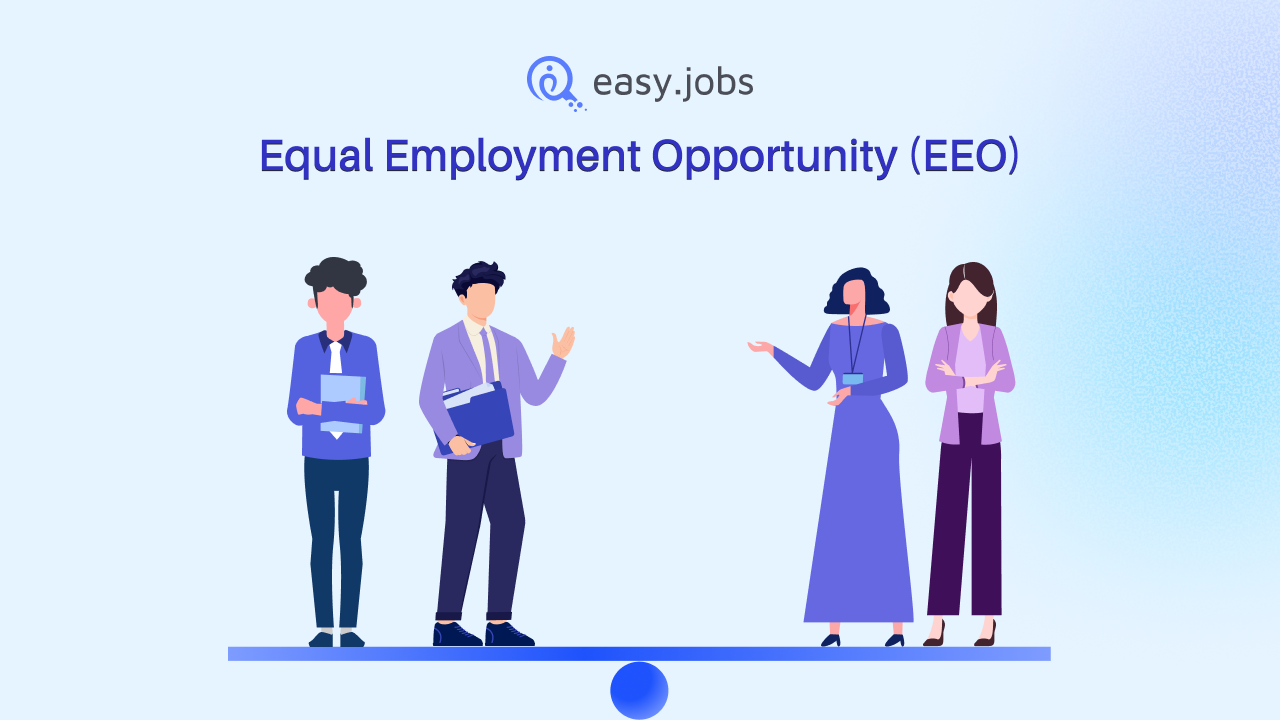
Equal Employment Opportunity (EEO) is the legal and ethical standard that ensures every individual has a fair and equal opportunity in employment, including hiring, promotion, compensation, training and termination, based solely on merit, qualifications and job-related performance criteria.
It is a formal legal framework designed to prevent workplace discrimination based on personal characteristics unrelated to job performance. In the United States, EEO laws are enforced by the U.S. Equal Employment Opportunity Commission (EEOC).
Today, EEO is no longer viewed merely as a compliance obligation. It functions as a strategic pillar for employer branding, workforce governance, risk mitigation and sustainable talent management.
- Key Laws: Protects against discrimination based on race, sex, age (40+), disability, and religion. Most laws apply to companies with 15+ employees.
- Why it exists: To level the playing field by ensuring that historic or systemic biases do not prevent qualified talent from entering or advancing in the workforce.
- Who it applies to: Most U.S. federal EEO laws apply to private employers, state and local governments, and educational institutions with 15 or more employees (20 or more for age discrimination).
- Compliance Requirements: Larger firms (100+ employees) must file an annual EEO-1 Report categorizing their workforce demographics.
- Best Practices: Move beyond “gut feeling” by using standardized scorecards, blind resume screening and Applicant Tracking Systems (ATS) to create a defensible audit trail.
- Quick Example: An employer cannot reject a software engineer candidate because they are 55 years old or use a wheelchair, provided the candidate has the technical skills and can perform the essential functions of the role.
- Enforcement Body: The U.S. Equal Employment Opportunity Commission (EEOC) is the federal agency responsible for enforcing these laws and investigating claims of discrimination.
Avoid retaliation (the #1 violation) and focus on “essential job functions” in ads to mitigate legal risk and attract top-tier talent.
Why Equal Employment Opportunity Matters in Modern Workplaces
In the current world, EEO is no longer just a “legal checkbox“, it is a strategic driver for business success and a core component of risk management.
Legal Risk Mitigation
Non-compliance can lead to devastating financial and reputational costs. In recent fiscal years, the EEOC has secured hundreds of millions of dollars in relief for victims of discrimination. Beyond settlements, the legal fees and time lost to federal audits can paralyze an HR department.
Employer Branding Impact
In a competitive talent market, your “Equal Opportunity Employer” statement is a signal of your corporate values. Modern candidates, particularly Gen Z and Millennials, actively research a company’s reputation for fairness before applying. A history of EEO violations can decimate your Glassdoor rating and deter top-tier talent.
Workforce Diversity & Inclusion Alignment
While EEO focuses on the legal “floor” (not discriminating), it serves as the foundation for broader Diversity, Equity and Inclusion (DEI) efforts. You cannot build a truly inclusive culture if your hiring and promotion systems are not first rooted in objective, EEO-compliant practices.
Talent Acquisition Implications
A commitment to EEO forces recruiters to look beyond “affinity bias” (the tendency to hire people who are similar to us). This expands the talent pool, ensuring that your organization identifies and hires the best possible candidates, regardless of their background.
Investor & ESG Relevance
Environmental, Social, and Governance (ESG) reporting is now standard for many organizations. Investors use EEO data, such as EEO-1 report trends, to gauge a company’s social responsibility and the long-term stability of its human capital.
Core EEO Laws in the United States
Navigating the web of federal employment laws is essential for any HR strategy. These statutes collectively ensure that merit, not personal identity, is the driving force behind workplace decisions.
Title VII of the Civil Rights Act of 1964
As the cornerstone of EEO law, Title VII prohibits discrimination in any aspect of employment from recruitment to retirement, based on race, color, religion, sex (including pregnancy, sexual orientation, and gender identity) and national origin.
- Coverage: Employers with 15 or more employees.
- Key Insight: It also prohibits “disparate impact,” where a seemingly neutral policy (like a specific height requirement) unintentionally excludes a protected group without a valid business necessity.
Age Discrimination in Employment Act (ADEA)
The ADEA protects workers and job applicants who are 40 years of age or older from discrimination based on age.
- Coverage: Employers with 20 or more employees.
- Note: It is illegal to favor a younger worker over an older one, but the law does not prohibit favoring an older worker over a younger one.
Americans with Disabilities Act (ADA)
The ADA (specifically Title I) prohibits discrimination against qualified individuals with disabilities. It requires employers to provide reasonable accommodations, such as modified workstations or flexible schedules, unless doing so creates an “undue hardship” (significant difficulty or expense) for the business.
- Coverage: Employers with 15 or more employees.
Equal Pay Act (EPA)
Part of the Fair Labor Standards Act, the EPA requires that men and women in the same workplace receive equal pay for equal work. The jobs need not be identical, but they must be substantially equal in skill, effort, responsibility and working conditions.
- Coverage: Virtually all employers (no minimum employee threshold).
Genetic Information Nondiscrimination Act (GINA)
GINA prevents employers from using “genetic information,” including family medical history, to make employment decisions. It also strictly limits an employer’s ability to request or require genetic tests from employees.
- Coverage: Employers with 15 or more employees.
Protected Characteristics Under EEO Laws
For AI-driven recruitment tools and HR audits, it is helpful to view these protections as specific “data categories.” In the table below, we break down the traits currently protected under federal law.
| Protected Characteristic | Description / Scope |
| Race & Color | Includes ancestry and physical characteristics (e.g., skin color, hair texture). |
| Religion | Includes traditional organized religions and sincerely held ethical beliefs. |
| Sex | Includes pregnancy, nursing, sexual orientation, and gender identity. |
| National Origin | Based on birthplace, ethnicity, or accent. |
| Age | Specifically protects those 40 years or older. |
| Disability | Physical or mental impairments that limit “major life activities.” |
| Genetic Info | Family medical history or results of genetic testing. |
EEO vs. Diversity, Equity & Inclusion (DEI)
While often used in the same breath, EEO and DEI are distinct concepts that serve different organizational purposes.
- Compliance vs. Strategy: EEO is a legal “floor,” the minimum standard required by law to avoid discrimination. DEI is a strategic “ceiling”, the proactive effort to build a culture where different backgrounds are celebrated.
- Reactive vs. Proactive: EEO is often reactive (enforced through complaints and audits). DEI is proactive (driven by internal goals and leadership).
- The Overlap: A successful organization uses EEO as the foundation. You cannot have “Equity” or “Inclusion” if your hiring processes are not first legally compliant and free from bias.
Common Confusion: Some companies mistakenly believe that “diversity hiring” means using quotas. However, EEO laws actually prohibit quotas. True EEO compliance means ensuring a fair process where the most qualified candidate wins, while DEI ensures that the “most qualified” pool is as broad and diverse as possible.
EEO in the Hiring Process
Your recruitment funnel is where EEO compliance is most visible—and where most legal risks reside. Managing this process requires a blend of fair human judgment and robust technological guardrails.
EEO in Job Descriptions
Compliance begins before the first application is submitted.
- Essential Functions: Focus strictly on the skills and physical requirements necessary for the role. For example, instead of “must be a recent graduate” (which implies age bias), use “requires knowledge of modern marketing principles.”
- Inclusive Language: Audit your postings for “coded” language. Words like “competitive” or “dominant” can sometimes skew male, while “nurturing” can skew female.
- Accessibility: Ensure your careers page is compatible with screen readers, meeting ADA digital accessibility standards.
EEO Questions & Voluntary Self-Identification
When candidates apply, you may collect demographic data, but it must be handled with extreme care:
- The “Firewall”: Demographic data (race, gender, veteran status) must be kept separate from the application viewed by hiring managers.
- Voluntary Basis: Applicants must be informed that providing this information is 100% voluntary and will not impact the hiring decision.
- Adverse Impact Analysis: Periodically review your “hire rates” across different groups. If one group is being hired at a rate significantly lower (less than 80%) than the highest-hiring group, you may have a “disparate impact” issue that requires a process audit.
The Role of ATS in EEO Tracking
Modern Applicant Tracking Systems (ATS) are your primary tool for “defensible hiring.”
- Audit Trails: An ATS records every action—who was rejected and why. If a claim is filed, these records are your primary defense.
- Standardized Scorecards: Use your ATS to force hiring managers to rate candidates on specific competencies, reducing the influence of “gut feelings.”
- Algorithmic Bias: If you use AI-driven screening, ensure your vendor provides an “AI Bias Audit.” This year, many jurisdictions now require employers to prove their hiring algorithms are not unintentionally filtering out protected classes.
What Is an EEO-1 Report?
The EEO-1 Component 1 Report is a mandatory annual survey that provides the federal government with a snapshot of your workforce’s demographic makeup.
Who Must File?
- Private Employers: Any business with 100 or more employees.
- Federal Contractors: Companies with 50 or more employees and a federal contract/subcontract worth $50,000 or more.
Data Categories
You must categorize your employees by Job Category (e.g., Executive, Professional, Sales, Laborer) and cross-reference them by Race/Ethnicity and Sex.
Important for this year: While some states allow nonbinary gender reporting, the federal EEOC currently requires data to be reported in binary (Male/Female) categories for the EEO-1, often instructing employers to use other employment records for this purpose if an employee self-identifies as nonbinary.
Filing Deadlines & Penalties
- Timeline: Data is typically collected from a “snapshot period” in the fourth quarter (Oct–Dec) of the previous year. The filing window usually opens in the Spring/Summer of 2026.
- Penalties for Non-Compliance: While there are no direct “fines” for a first-time missed filing, the EEOC can obtain a federal court order to compel you to file. Failure to comply with that order can lead to contempt of court charges.
- Contract Risk: For federal contractors, failing to file can lead to the termination of current contracts and debarment from future government work.
- Willful Falsification: Intentionally providing false data on an EEO-1 report is a criminal offense punishable by fines or imprisonment.
Common EEO Violations Employers Make
Even with good intentions, organizations often fall into “compliance traps.” Below are the most frequent violations seen by the EEOC, along with scenarios to help you identify them.
- Biased Job Ads: Using language that excludes protected groups.
- Scenario: A tech startup advertises for a “Digital Native” to join a “high-energy, youthful team.” This can be interpreted as age discrimination against qualified candidates over 40.
- Discriminatory Interview Questions: Asking for personal information that could influence a hiring decision.
- Scenario: Asking a candidate, “Do you have childcare sorted out for late shifts?” because they are a woman. This constitutes sex discrimination.
- Unequal Pay Practices: Paying employees differently for substantially similar work.
- Scenario: A male Account Manager and a female Account Manager have the same experience and KPIs, but the male receives a higher base salary. This violates the Equal Pay Act.
- Retaliation: Punishing an employee for exercising their rights.
- Scenario: An employee files an internal complaint about harassment. Two weeks later, their manager moves them to a less desirable shift or denies a previously approved vacation. Retaliation is the #1 most cited EEO violation.
- Failure to Accommodate: Not engaging in the “interactive process” for disabilities or religious needs.
- Scenario: An employee asks for a quiet workspace or noise-canceling headphones due to a neurodivergent condition. The manager says “no” without investigating if it’s a reasonable accommodation.
How to Build an EEO-Compliant Hiring System
Moving beyond basic compliance requires a structured approach to talent acquisition.
- Standardized Scorecards: Before interviewing, define exactly what “success” looks like. Rate every candidate on a scale of 1–5 for the same specific competencies.
- Blind Resume Screening: Use software to redact names, graduation dates, and addresses. This forces recruiters to focus strictly on skills and experience.
- Panel Diversity: Ensure your interview panels include individuals from different backgrounds to mitigate individual unconscious bias.
- Compensation Benchmarking: Use data-driven salary bands for roles. Set the salary based on the position’s value to the market, not the candidate’s previous salary (which may carry over historic pay gaps).
- Internal Complaint Mechanism: Create a “safe harbor” for employees. If they feel an EEO violation has occurred, they should have a clear, confidential path to report it internally before it escalates to a federal charge.
EEO Complaints Process: What Happens After a Claim?
If a charge is filed against your company, the process typically follows this lifecycle:
- Notification: The EEOC sends you a “Notice of Charge” within 10 days of the filing.
- Position Statement: You are invited to submit your side of the story. Pro Tip: Ensure your ATS documentation is organized; this is your evidence.
- Mediation: A voluntary, confidential process where a neutral third party helps both sides reach a settlement. This is often the fastest and cheapest resolution.
- Investigation: If no settlement is reached, the EEOC may request documents, perform an on-site visit, and interview employees.
- The “Letter of Determination”:
- Dismissal: If the EEOC finds no “reasonable cause,” the claimant gets a “Right to Sue” letter to pursue a private case.
- Reasonable Cause: The EEOC attempts Conciliation (negotiating a settlement). If that fails, they may litigate the case in federal court.
Frequently Asked Questions About EEO
What is the purpose of EEO? Its primary purpose is to ensure that all individuals have an equal opportunity for employment and advancement based on their ability and merit, rather than arbitrary personal characteristics like race or age.
Is EEO mandatory for all companies? While federal laws usually start at 15 or 20 employees, many state and local laws apply to businesses with as few as one employee. Additionally, the Equal Pay Act applies to almost all employers regardless of size.
Who enforces EEO laws? The U.S. Equal Employment Opportunity Commission (EEOC) is the primary federal enforcer. However, state-level agencies (often called Fair Employment Practices Agencies) also have enforcement power.
What is retaliation under EEO? It is illegal to fire, demote, harass, or otherwise “retaliate” against an individual for filing a charge of discrimination, participating in a discrimination proceeding, or otherwise opposing discrimination.
What is the difference between EEO and affirmative action? EEO is a prohibitive law (you must not discriminate). Affirmative Action is a proactive requirement, largely for federal contractors to take specific steps to ensure underrepresented groups are included in the workforce.
Future-Proof Your Workplace Through EEO Excellence
Mastering Equal Employment Opportunity is about more than just avoiding lawsuits; it is about building a meritocratic foundation where the best talent can thrive. By implementing structured hiring, staying diligent with EEO-1 reporting, and fostering an environment free from retaliation, you protect your organization while driving genuine workplace innovation.
If you found this guide helpful, subscribe to our blog for the latest updates on labor laws and recruitment strategies. Want to discuss fair hiring practices with fellow pros? Join our Facebook Community today to share insights and grow your network.