In the early days of social media hiring, success was measured by “noise”, a spike in followers or a handful of likes on a job post. But in a competitive talent market, noise does not fill open roles. Today, social media is a high-intent sourcing engine, and if you are not tracking the right data, you are essentially flying a plane without a dashboard.
For talent acquisition teams at growing companies, the shift from “being active” to “being effective” happens through Social Recruiting Metrics. These numbers do more than just prove you are busy. They justify your recruitment budget, identify which platforms actually yield high-quality talent and help you stop wasting time on channels that only deliver “ghost” applicants.
TL;DR: Optimize Your Social Recruiting Success
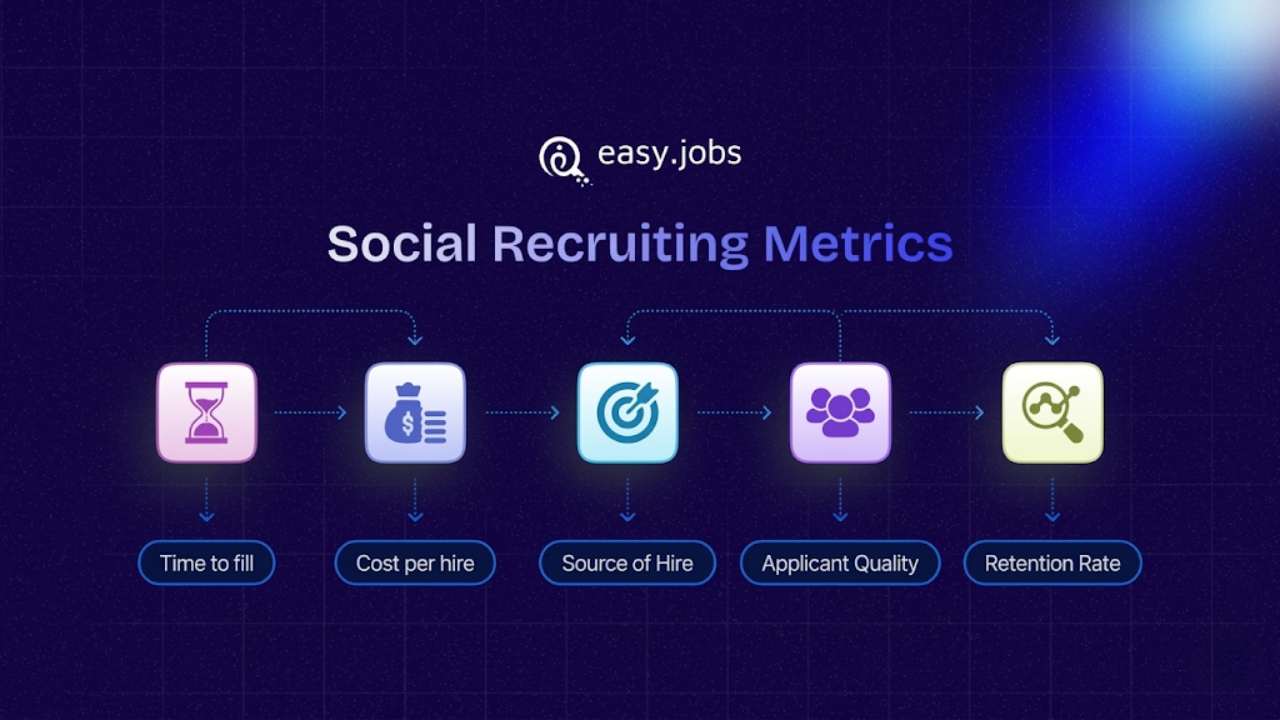
Stop relying on vanity metrics like “likes” and start using Talent Acquisition Analytics to drive real growth. To maximize your Recruitment ROI, you must track the five core Social Recruiting Metrics: Time to Fill, Cost Per Hire, Source of Hire, Applicant Quality og Retention Rate. By automating your data collection with an ATS like easy.jobs and using UTM parameters, you can transform social media from a content archive into a high-performance talent engine.
Why You Must Measure Social Recruiting Metrics
Most recruitment strategies fail not because of a lack of effort, but because of a lack of direction. When you treat social media as a black box, you lose the ability to replicate your wins.
By leaning into Talent Acquisition Analytics, you move away from guesswork. Measuring your performance allows you to see the direct line between a LinkedIn post and a signed offer letter. It turns social media from a “nice-to-have” branding exercise into a measurable, scalable part of your hiring funnel. Without these metrics, you are just posting content. With them, you are engineering a workforce.
Moving into the meat of the blog, this section connects the dots between your feature image and the daily reality of a recruiter.
Top 5 KPIs for Social Media Recruitment Success
Data only matters if it tells a story. For a recruitment team, that story should focus on efficiency, cost, and the ultimate value of the person hired. Based on the core pillars of a successful strategy, here are the five metrics that deserve a permanent spot on your weekly report.
Time to Fill via Social Channels
Speed is a competitive advantage. This metric tracks the total days from the moment a job is posted on social media to the day a candidate accepts the offer.
Social sourcing often speeds up this process because it taps into passive candidates, talented professionals who were not actively looking but were prompted to act by a well-timed post. If your social “Time to Fill” is consistently lower than your job board average, you have found your most efficient channel.
Cost Per Hire (CPH) Breakdown
Every recruiter has a budget, and social media is often the most cost-effective way to spend it. To find your Recruitment ROI, total your social expenses (ad spend, tool subscriptions and content creation time) and divide it by the number of hires from those channels.
When you compare this to the high fees of external agencies or premium job board credits, the financial benefit of a strong social presence usually becomes undeniable.
Source of Hire (SoH) Accuracy
You cannot optimize what you cannot see. This KPI identifies exactly where your successful candidates are “walking through the door.”
By using UTM parameters or integrated tracking in your ATS, you can distinguish whether a hire came from a LinkedIn employee advocacy post or a targeted Facebook ad. Source of Hire data is the ultimate “filter” that tells you where to double down and where to stop spending.
Applicant Quality and Sourcing Depth
High volume is often a distraction. A post that generates 500 applications is a failure if 499 are unqualified.
Instead, track the percentage of social media applicants who make it to the “Shortlisted” or “Interview” stages. This determines your sourcing depth. If social media candidates consistently move further down the funnel than those from other sources, your social messaging is successfully attracting the right “culture fit.”
Employee Retention Rate from Social Sourcing
The true test of a hire is not the first day. It is the first year. Because social media allows you to showcase your “Employer Brand” and company culture authentically, candidates often enter the role with a clearer understanding of the environment.
Tracking how long these hires stay with the company provides a long-term view of your social recruiting health. High retention from social channels proves that your content is not just “selling” a job. It is finding a match.
Now we move into the practical side of the blog: how to stop manual tracking and start using automation.
Essential Tools for Accurate Recruitment Data
Collecting data should not be a full-time job. If you are still manually asking every candidate, “Where did you hear about us?” during an interview, your data is likely incomplete or inaccurate. To get a clean view of your Source of Hire, you need a technical setup that works in the background.
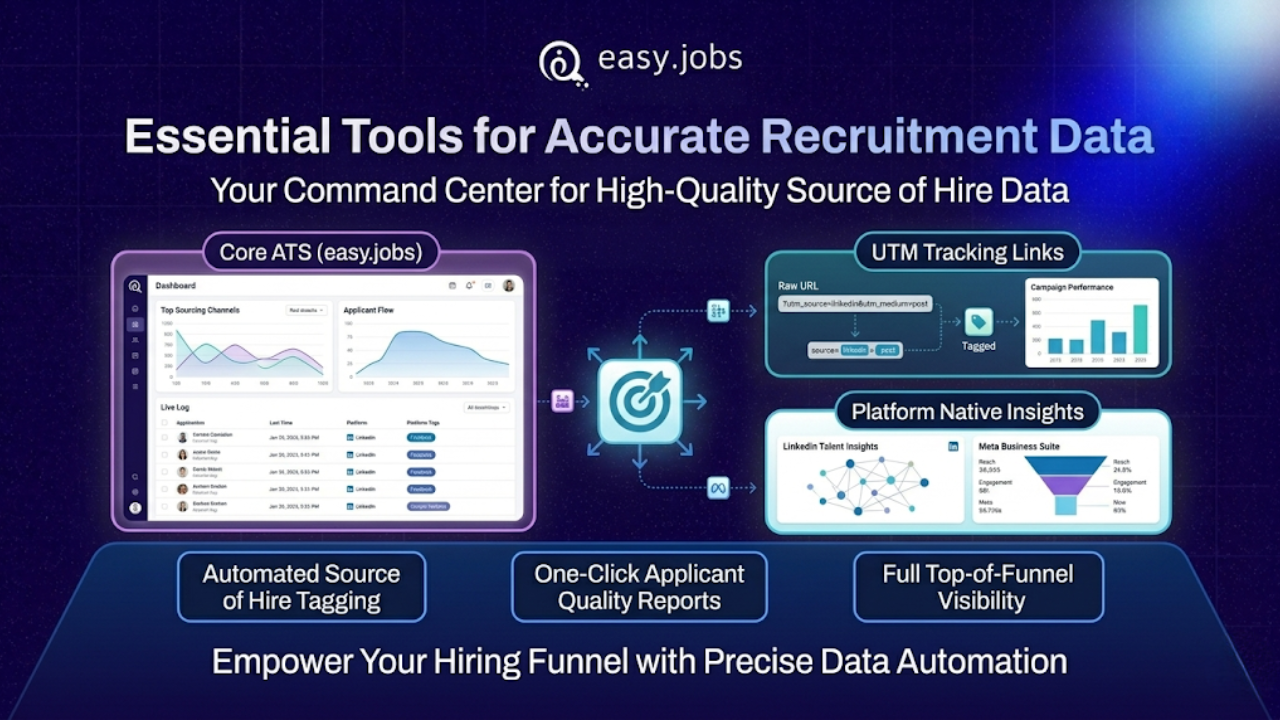
A modern Applicant Tracking System (ATS) like easy.jobs acts as the central hub for this data. By generating unique tracking links for each social platform, the system automatically tags every applicant with their point of origin. This allows you to generate one-click reports that show exactly which platform is driving your Applicant Quality. Beyond the ATS, you should leverage:
- UTM Parameters: These are simple tags added to the end of your URLs (e.g., ?utm_source=linkedin) that tell Google Analytics and your hiring platform exactly which post or campaign triggered a click.
- Built-in Platform Analytics: LinkedIn Talent Insights og Meta Business Suite provide deep dives into your reach and engagement, helping you understand the “top of the funnel” before a candidate even hits your career site.
Ultimately, the most powerful tool is one that synthesizes these various data streams. By integrating an automated ATS like easy.jobs with platform-native insights and precise UTM tracking, you create a cohesive command center. This technical infrastructure removes the guesswork from your sourcing, ensuring that you are making strategic decisions based on a clear, accurate, and comprehensive view of your entire recruitment funnel.
Transition from Metrics to a Social Recruiting Strategy
Data is the map, but your strategy is the vehicle. Metrics tell you where you have been, but they do not necessarily tell you where to go next if you do not have a solid plan in place. Tracking your KPIs is most effective when you have a structured approach to how, when, and what you post.
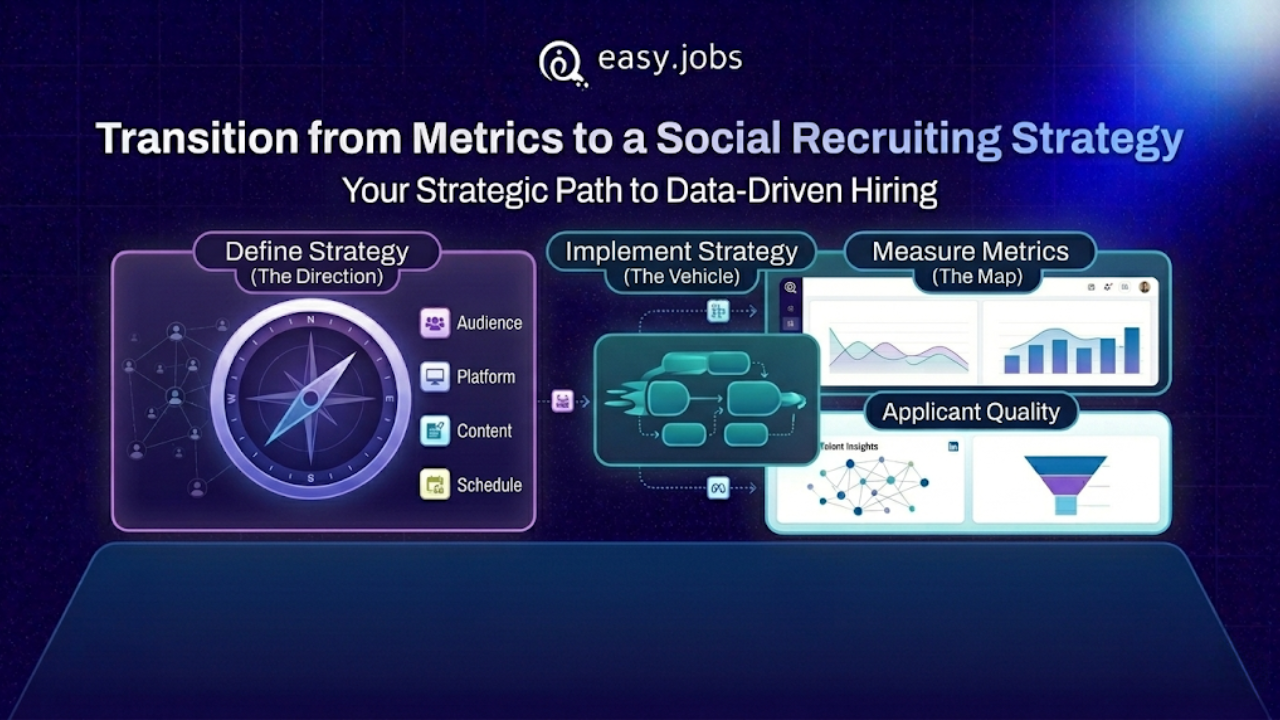
Before you can measure success, you need a solid foundation. If your numbers are not where you want them to be, it might be time to revisit your fundamentals. Check out our comprehensive guide on how to build a social recruiting strategy to ensure you are optimized for the best possible results.
Summary of Key Performance Indicators
To build a high-performing recruitment engine, you do not need to track every single data point available. Instead, focus on the “Vital Few” that impact your bottom line. Use the table below as a quick-reference checklist for your next monthly hiring review:
| Metric | What it Tells You | Success Signal |
| Time to Fill | Process efficiency | Social hires are faster than job board hires. |
| Cost Per Hire | Financial ROI | Lower spend per hire compared to agencies. |
| Source of Hire | Channel effectiveness | Clear data on which platform generates the most talent. |
| Applicant Quality | Targeting accuracy | Higher % of social candidates reaching final interviews. |
| Retention Rate | Long-term fit | Social hires stay 12+ months at a higher rate. |
Start Tracking Today to Hire Top Talents
Data-driven recruiting is not a luxury reserved for giant corporations. It is a necessity for any team that wants to spend their time and budget wisely. By moving beyond vanity metrics and focusing on these five core KPIs, you turn social media into a predictable, scalable talent pipeline.
The easiest way to start is by letting technology do the heavy lifting. Platforms like easy.jobs can automate your tracking, giving you back the hours you used to spend on spreadsheets. Once you have the data, you have the power to stop guessing and start growing your team with confidence.If you found this blog helpful, subscribe to our blog to stay ahead with the latest recruitment strategies, data-driven hiring tips and industry insights. Join our Facebook-fellesskapet to connect with fellow recruiters, share success stories and engage in meaningful discussions that will help elevate your talent acquisition game.